Anatomy & Physiology
나의 코스
배우기
시험 준비
AI 튜터
학습 가이드
교과서적 해결책
플래시카드
탐험해 보세요
앱을 사용해 보세요
나의 코스
배우기
시험 준비
AI 튜터
학습 가이드
교과서적 해결책
플래시카드
탐험해 보세요
앱을 사용해 보세요
뒤로
Introduction to Adaptive Immunity definitions
카드를 뒤집기 위해 탭할 수 있습니다.
Adaptive Immunity
카드를 뒤집기 위해 탭할 수 있습니다.
👆
Adaptive Immunity
A specialized defense mechanism targeting specific pathogens, evolving over time for improved response.
진행 상황 추적
컨트롤 버튼이 '내비게이션' 모드로 변경되었습니다.
1/15
관련 플래시카드
추천 영상
Introduction to Adaptive Immunity quiz #1
Introduction to Adaptive Immunity
37 용어
Introduction to Adaptive Immunity quiz #2
Introduction to Adaptive Immunity
38 용어
Introduction to Adaptive Immunity quiz #3
Introduction to Adaptive Immunity
11 용어
5:08
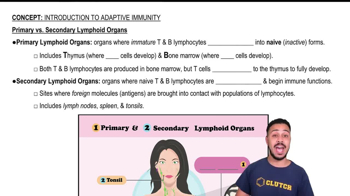
Primary vs. Secondary Lymphoid Organs
1901
views
20
rank
5:47
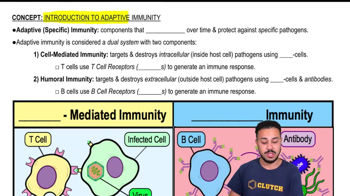
Adaptive Immunity
2191
views
21
rank
3:44
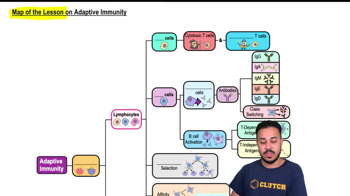
Map of the Lesson on Adaptive Immunity
1687
views
19
rank
이 집합의 용어 (15)
하이드의 정의
Adaptive Immunity
A specialized defense mechanism targeting specific pathogens, evolving over time for improved response.
Cell-mediated Immunity
Targets intracellular pathogens using T cells, crucial for combating infections within host cells.
Humoral Immunity
Targets extracellular pathogens using B cells and antibodies, addressing threats outside host cells.
T Cells
Lymphocytes involved in cell-mediated immunity, using TCRs to recognize specific antigens.
B Cells
Lymphocytes involved in humoral immunity, using BCRs to recognize antigens and produce antibodies.
Antibodies
Proteins secreted by plasma cells, binding to specific antigens to neutralize or mark them for destruction.
Primary Lymphoid Organs
Sites where immature lymphocytes develop into naive forms, including the thymus and bone marrow.
Secondary Lymphoid Organs
Sites where naive lymphocytes become activated, including lymph nodes, spleen, and tonsils.
Thymus
Primary lymphoid organ where T cells fully develop, located above the heart.
Bone Marrow
Primary lymphoid organ where B cells fully develop, also the initial production site for T cells.
Naive Lymphocytes
Inactive T and B cells that have not yet encountered their specific antigen.
T Cell Receptors (TCRs)
Membrane proteins on T cells that recognize specific antigens to initiate immune responses.
B Cell Receptors (BCRs)
Membrane proteins on B cells that recognize specific antigens, resembling antibodies they release.
Memory Cells
Long-lived cells that provide a rapid response upon re-exposure to a previously encountered antigen.
Antigen Presenting Cells
Cells like dendritic cells that present antigens to T cells, crucial for their activation.