Anatomy & Physiology
나의 코스
배우기
시험 준비
AI 튜터
학습 가이드
교과서적 해결책
플래시카드
탐험해 보세요
앱을 사용해 보세요
나의 코스
배우기
시험 준비
AI 튜터
학습 가이드
교과서적 해결책
플래시카드
탐험해 보세요
앱을 사용해 보세요
뒤로
Introduction to Inflammation definitions
2 학생들은 이 점이 도움이 되었다고 느꼈습니다
카드를 뒤집기 위해 탭할 수 있습니다.
Inflammation
카드를 뒤집기 위해 탭할 수 있습니다.
👆
Inflammation
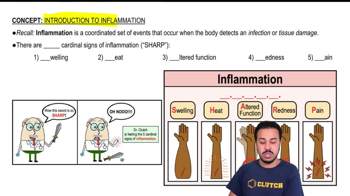
A coordinated immune response to infection or tissue damage, marked by swelling, heat, altered function, redness, and pain.
진행 상황 추적
컨트롤 버튼이 '내비게이션' 모드로 변경되었습니다.
1/15
관련 플래시카드
추천 영상
Introduction to Inflammation quiz
Introduction to Inflammation
24 용어
Introduction to Inflammation quiz #1
Introduction to Inflammation
10 용어
1:38
Inflammation
1638
views
21
rank
3:09
Chronic Inflammation
1383
views
12
rank
2:52
Types of Inflammatory Response
1632
views
18
rank
이 집합의 용어 (15)
하이드의 정의
Inflammation
A coordinated immune response to infection or tissue damage, marked by swelling, heat, altered function, redness, and pain.
SHARP
An acronym for the five cardinal signs of inflammation: Swelling, Heat, Altered function, Redness, and Pain.
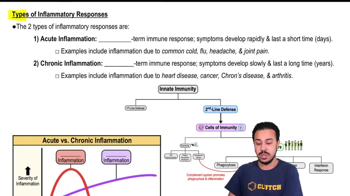
Acute inflammation
A short-term immune response characterized by rapid symptom development and an abundance of neutrophils.
Chronic inflammation
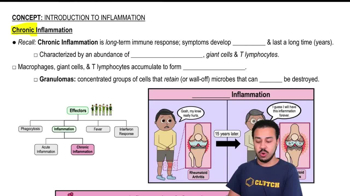
A long-term immune response with slow symptom development, involving macrophages, giant cells, and T lymphocytes.
Neutrophils
Immune cells that are the first to arrive at the site of infection during acute inflammation.
Macrophages
Immune cells involved in chronic inflammation, capable of forming giant cells and granulomas.
Giant cells
Formed by the fusion of two macrophages, these cells are involved in chronic inflammation.
T lymphocytes
Cells of the adaptive immune system that play a role in chronic inflammation and granuloma formation.
Granuloma
A structure formed by immune cells to wall off microbes that cannot be easily destroyed during chronic inflammation.
Innate immunity
The body's second line of defense, involving non-specific responses like inflammation.
Rheumatoid arthritis
An example of chronic inflammation where the immune system causes long-term joint inflammation.
Mycobacterium tuberculosis
The bacterium that causes tuberculosis, often associated with granuloma formation in chronic inflammation.
Phagocytosis
The process by which cells, like neutrophils, engulf and digest pathogens and debris.
Adaptive immunity
The immune system's ability to recognize and remember specific pathogens for more efficient responses.
Tissue repair
The process of healing and restoring tissue function following damage or infection.