Skip to main content
Anatomy & Physiology
나의 코스
배우기
시험 준비
AI 튜터
학습 가이드
교과서적 해결책
플래시카드
탐험해 보세요
앱을 사용해 보세요
나의 코스
배우기
시험 준비
AI 튜터
학습 가이드
교과서적 해결책
플래시카드
탐험해 보세요
앱을 사용해 보세요
뒤로
Introduction to Special Senses definitions
4 학생들은 이 점이 도움이 되었다고 느꼈습니다
카드를 뒤집기 위해 탭할 수 있습니다.
General senses
카드를 뒤집기 위해 탭할 수 있습니다.
👆
General senses
Senses distributed throughout the body, including temperature, pain, and pressure.
진행 상황 추적
컨트롤 버튼이 '내비게이션' 모드로 변경되었습니다.
1/15
관련 플래시카드
관련 실천
추천 영상
Introduction to Special Senses quiz #1
Introduction to Special Senses
39 용어
Introduction to Special Senses quiz #2
Introduction to Special Senses
18 용어
Introduction to Special Senses quiz #3
Introduction to Special Senses
10 용어
Introduction to Special Senses
15. The Special Senses
5 문제점
주제
Bruce
Structure of the Eyeball
15. The Special Senses
2 문제점
주제
15. The Special Senses
8 주제
13 문제점
장
Bruce
5:05
Special Senses
9849
views
256
rank
2
comments
3:08
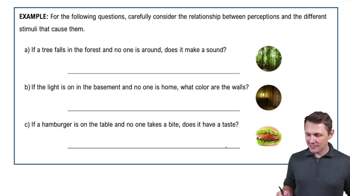
Introduction to Special Senses Example 1
6422
views
143
rank
이 집합의 용어 (15)
하이드의 정의
General senses
Senses distributed throughout the body, including temperature, pain, and pressure.
Special senses
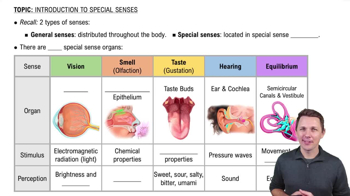
Senses located in specific organs in the head, including vision, smell, taste, hearing, and equilibrium.
Vision
The sense that measures electromagnetic radiation, perceived as brightness and color.
Olfactory epithelium
Tissue in the nasal cavity responsible for detecting chemical properties perceived as odors.
Gustation
The sense of taste, detecting chemical properties of food as sweet, sour, salty, bitter, and umami.
Cochlea
A spiral-shaped organ in the ear that detects pressure waves, perceived as sound.
Equilibrium
The sense that measures movement and gravity, helping determine orientation and balance.
Electromagnetic radiation
Energy waves, including light, that are detected by the eyes for vision.
Olfactory bulb
A brain structure connected to the olfactory epithelium, processing smell information.
Taste buds
Sensory organs on the tongue that detect the five basic tastes.
Semicircular canals
Structures in the inner ear involved in detecting rotational movement for balance.
Vestibule
Part of the inner ear that helps sense linear movement and gravity for balance.
Brightness
The intensity of electromagnetic radiation perceived by the eyes.
Color
A perception based on the wavelength of light entering the eyes.
Pressure waves
Vibrations in the air detected by the ear, perceived as sound.
 뒤로뒤로
뒤로뒤로
 5:05
5:05