Skip to main content
Anatomy & Physiology
나의 코스
배우기
시험 준비
AI 튜터
학습 가이드
교과서적 해결책
플래시카드
탐험해 보세요
앱을 사용해 보세요
나의 코스
배우기
시험 준비
AI 튜터
학습 가이드
교과서적 해결책
플래시카드
탐험해 보세요
앱을 사용해 보세요
뒤로
Introduction to the Central Nervous System quiz #3
카드를 뒤집기 위해 탭할 수 있습니다.
How is the brain structurally divided?
카드를 뒤집기 위해 탭할 수 있습니다.
👆
How is the brain structurally divided?
The brain is divided into several regions, each with specific functions, including the cerebrum, cerebellum, and brainstem.
진행 상황 추적
컨트롤 버튼이 '내비게이션' 모드로 변경되었습니다.
1/38
관련 플래시카드
관련 실천
추천 영상
Introduction to the Central Nervous System definitions
Introduction to the Central Nervous System
15 용어
Introduction to the Central Nervous System quiz #1
Introduction to the Central Nervous System
40 용어
Introduction to the Central Nervous System quiz #2
Introduction to the Central Nervous System
36 용어
Introduction to the Central Nervous System
12. The Central Nervous System
8 문제점
주제
Bruce
The Cerebrum
12. The Central Nervous System
7 문제점
주제
Bruce
12. The Central Nervous System
2 주제
6 문제점
장
Bruce
0:50
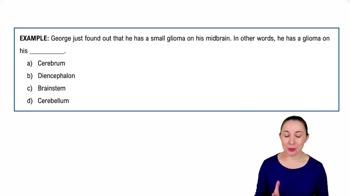
Introduction to the Central Nervous System Example 1
13067
views
246
rank
2
comments
2:41
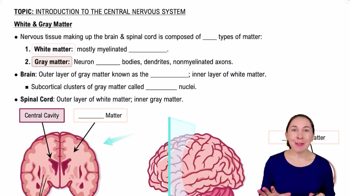
White & Gray Matter
13187
views
242
rank
3:34
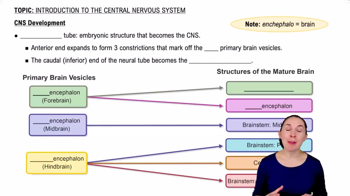
CNS Development
13831
views
275
rank
2
comments
이 집합의 용어 (38)
하이드의 정의
How is the brain structurally divided?
The brain is divided into several regions, each with specific functions, including the cerebrum, cerebellum, and brainstem.
What are the functions of the temporal lobe?
The temporal lobe is involved in auditory processing, language comprehension, and memory.
Which structure is not a division of the nervous system?
The limbic system is not a division of the nervous system; it is a functional system within the brain.
What is the priority when caring for a patient having a generalized tonic-clonic seizure?
The priority is to ensure the patient's safety and prevent injury during the seizure.
What are the two main divisions of the vertebrate nervous system?
The two main divisions are the central nervous system (CNS) and the peripheral nervous system (PNS).
Which part of the brain controls breathing and heartbeat?
The medulla oblongata controls breathing and heartbeat.
Which portion of the ventricular system is found within the diencephalon?
The third ventricle is found within the diencephalon.
What is a function of the thalamus?
The thalamus acts as a relay station for sensory information going to the cerebral cortex.
Which client should the nurse identify as having an absence seizure?
A client experiencing brief, sudden lapses in attention or staring spells should be identified as having an absence seizure.
How are oxygen and carbon dioxide levels in the blood detected by the CNS?
Chemoreceptors in the medulla oblongata detect changes in blood oxygen and carbon dioxide levels.
What are the two main organs of the nervous system?
The two main organs of the nervous system are the brain and the spinal cord.
What are the main structural components of the brain?
The brain is composed of the cerebrum, cerebellum, and brainstem, each with distinct functions.
What is a major role of the thalamus?
The thalamus serves as a relay station for sensory information to the cerebral cortex.
Which of these is not a function of the pons?
The pons is not primarily responsible for visual processing.
Where are the structures of the limbic system located?
The structures of the limbic system are located in the medial temporal lobe and surrounding areas.
Which component is not part of the diencephalon?
c. cerebellum
What is a false statement about the cerebellum?
The cerebellum is not primarily involved in language processing.
What is a similarity between Wernicke's area and Broca's area?
Both Wernicke's area and Broca's area are involved in language processing.
What part of the brain controls balance and coordination?
The cerebellum controls balance and coordination.
Which of these is a function of the thalamus?
The thalamus functions as a relay station for sensory information to the cerebral cortex.
Which skills are associated with the right hemisphere for most individuals?
The right hemisphere is associated with spatial abilities, face recognition, and processing music.
What is the name of the structure that connects the two hemispheres of the brain?
The corpus callosum connects the two hemispheres of the brain.
Which part of the nervous system is entirely located within the central nervous system?
a. spinal cord
What is true of the reticular activating system?
The reticular activating system is involved in regulating wakefulness and sleep-wake transitions.
What is not part of the diencephalon?
The cerebellum is not part of the diencephalon.
What part of the brain is not included in the brainstem?
The cerebellum is not part of the brainstem.
What functions are controlled by the medulla?
The medulla controls functions such as heart rate, breathing, and blood pressure.
What part of the brain is not included in the brain stem?
The cerebellum is not part of the brain stem.
What area of the brain is responsible for motor control and coordination?
The cerebellum is responsible for motor control and coordination.
Which nerve fibers cross in the optic chiasma?
The optic nerve fibers cross in the optic chiasma.
Which region of the brain is concerned with reasoning and decision making?
The frontal lobe is concerned with reasoning and decision making.
Which question is appropriate for a nurse to ask a client to assess the client's recent memory?
A nurse might ask, 'What did you have for breakfast this morning?' to assess recent memory.
What is not true about brain lateralization?
It is not true that each hemisphere of the brain is completely independent in function.
What role does the thalamus play in the brain?
The thalamus acts as a relay station for sensory information to the cerebral cortex.
If Broca's area is damaged, what is the likely outcome?
Damage to Broca's area can result in difficulties with speech production, known as Broca's aphasia.
Which part of the brain is responsible for balance and coordination?
The cerebellum is responsible for balance and coordination.
Which brain region relies on visual information in coordinating our voluntary movements?
The cerebellum relies on visual information to coordinate voluntary movements.
Which nerve communicates with the cerebellum about balance?
The vestibulocochlear nerve communicates with the cerebellum about balance.
 뒤로뒤로
뒤로뒤로
 0:50
0:50