Skip to main content
Anatomy & Physiology
나의 코스
배우기
시험 준비
AI 튜터
학습 가이드
교과서적 해결책
플래시카드
탐험해 보세요
앱을 사용해 보세요
나의 코스
배우기
시험 준비
AI 튜터
학습 가이드
교과서적 해결책
플래시카드
탐험해 보세요
앱을 사용해 보세요
뒤로
Lung Volumes and Capacities definitions
카드를 뒤집기 위해 탭할 수 있습니다.
Tidal Volume
카드를 뒤집기 위해 탭할 수 있습니다.
👆
Tidal Volume
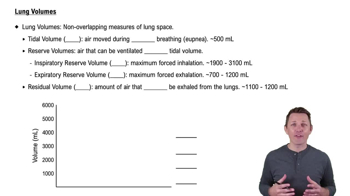
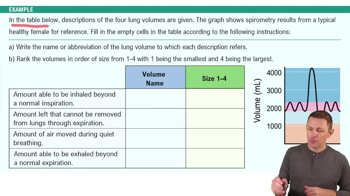
The amount of air moved during quiet breathing, approximately 500 milliliters for both males and females.
진행 상황 추적
컨트롤 버튼이 '내비게이션' 모드로 변경되었습니다.
1/15
관련 플래시카드
관련 실천
추천 영상
Lung Volumes and Capacities quiz
Lung Volumes and Capacities
11 용어
Lung Volumes and Capacities quiz #1
Lung Volumes and Capacities
11 용어
Lung Volumes and Capacities
22. The Respiratory System
2 문제점
주제
Bruce
Law of Partial Pressure
22. The Respiratory System
3 문제점
주제
Jason
22. The Respiratory System - Part 1 of 2
5 주제
9 문제점
장
Bruce
22. The Respiratory System - Part 2 of 2
1 주제
2 문제점
장
6:38
Lung Capacities
4172
views
83
rank
6:28
Lung Volumes
5064
views
115
rank
1
comments
4:45
Lung Volumes and Capacities Example 1
3989
views
73
rank
이 집합의 용어 (15)
하이드의 정의
Tidal Volume
The amount of air moved during quiet breathing, approximately 500 milliliters for both males and females.
Inspiratory Reserve Volume
Additional air that can be inhaled after a normal breath, ranging from 1900 to 3100 milliliters.
Expiratory Reserve Volume
Additional air that can be exhaled after a normal breath, ranging from 700 to 1200 milliliters.
Residual Volume
Air remaining in the lungs after maximum exhalation, typically between 1100 to 1200 milliliters.
Inspiratory Capacity
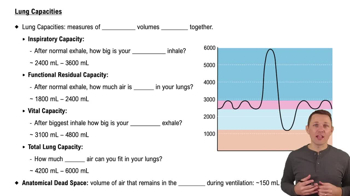
Maximum air that can be inhaled after a normal exhale, about 2400 to 3600 milliliters.
Functional Residual Capacity
Amount of air left in the lungs after a normal exhale, around 1800 to 2400 milliliters.
Vital Capacity
Total air that can be exhaled after a maximum inhalation, approximately 3100 to 4800 milliliters.
Total Lung Capacity
Sum of all lung volumes, about 4200 to 6000 milliliters, including anatomical dead space.
Anatomical Dead Space
Volume of air remaining in the airway during ventilation, approximately 150 milliliters.
Ventilation
The movement of air in and out of the lungs, crucial for gas exchange.
Alveoli
Tiny air sacs in the lungs where gas exchange occurs, essential for oxygen and carbon dioxide transfer.
Bronchi
Major air passages of the lungs that diverge from the windpipe, conducting air to the alveoli.
Trachea
The windpipe, a tube that connects the larynx to the bronchi, allowing air passage to the lungs.
Upper Respiratory Tract
Part of the respiratory system including the nose, nasal passages, and throat.
Eupnea
Normal, unlabored breathing, typically involving tidal volume.
 뒤로뒤로
뒤로뒤로

 6:38
6:38