Skip to main content
Anatomy & Physiology
나의 코스
배우기
시험 준비
AI 튜터
학습 가이드
교과서적 해결책
플래시카드
탐험해 보세요
앱을 사용해 보세요
나의 코스
배우기
시험 준비
AI 튜터
학습 가이드
교과서적 해결책
플래시카드
탐험해 보세요
앱을 사용해 보세요
뒤로
The Spine quiz
2 학생들은 이 점이 도움이 되었다고 느꼈습니다
카드를 뒤집기 위해 탭할 수 있습니다.
How many spinal nerves are there in the human body?
카드를 뒤집기 위해 탭할 수 있습니다.
👆
How many spinal nerves are there in the human body?
There are 31 pairs of spinal nerves in the human body.
진행 상황 추적
컨트롤 버튼이 '내비게이션' 모드로 변경되었습니다.
1/10
관련 플래시카드
관련 실천
추천 영상
The Spine definitions
The Spine
14 용어
The Spine
7. The Skeletal System
7 문제점
주제
Bruce
The Thoracic Cage
7. The Skeletal System
3 문제점
주제
Bruce
7. The Skeletal System - Part 1 of 2
7 주제
14 문제점
장
Bruce
7. The Skeletal System - Part 2 of 2
1 주제
2 문제점
장
Jason
6:29
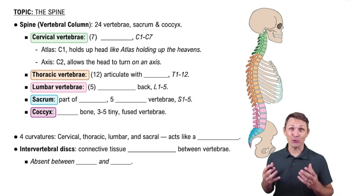
Spine (Vertebral Column)
11193
views
237
rank
5:17
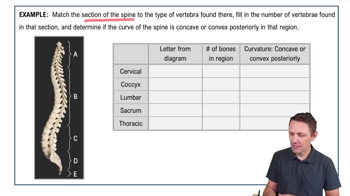
The Spine Example 1
7934
views
170
rank
이 집합의 용어 (10)
하이드의 정의
How many spinal nerves are there in the human body?
There are 31 pairs of spinal nerves in the human body.
How many pairs of spinal nerves are there in the human body?
There are 31 pairs of spinal nerves in the human body.
Which region of the spine provides attachment points for the ribs?
The thoracic region of the spine provides attachment points for the ribs.
What is a primary function of the spinal column?
Supports the body's weight
What is the primary function of the cervical vertebrae?
The primary function of the cervical vertebrae is to support the head and allow for its movement.
What is unique about the first two cervical vertebrae, C1 and C2?
C1, the Atlas, supports the head, and C2, the Axis, allows for head rotation.
What is the role of intervertebral discs in the spine?
Intervertebral discs provide cushioning and flexibility between the vertebrae.
What is the sacrum, and how is it formed?
The sacrum is part of the pelvis, formed from five fused vertebrae.
What is the coccyx, and how many vertebrae typically form it?
The coccyx, or tailbone, is typically formed from four fused vertebrae.
What are the four curves of the spine, and what is their function?
The four curves are cervical, thoracic, lumbar, and sacral, providing flexibility and shock absorption.
 뒤로뒤로
뒤로뒤로

 6:29
6:29