 뒤로
뒤로Advanced Anatomy & Physiology: Reproductive System
 2:08
2:08
이 집합의 용어 (26)
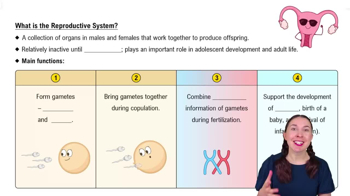
Process by which organisms produce offspring.
Sperm determines sex of child: XX = female, XY = male.
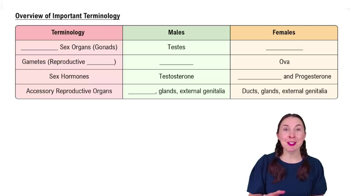
Produce gametes (sperm/oocyte) and secrete sex hormones.
Tightly coiled tubes in testes where sperm are produced.
Requires temperature about 2-3°C below core body temperature.
Reabsorbs degenerated sperm, site of sperm maturation, and stores sperm for months.
Conveys sperm during arousal by peristaltic contractions and stores sperm.
Produce about 60% of semen; secrete alkaline fluid, fructose, clotting proteins, and prostaglandins.
Contributes ~30% of semen; secretes citric acid, proteolytic enzymes, and seminalplasmin (antibiotic).
Secrete alkaline fluid and mucus to neutralize and lubricate urethra for sperm protection.
Contains erectile tissue; passageway for ejaculation and urine excretion; includes glans and prepuce (foreskin).
Parasympathetic fibers release nitric oxide (NO) causing arteriole dilation and blood engorgement.
Head contains nucleus (DNA) and acrosome; midpiece has mitochondria; tail (flagellum) enables movement.
FSH stimulates spermatogenesis; LH stimulates testosterone production; controlled by GnRH from hypothalamus.
Support spermatogenic cells, form blood-testis barrier, nourish sperm, secrete androgen-binding protein and inhibin.
Mitosis produces identical diploid cells; meiosis produces haploid gametes with genetic variation via crossing over.
Spermatogonia (2n) → primary spermatocytes (2n) → secondary spermatocytes (n) → spermatids (n) → sperm (mature).
Formation of female gametes; primary oocytes begin meiosis before birth; secondary oocyte released at ovulation.
Primordial → primary → secondary → mature (Graafian) follicle; ovulation releases secondary oocyte.
Forms after ovulation; secretes progesterone, estrogens, relaxin, and inhibin to maintain endometrium.
Menstrual, proliferative (preovulatory), ovulation, and secretory (postovulatory) phases.
GnRH stimulates FSH and LH; FSH promotes follicle growth; LH triggers ovulation and corpus luteum formation.
Promote female reproductive development, secondary sex characteristics, increase protein synthesis, and lower blood cholesterol.
Prepares and maintains endometrium for implantation; inhibits GnRH and LH secretion; supports mammary gland development.
Relaxes uterine muscles, increases pubic symphysis flexibility, and softens uterine cervix during pregnancy.
Secreted by granulosa cells and corpus luteum; inhibits secretion of FSH and LH.