 뒤로
뒤로Anatomical Terms: Head and Neck
 04:19
04:19
이 집합의 용어 (76)
Anterior means toward the front of the body.
Posterior means toward the back of the body.
Superior means above or higher in position.
Inferior means below or lower in position.
Medial means toward the midline of the body.
Lateral means away from the midline of the body.
Proximal means closer to the point of attachment or origin.
Distal means farther from the point of attachment or origin.
Superficial means toward or on the surface of the body.
Deep means away from the surface, more internal.
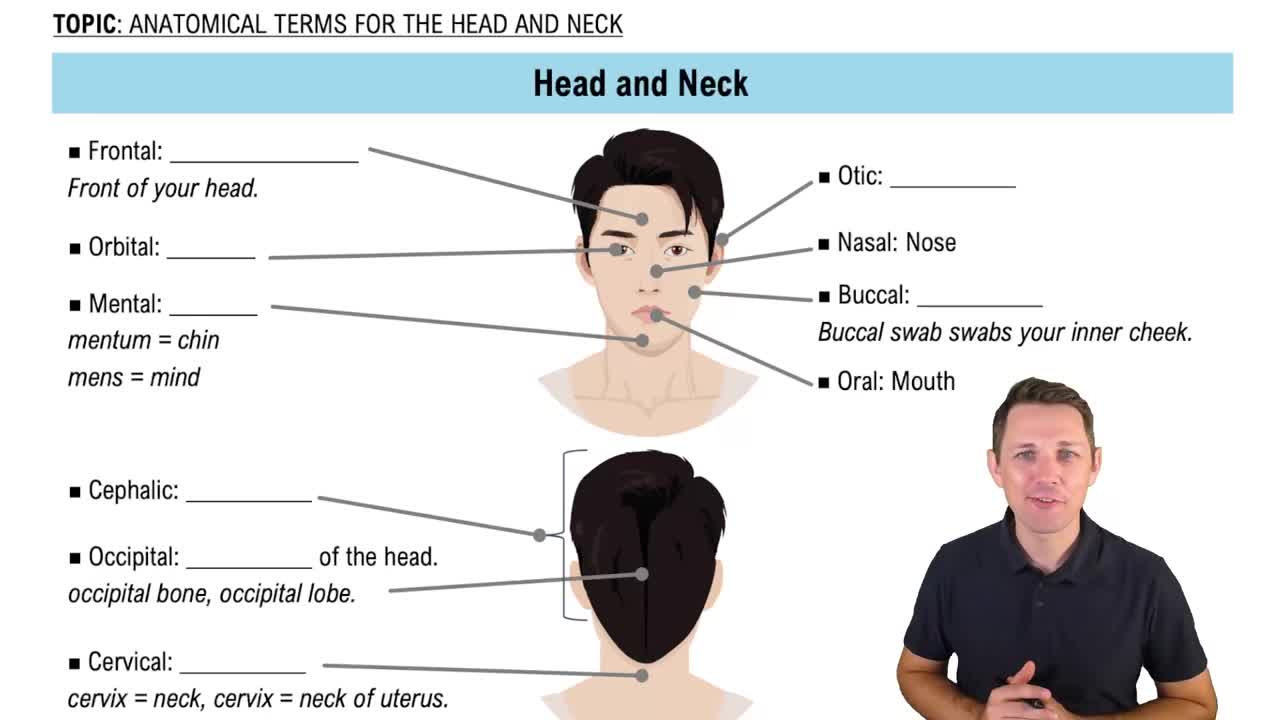
Frontal refers to the front part of the head or forehead.
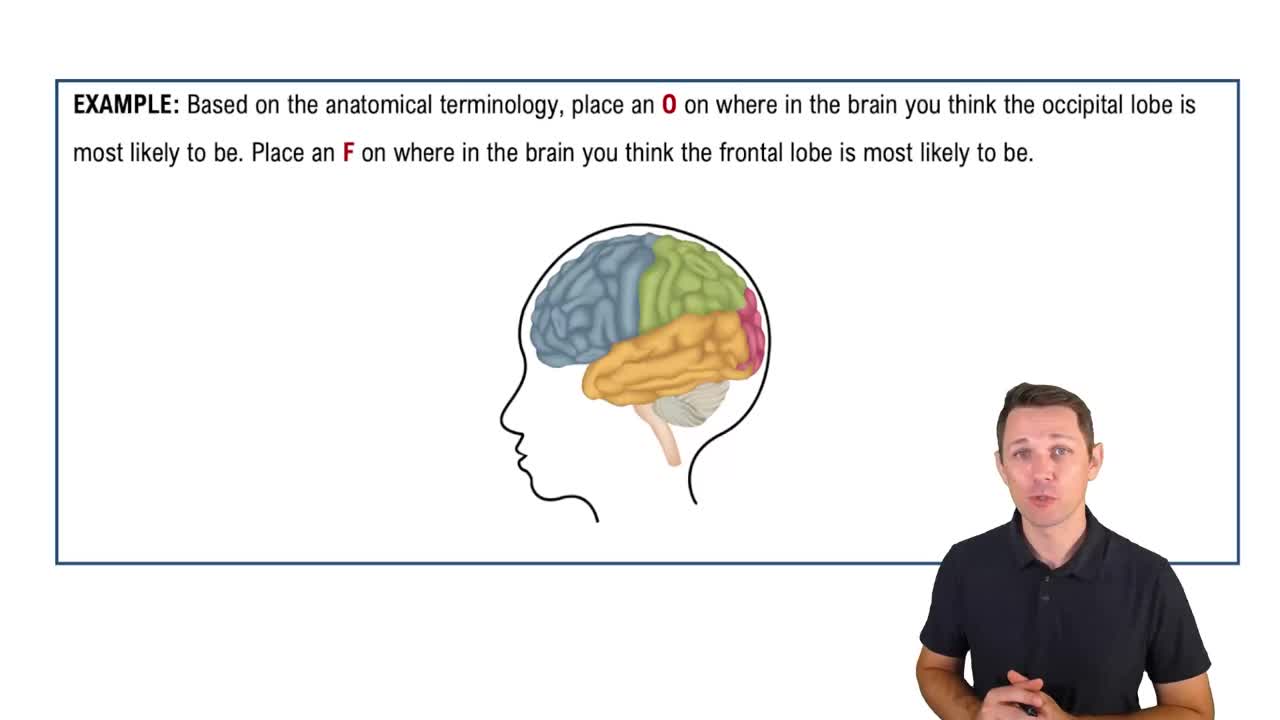
Occipital refers to the back of the head or skull.
Define 'cephalic' in relation to anatomy.
Cephalic relates to the head
Mandibular refers to the lower jaw area.
Orbital relates to the eye socket.
Buccal refers to the cheek area.
Nasal relates to the nose region.
Oral refers to the mouth area.
Mental refers to the chin region.
What does 'otic" refer to in anatomy?
Otic refers to the ear region.
What does 'cervical' refer to in anatomy?
Cervical refers to neck
Armpit
Axillary
Breast
Mammary
Navel
Umbilical
Grion
Inguinal
Pubic
Genitals
Chest
Thoracic
Sternum
Sternal
Abdomen
Abdominal
Pelvis
Pelvic
shoulder blade
scapular
vertebral
spine
lumbar
lower back
gluteal
buttocks
metacarpal
bones of hand
perineal
between anus and genitals
olecarnal
back of the elbow
sacral
bottom of spine
Organs are housed in specific areas
Anterior CAVITY AND POSTERIOR CAVITY
Anterior /Ventral Cavity holds
Organs of Chest and abdomen
Posterior /Dorsal Cavity
brain and spinal cord
Thoracic Cavity
contain heart, lungs
Abdominopelvic
abdomen - liver, stomach
pelvic - bladder
plane that divides the body into left and right portions
Sagittal Plane
plane that divides the body into superior and inferior portions
Transverse Plane
plane that divides the body into anterior and posterior portions
Frontal Plane
Integumentary Sytem
Outermost layer, Temperature
Hair, Skin, Nails
Skeletal System
Support and protect
Joint, Bones
Muscular System
Movement
Skeletal Muscles
Nervous System
communication, sensory
Brain, Nerves, Spinal Cord
Endocrine System
growth, hormones
Reproduction like Thyroid Gland, Adrenal Gland, Pancreas, Testis, Ovary
Cardiovascular System
transport blood
Heart, Blood Vessels
Lymphatic System/Immunity
attack against foregin substances
Thymus, Lymph nodes, spleen
Respiratory System
delivers oxygen and release carbon dioxide
Nasal cavity, pharynx, larynx, lung
Digestive System
process food
oral cavity, esophagus, liver, stomach, intestine, anus
urinary System
eliminates waste from body
Kidney, Ureter, Bladder
Male Reproductive System
production of offspring
Penis, Testis, Scrotum
Female Reproductive System
production of offspring
Uterus, Vagina, Ovary, Mammary
ocular lens
microscope that you look through to observe a specimen
coarse adjustment knob
dial to move stage up and down
total magnification formula
ocular lens magnifcation x objective lens magnification
ex: 10x ocular x 40x objective lens = 400x
cause water to leave the cell, leading to shrinking
hypertonic solutions
cause water to rush into the cell, leading to cell swelling
hypotonic solutions
plasma membrane
big outer circle
keeps everything in
nucleus
outer peanut nut
dna to mrna
mitochondria
jelly bean
powerhouse
convert food into energy
golgi apparatus
stack strips
modify and package proten
lysosomes
rocks
digestive enzymes/break down chemicals
centrioles
chrio
paired (2) divsion cells
ribosome
pebbles
translate mrna into protein "building"
rough endoplasmic reticulum
big maze
modifies protein getting ready to send
smooth endoplasmic reticulum
small maze
sythesizes lipids/carbs
nucleolus
inside m&m
make ribosome (protein)
The IV fluid has a lower solute (salt/sugar) concentration than the inside of the blood cells.
Hypotonic Solutions (Too Much Water) Water rushes into the red blood cells to balance the concentration. The cells swell up and may burst.
The IV fluid has a higher solute concentration than the inside of the blood cells.
Hypertonic Solutions (Too Much Salt) Water is pulled out of the red blood cells into the surrounding fluid. The cells shrink and shrivel up.
The heart is housed in the
pericardial cavity