Skip to main content
Anatomy & Physiology
나의 코스
배우기
시험 준비
AI 튜터
학습 가이드
교과서적 해결책
플래시카드
탐험해 보세요
앱을 사용해 보세요
나의 코스
배우기
시험 준비
AI 튜터
학습 가이드
교과서적 해결책
플래시카드
탐험해 보세요
앱을 사용해 보세요
뒤로
Anatomy & Physiology: Blood and Hemostasis
카드를 뒤집기 위해 탭할 수 있습니다.
What are the primary functions of blood?
카드를 뒤집기 위해 탭할 수 있습니다.
👆
What are the primary functions of blood?
Transport
of gases, nutrients, hormones;
regulation
of pH, temperature, fluid volume;
protection
against blood loss and infection.
진행 상황 추적
컨트롤 버튼이 '내비게이션' 모드로 변경되었습니다.
1/28
추천 영상
VideoThumbView.guidedCourse
2:36
Introduction to Blood Example 1
9867
views
294
rank
VideoThumbView.guidedCourse
7:49
Composition of Blood
10510
views
297
rank
VideoThumbView.guidedCourse
1:55
Introduction to Blood Example 2
8211
views
193
rank
이 집합의 용어 (28)
하이드의 정의
What are the primary functions of blood?
Transport
of gases, nutrients, hormones;
regulation
of pH, temperature, fluid volume;
protection
against blood loss and infection.
What is the typical pH range of blood?
Blood is slightly
alkaline
with a pH range of \(7.35-7.45\).
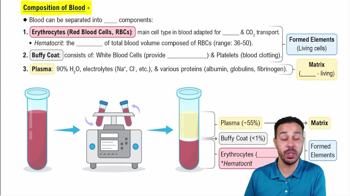
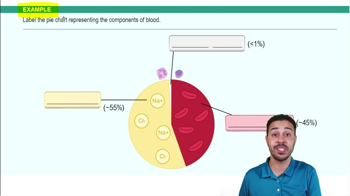
What are the main components of blood?
Blood consists of
erythrocytes
(RBCs),
buffy coat
(white blood cells and platelets), and
plasma
(90% water, electrolytes, proteins).
What is hematocrit?
The percentage of total blood volume composed of
red blood cells
, typically ranging from 36-50%.
What is the main function of erythrocytes?
To transport
oxygen
and
carbon dioxide
between lungs and tissues.
Why is hemoglobin important in erythrocytes?
Hemoglobin is a protein that
reversibly binds oxygen and CO2
, enabling efficient gas transport.
How many oxygen molecules can one hemoglobin molecule carry?
Each hemoglobin molecule can carry up to \(4\) oxygen molecules.
What happens to hematocrit at high altitudes?
Hematocrit increases due to more erythrocytes being produced to compensate for lower oxygen availability.
What are leukocytes and their primary function?
Leukocytes, or white blood cells,
defend the body against infection
and foreign substances.
What differentiates granulocytes from agranulocytes?
Granulocytes contain
visible cytoplasmic granules
under a microscope; agranulocytes do not.
Name the three types of granulocytes.
Neutrophils, eosinophils, and basophils.
What is the role of neutrophils?
Neutrophils are the most abundant leukocytes; they
phagocytose microbes
and release enzymes to kill pathogens.
What is the primary function of eosinophils?
Eosinophils protect against
parasitic helminths
and contribute to allergic responses.
What role do basophils and mast cells play?
They release
histamine
and other chemicals to promote
inflammation
and increase capillary permeability.
What are the two main types of agranulocytes?
Monocytes and lymphocytes.
What do monocytes differentiate into?
Monocytes develop into
macrophages
and
dendritic cells
, both phagocytic and antigen-presenting cells.
What are lymphocytes responsible for?
Lymphocytes (B and T cells) mediate
adaptive immunity
, while innate lymphoid cells provide innate immune responses.
What are platelets and their function?
Platelets are cell fragments that
plug holes
in damaged blood vessels to prevent blood loss.
What is hemostasis?
A controlled process to
stop bleeding
involving vascular spasm, platelet plug formation, and coagulation.
What occurs during vascular spasm?
Immediate
vasoconstriction
of damaged blood vessels to reduce blood flow and loss.
What is the role of von Willebrand factor in platelet plug formation?
It acts as a
bridge
between platelets and exposed collagen, initiating platelet adhesion.
What are the three steps of platelet plug formation?
Adhesion, activation & degranulation, and aggregation to form an unstable plug.
What stabilizes the platelet plug during coagulation?
Fibrin forms a mesh that
stabilizes
the platelet plug into a blood clot.
What are the two pathways initiating coagulation?
The
extrinsic pathway
(triggered by tissue factor outside blood) and the
intrinsic pathway
(triggered by factors within blood).
What is the sequence of key coagulation components?
Prothrombin activator converts prothrombin to thrombin, which converts fibrinogen to fibrin.
What is clot retraction?
Platelets contract to
pull torn vessel edges together
and secrete growth factors to promote healing.
What is fibrinolysis?
The process of breaking down fibrin clots by converting plasminogen to plasmin after healing.
What might happen if fibrinolysis does not occur?
There would be a
buildup of blood clots
, potentially causing blockages.
 뒤로뒤로
뒤로뒤로
 2:36
2:36