 뒤로
뒤로Anatomy & Physiology: Blood, Cardiovascular, Respiratory, Urinary, and Fluid Balance
 2:36
2:36
이 집합의 용어 (34)
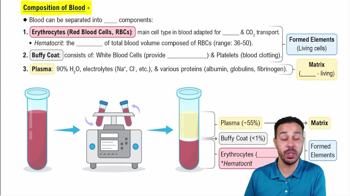
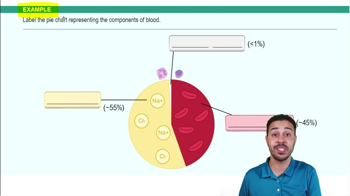
Plasma, red blood cells, white blood cells, and platelets.
Small, biconcave, anucleate cells specialized for oxygen transport using hemoglobin.
Transports oxygen from lungs to tissues and carries some carbon dioxide back to lungs.
Glycolysis (anaerobic metabolism) since they lack mitochondria.
In the red bone marrow through a process called erythropoiesis.
By the hormone erythropoietin, released mainly by the kidneys in response to low oxygen.
Iron is essential for hemoglobin synthesis, enabling oxygen binding.
Vitamin B12 and folic acid are required for DNA synthesis in RBC precursors.
A condition characterized by a decrease in red blood cells or hemoglobin, reducing oxygen delivery.
They are phagocytized mainly by macrophages in the spleen and liver.
Heme is broken down into bilirubin and iron; globin is recycled into amino acids.
Granulocytes have visible granules (neutrophils, eosinophils, basophils); agranulocytes do not (lymphocytes, monocytes).
Neutrophils and monocytes are the primary phagocytes.
Help in hemostasis by forming platelet plugs and releasing clotting factors.
Albumins maintain osmotic pressure, globulins transport and immune functions, fibrinogens aid clotting.
By exerting colloid osmotic pressure that draws water into blood vessels.
Converted to fibrin during clotting to form a mesh that stabilizes blood clots.
The process that stops bleeding through vascular spasm, platelet plug formation, and coagulation.
Extrinsic is triggered by external tissue damage; intrinsic is activated by blood contact with damaged endothelium.
Conversion of prothrombin to thrombin, then fibrinogen to fibrin to form the clot.
Inhibits thrombin and other clotting factors to prevent excessive clotting.
Antigens are molecules on cell surfaces that trigger immune response; antibodies are proteins that bind to antigens.
Because it has no anti-A or anti-B antibodies, so it accepts all blood types.
Because it has no A or B antigens, so it can be given to any blood type.
Pulmonary circuit carries blood between heart and lungs; systemic circuit carries blood between heart and body tissues.
Generates and conducts electrical impulses to coordinate heartbeats.
Closing of heart valves during the cardiac cycle produces the lub-dub sounds.
Cardiac output = \(\text{heart rate} \times \text{stroke volume}\).
Thin barrier of alveolar and capillary walls allowing gas exchange by diffusion.
Mostly bound to hemoglobin in red blood cells; a small amount dissolved in plasma.
Functional kidney unit consisting of the glomerulus, Bowman's capsule, proximal tubule, loop of Henle, distal tubule, and collecting duct.
Active transport of substances from blood into the nephron tubules for excretion.
Increases sodium reabsorption and potassium secretion in the distal tubules.
By controlling CO2 levels through breathing rate, affecting blood pH.