뒤로

Anatomy & Physiology - Blood Chapter 17 Flashcards

컨트롤 버튼이 '내비게이션' 모드로 변경되었습니다.
1/33
  • What are the main components of blood?

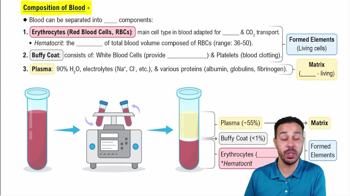
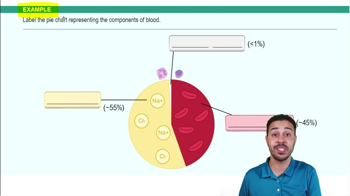
    Blood consists of plasma (non-living fluid matrix) and formed elements (living cells: erythrocytes, leukocytes, and platelets).
  • What is hematocrit?

    Hematocrit is the percentage of blood volume occupied by erythrocytes, typically about 47% ± 5% in males and 42% ± 5% in females.
  • What are the physical characteristics of blood?

    Blood is a sticky, opaque fluid with a metallic taste, thicker than water, pH 7.35–7.45, and volume about 5–6 L in males and 4–5 L in females.
  • List the primary functions of blood.

    Blood functions in distribution (O2, nutrients, wastes, hormones), regulation (temperature, pH, fluid volume), and protection (clotting, infection prevention).
  • What are the major plasma proteins and their functions?

    Albumin (60%) maintains osmotic pressure and transport; Globulins (36%) transport and antibodies; Fibrinogen (4%) is essential for blood clotting.
  • Describe erythrocytes and their main function.

    Erythrocytes are biconcave, anucleate cells filled with hemoglobin, specialized for respiratory gas transport.
  • What is the structure of hemoglobin?

    Hemoglobin consists of four polypeptide chains (two alpha, two beta) each with a heme group containing iron that binds one O2 molecule.
  • What is hematopoiesis?

    Hematopoiesis is the formation of blood cells in red bone marrow from hematopoietic stem cells (hemocytoblasts).
  • Outline the stages of erythropoiesis.

    Myeloid stem cell → proerythroblast → basophilic erythroblast → polychromatic erythroblast → orthochromatic erythroblast → reticulocyte → mature erythrocyte.
  • What hormone regulates erythropoiesis and how?

    Erythropoietin (EPO), released by kidneys in response to hypoxia, stimulates red bone marrow to increase RBC production.
  • What dietary components are essential for erythropoiesis?

    Amino acids, lipids, carbohydrates, iron (for hemoglobin), vitamin B12, and folic acid (for DNA synthesis) are essential.
  • Describe the fate of aged erythrocytes.

    Old RBCs are engulfed by macrophages; hemoglobin is broken down, iron is recycled, heme is converted to bilirubin, and globin is metabolized to amino acids.
  • What is anemia?

    Anemia is a condition with abnormally low O2-carrying capacity of blood, caused by blood loss, low RBC production, or high RBC destruction.
  • What is polycythemia?

    Polycythemia is an excess of RBCs causing increased blood viscosity; types include polycythemia vera (bone marrow cancer) and secondary polycythemia (response to low O2).
  • What are leukocytes and their general functions?

    Leukocytes (WBCs) are defense cells that protect against disease, can leave capillaries by diapedesis, and move by ameboid motion.
  • Differentiate granulocytes and agranulocytes.

    Granulocytes have visible cytoplasmic granules (neutrophils, eosinophils, basophils); agranulocytes lack granules (lymphocytes, monocytes).
  • What is the role of neutrophils?

    Neutrophils are the most numerous WBCs, highly phagocytic, and kill bacteria using respiratory burst producing bleach and hydrogen peroxide.
  • What is the function of eosinophils?

    Eosinophils combat parasitic worms, modulate allergic responses, and contribute to tissue damage in asthma.
  • What do basophils do?

    Basophils release histamine, a vasodilator that attracts other WBCs to inflammation sites, and are similar to mast cells.
  • Describe the function of lymphocytes.

    Lymphocytes are crucial for immunity; T cells attack virus-infected and tumor cells, B cells produce antibodies via plasma cells.
  • What is leukopoiesis?

    Leukopoiesis is the production of WBCs stimulated by interleukins and colony-stimulating factors from hematopoietic stem cells.
  • What are platelets and their role?

    Platelets are cytoplasmic fragments from megakaryocytes that form temporary plugs to seal blood vessel breaks and release clotting chemicals.
  • What are the three steps of hemostasis?

    1. Vascular spasm (vasoconstriction), 2. Platelet plug formation, 3. Coagulation (blood clotting with fibrin mesh).
  • What triggers platelet plug formation?

    Damaged endothelium exposes collagen; platelets stick via von Willebrand factor, swell, release chemicals, and recruit more platelets.
  • What is the goal of coagulation?

    To convert fibrinogen into fibrin, forming a mesh that stabilizes the platelet plug and stops bleeding.
  • What is clot retraction?

    Platelets contract using actin and myosin, pulling fibrin strands to stabilize the clot and draw vessel edges together.
  • What is fibrinolysis?

    Fibrinolysis removes unneeded clots by activating plasminogen to plasmin, which digests fibrin after healing.
  • What causes thromboembolic disorders?

    Undesirable clot formation due to rough vessel walls, slow blood flow, or blood stasis, leading to thrombus or embolus formation.
  • What are common anticoagulant drugs?

    Aspirin, heparin, warfarin, dabigatran, and Brilinta prevent clot formation or platelet aggregation.
  • What is hemophilia?

    A hereditary bleeding disorder caused by lack of clotting factors, leading to prolonged bleeding and treated with plasma transfusions.
  • What are the ABO blood groups?

    Blood groups based on presence of A and/or B antigens on RBCs and corresponding antibodies in plasma; O is universal donor, AB universal recipient.
  • What is the Rh blood group system?

    Rh+ individuals have Rh antigens; Rh– do not. Rh– exposed to Rh+ blood develop anti-Rh antibodies causing transfusion reactions in subsequent exposures.
  • What is hemolytic disease of the newborn?

    Occurs when an Rh– mother has an Rh+ fetus; mother's anti-Rh antibodies attack fetal RBCs in subsequent pregnancies, causing anemia in the baby.