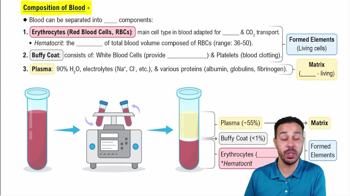
Transportation of gases, nutrients, wastes, hormones; Regulation of pH, temperature, fluid balance; Protection via immune response and clotting.
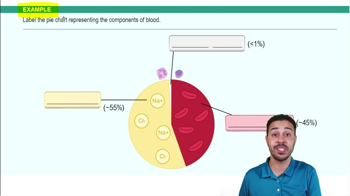
Composition of blood
Blood is 55% plasma (mostly water and proteins) and 45% formed elements (RBCs, WBCs, platelets).
Plasma proteins and their functions
Albumins (54-60%) maintain blood volume by drawing water; Globulins (36-38%) transport fats and include antibodies; Fibrinogen (4-7%) is essential for clotting.
Erythropoiesis
Process of RBC production from proerythroblasts in red bone marrow, stimulated by erythropoietin from kidneys.
Structure and function of erythrocytes
Biconcave, anucleate cells containing hemoglobin that transport oxygen and carbon dioxide.
Hemoglobin composition and oxygen transport
Hemoglobin has 4 polypeptide chains and 4 heme groups with iron ions that reversibly bind oxygen for transport.
Leukocytes classification
Granulocytes: neutrophils, eosinophils, basophils; Agranulocytes: lymphocytes (T and B cells), monocytes.
Functions of neutrophils
Phagocytize bacteria, release lysozyme, oxidants, and defensins to destroy pathogens.
Role of eosinophils
Combat allergic reactions by releasing enzymes, phagocytize antigen-antibody complexes, and fight parasitic worms.
Basophils function
Involved in inflammation by releasing heparin, histamine, and serotonin; contribute to hypersensitivity reactions.
Platelets (thrombocytes)
Cell fragments that promote blood clotting by forming platelet plugs and releasing clotting chemicals.
Intrinsic: activated by blood contact with damaged endothelium; Extrinsic: triggered by tissue factor from outside vessels; both converge to form prothrombinase.
Blood groups ABO system
Based on A and B antigens on RBCs; types A, B, AB, and O with corresponding antibodies in plasma.
Rh blood group system
Presence (Rh+) or absence (Rh-) of D antigen; Rh- individuals develop antibodies if exposed to Rh+ blood.
Lymphatic system functions
Drains interstitial fluid, transports dietary fats, and mediates immune responses.
Primary lymphatic organs
Bone marrow (B cell maturation) and thymus gland (T cell maturation).
Secondary lymphatic organs
Lymph nodes and spleen where immune responses occur.
Heart conduction system
SA node initiates heartbeat; impulse travels to AV node, Bundle of His, bundle branches, and Purkinje fibers causing ventricular contraction.
Cardiac cycle phases
Atrial systole (0.1s), ventricular systole (0.3s), and total heart relaxation (0.4s) in a 0.8s cycle at rest.
Respiratory system major organs
Nose, pharynx, larynx, trachea, bronchi, and lungs.
Boyle's Law in respiration
At constant temperature, gas volume varies inversely with pressure; lung volume increase lowers pressure causing inspiration.
Gas composition of atmospheric air
Approximately 78.6% nitrogen, 21% oxygen, 0.5% water vapor, and 0.04% carbon dioxide.
Oxygen transport in blood
Mostly bound to hemoglobin as oxyhemoglobin; small amount dissolved in plasma.
Carbon dioxide transport in blood
70% as bicarbonate ions, 23% bound to hemoglobin as carbaminohemoglobin, 7% dissolved in plasma.
Digestive system main organs
Mouth, pharynx, esophagus, stomach, small intestine, large intestine.
 뒤로
뒤로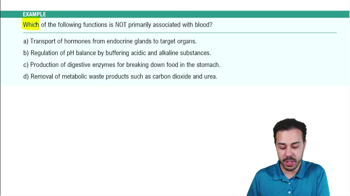
 2:36
2:36