What is the main characteristic of hyaline cartilage?
Provides support, flexibility, and resilience; most abundant skeletal cartilage.
Where is elastic cartilage found?
In the external ear and the epiglottis.
What is fibrocartilage and where is it found?
Highly compressed with great tensile strength; found in menisci of the knee and intervertebral discs.
What are the two types of cartilage growth?
Appositional (matrix secreted on cartilage surface) and interstitial (chondrocytes divide within cartilage).
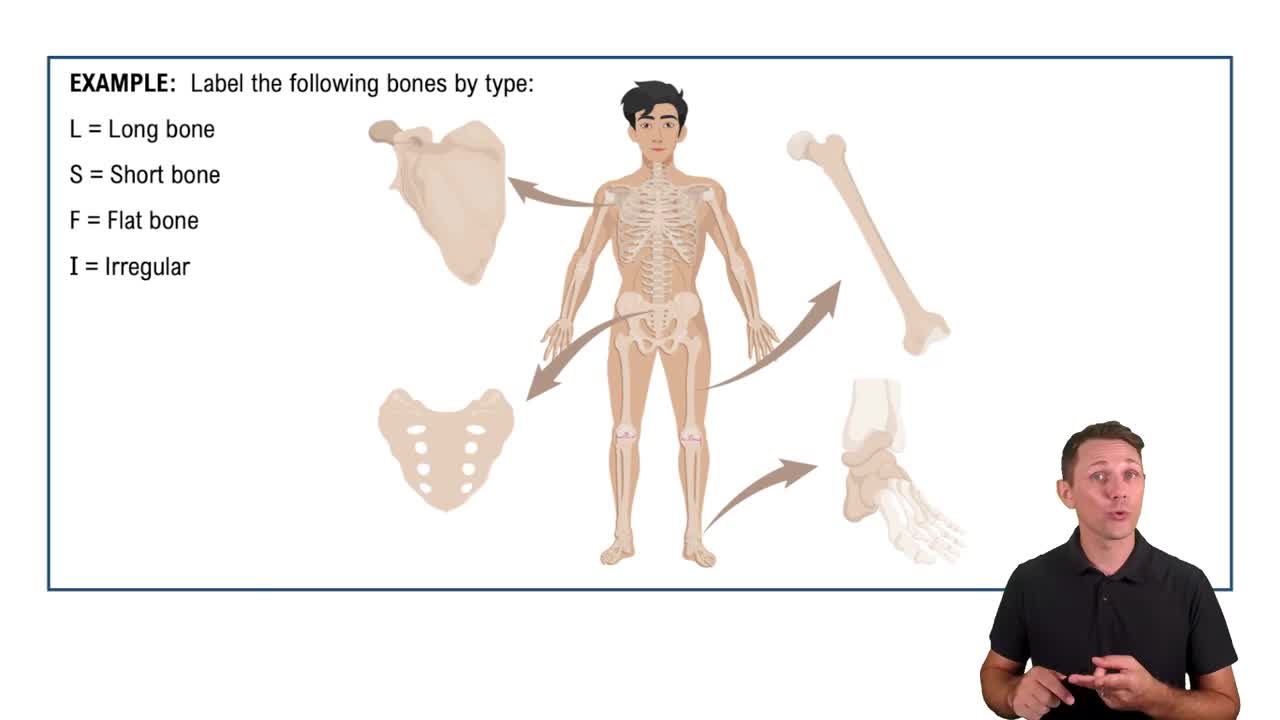
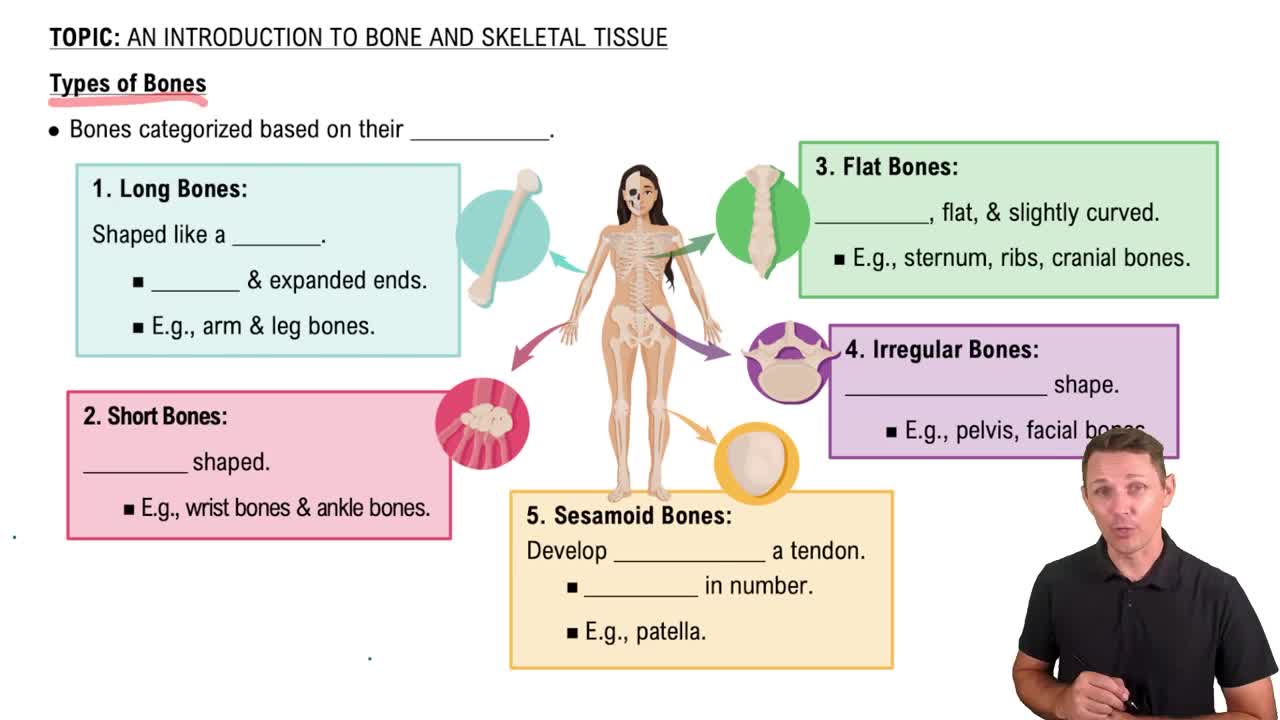
How are bones classified by shape?
Long, short, flat, and irregular bones.
What is the function of bones?
Support, protection, movement, mineral storage, and blood cell formation.
What are bone markings?
Bulges, depressions, and holes that serve as sites for muscle attachment, joint surfaces, or conduits for vessels and nerves.
What are the two main textures of bone?
Compact bone (dense outer layer) and spongy bone (honeycomb of trabeculae).
What are the main parts of a long bone?
Diaphysis (shaft), epiphyses (ends), medullary cavity, periosteum, and endosteum.
What is the periosteum?
Double-layered membrane covering bone; outer fibrous layer and inner osteogenic layer with osteoblasts and osteoclasts.
What is the structure of short, irregular, and flat bones?
Thin plates of compact bone covered by periosteum, with spongy bone (diploë) inside; no diaphysis or epiphyses.
Where is hematopoietic (red) marrow found in adults?
In the diploë of flat bones and the heads of the femur and humerus.
What is an osteon (Haversian system)?
The structural unit of compact bone, consisting of lamellae surrounding a central canal.
What are canaliculi?
Hairlike canals that connect lacunae to each other and the central canal, allowing nutrient and waste exchange.
What are the organic components of bone?
Osteoblasts, osteocytes, osteoclasts, and osteoid (unmineralized matrix of proteoglycans, glycoproteins, and collagen).
What are the inorganic components of bone?
Hydroxyapatites (mineral salts), mainly calcium phosphates, responsible for bone hardness and resistance to compression.
What are the two types of ossification?
Intramembranous (from fibrous membrane) and endochondral (replacing hyaline cartilage).
What are the functional zones of the epiphyseal plate during bone growth?
Growth zone (mitosis), transformation zone (cell enlargement and matrix calcification), osteogenic zone (new bone formation).
What hormones regulate bone growth during youth?
Growth hormone stimulates growth plate activity; testosterone and estrogens promote growth spurts and later induce epiphyseal plate closure.
What is bone remodeling?
Continuous process where osteoblasts deposit bone and osteoclasts resorb bone, maintaining bone strength and calcium homeostasis.
What is the role of alkaline phosphatase in bone deposition?
It is essential for mineralization of bone matrix.
How do osteoclasts resorb bone?
By secreting lysosomal enzymes to digest organic matrix and acids to dissolve calcium salts.
Why is calcium important in the body?
Necessary for nerve impulse transmission, muscle contraction, blood coagulation, gland secretion, and cell division.
How does the hormonal mechanism regulate blood calcium levels?
High blood Ca2+ triggers calcitonin release to deposit calcium in bone; low Ca2+ triggers parathyroid hormone (PTH) release to stimulate bone resorption.
What is Wolff's law?
Bone grows or remodels in response to mechanical stress placed upon it.
How are bone fractures classified?
By position of bone ends, completeness, orientation to long axis, and whether bone ends penetrate the skin.
What are common types of fractures?
Comminuted, spiral, depressed, compression, epiphyseal, and greenstick fractures.
What are the stages in healing a bone fracture?
Hematoma formation, fibrocartilaginous callus formation, bony callus formation, and bone remodeling.
What causes osteomalacia and rickets?
Inadequate bone mineralization due to insufficient calcium or vitamin D deficiency.
What is osteoporosis?
Disease where bone resorption outpaces bone deposit, leading to fragile bones, especially in postmenopausal women.
 뒤로
뒤로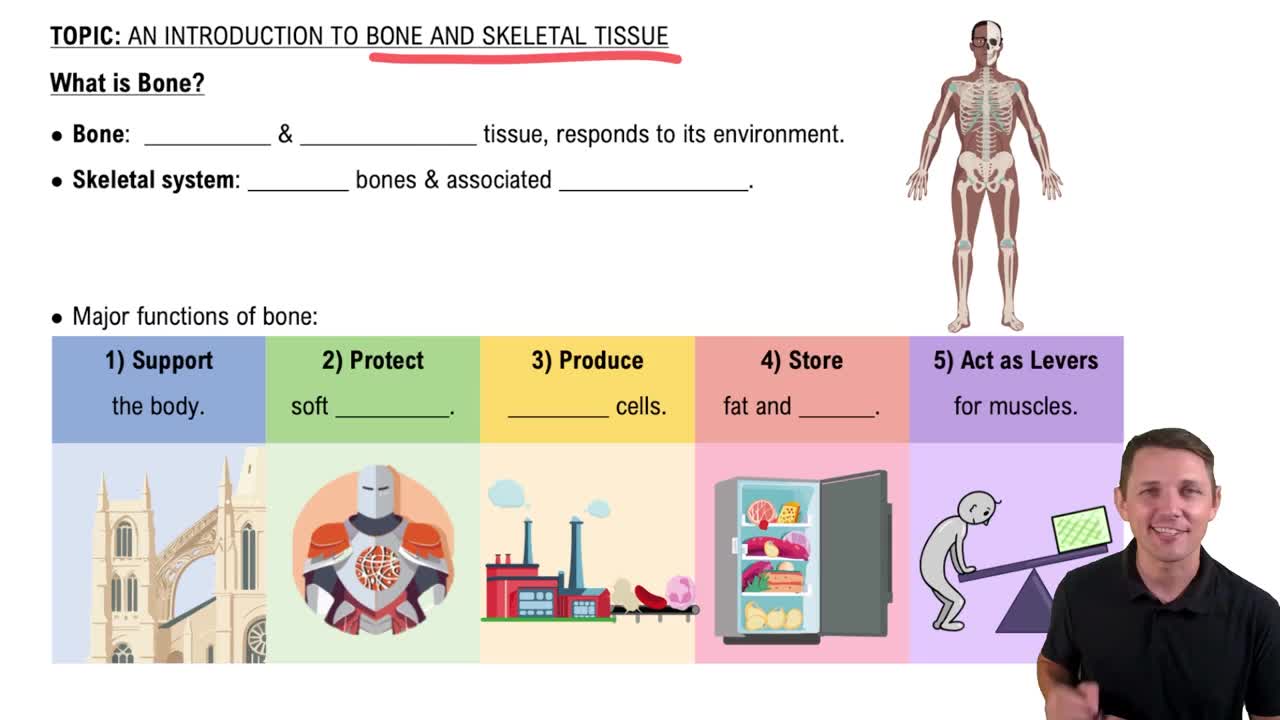
 3:56
3:56