Skip to main content
Anatomy & Physiology
나의 코스
배우기
시험 준비
AI 튜터
학습 가이드
교과서적 해결책
플래시카드
탐험해 보세요
앱을 사용해 보세요
나의 코스
배우기
시험 준비
AI 튜터
학습 가이드
교과서적 해결책
플래시카드
탐험해 보세요
앱을 사용해 보세요
뒤로
Anatomy & Physiology: Cell Structure and Function
카드를 뒤집기 위해 탭할 수 있습니다.
What are the four basic processes common to all cell types?
카드를 뒤집기 위해 탭할 수 있습니다.
👆
What are the four basic processes common to all cell types?
Cell metabolism
,
transport of substances
,
communication
, and
cell reproduction by division
.
진행 상황 추적
컨트롤 버튼이 '내비게이션' 모드로 변경되었습니다.
1/30
추천 영상
VideoThumbView.guidedCourse
03:45
Introduction to Eukaryotic Organelles
25772
views
436
rank
VideoThumbView.guidedCourse
05:32
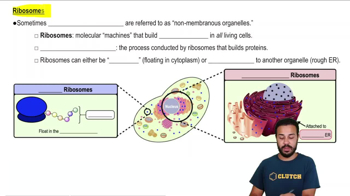
Ribosomes
21548
views
338
rank
VideoThumbView.guidedCourse
02:04
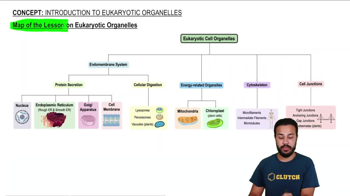
Map of the Lesson on Eukaryotic Organelles
18859
views
237
rank
이 집합의 용어 (30)
하이드의 정의
What are the four basic processes common to all cell types?
Cell metabolism
,
transport of substances
,
communication
, and
cell reproduction by division
.
What are the three basic components of most animal cells?
Plasma membrane
,
cytoplasm
, and
nucleus
.
Functions of the plasma membrane
Provides
structural support
,
communication
with surroundings and other cells, and
cell identification
.
What is cytosol?
The
intracellular fluid
mostly water with dissolved solutes, inclusions, and proteins; site of many chemical reactions.
What is the role of organelles in the cytoplasm?
Organelles are cellular machines with specific functions that
compartmentalize
chemical reactions to protect cell structures.
Describe the fluid mosaic model of the plasma membrane
A dynamic fluid structure with phospholipids and proteins that can move laterally; includes integral and peripheral proteins.
What is the function of cholesterol in the plasma membrane?
Cholesterol
stabilizes
the membrane's fluid structure during temperature changes.
Define selective permeability of the plasma membrane
Allows certain molecules to cross while blocking others, critical for cell survival.
What factors determine how substances move across the plasma membrane?
Type of substance, membrane permeability, and concentration difference between cytosol and extracellular fluid.
Difference between simple diffusion and facilitated diffusion
Simple diffusion moves nonpolar solutes directly through the bilayer; facilitated diffusion uses membrane proteins for polar or charged solutes.
What is osmosis?
Passive movement of water across a membrane from an area of lower solute concentration to higher solute concentration.
How does tonicity affect cells?
Isotonic: no volume change; Hypertonic: cell shrinks; Hypotonic: cell swells and may lyse.
What is primary active transport?
Uses ATP directly to pump solutes against their concentration gradient, e.g., the sodium-potassium pump.
What is secondary active transport?
Uses energy stored in concentration gradients created by primary active transport to move other substances against their gradients.
What creates the membrane potential?
Separation of charges across the plasma membrane with positive outside and negative inside creates an electrical gradient.
What is endocytosis?
Active transport process where the cell engulfs extracellular fluid, large molecules, or cells via vesicles.
What is the function of mitochondria?
Membrane-bound organelles that produce most of the cell's ATP through oxidative catabolism.
Role of ribosomes in the cell
Sites of protein synthesis; free ribosomes make proteins for the cell, bound ribosomes make proteins for export or membranes.
Functions of rough and smooth endoplasmic reticulum
Rough ER synthesizes proteins for export; Smooth ER synthesizes lipids, stores calcium, and detoxifies chemicals.
What is the Golgi apparatus responsible for?
Modifies, sorts, and packages proteins and lipids for secretion, membrane insertion, or lysosomes.
Describe the cytoskeleton
Network of protein filaments (actin, intermediate filaments, microtubules) that maintain cell shape, provide strength, and enable movement.
What are microvilli, cilia, and flagella?
Microvilli increase surface area; cilia move substances across cell surfaces; flagella propel the entire cell (e.g., sperm).
What is the nuclear envelope?
Double phospholipid bilayer surrounding the nucleus with pores allowing exchange between nucleoplasm and cytoplasm.
What is chromatin?
DNA and associated proteins organized to compact the DNA; condenses into chromosomes during cell division.
What is the nucleolus?
Region in the nucleus where ribosomal RNA is synthesized and ribosome assembly begins.
Outline the process of protein synthesis
DNA is transcribed into mRNA in the nucleus; mRNA is translated into a polypeptide at ribosomes in the cytosol.
What happens during the S phase of the cell cycle?
DNA replication occurs; each chromosome is duplicated to form sister chromatids.
List the stages of mitosis
Prophase, Metaphase, Anaphase, Telophase.
What is cytokinesis?
Division of the cytoplasm, organelles, and cell contents into two daughter cells after mitosis.
What is apoptosis?
Programmed cell death that removes damaged or unrepairable cells.
 뒤로뒤로
뒤로뒤로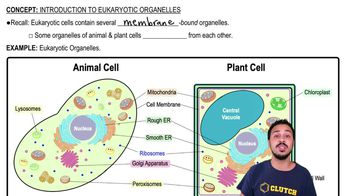
 03:45
03:45