 뒤로
뒤로Anatomy & Physiology: Cell Structure and Membrane Transport
 03:45
03:45
이 집합의 용어 (20)
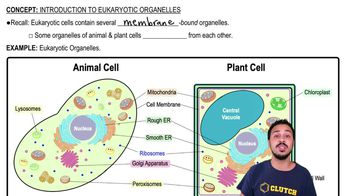
Plasma membrane: flexible outer boundary
Cytoplasm: intracellular fluid containing organelles
Nucleus: DNA-containing control center
A double layer of phospholipids with embedded proteins, cholesterol, and carbohydrates forming a fluid mosaic model that controls what enters and leaves the cell.
Phosphate heads: polar, hydrophilic (water-loving)
Fatty acid tails: nonpolar, hydrophobic (water-hating)
Located between phospholipid tails, cholesterol increases membrane stiffness and stability.
Integral proteins span the membrane and function as transporters, enzymes, or receptors.
Peripheral proteins are loosely attached and function in enzymes, motor proteins, and cell connections.
Passive transport: no energy required
Active transport: energy (ATP) required to move substances against their concentration gradient.
Movement of nonpolar, lipid-soluble substances directly through the lipid bilayer from high to low concentration without energy.
Facilitated diffusion uses carrier or channel proteins to transport specific hydrophobic molecules down their concentration gradient without energy.
Carrier-mediated: protein changes shape to move large polar molecules.
Channel-mediated: molecules move through aqueous channels based on size and charge.
Osmosis is the diffusion of water through a selectively permeable membrane via lipid bilayer or aquaporins, moving from low to high solute concentration.
Tonicity is a solution's ability to change cell shape by altering water volume.
Isotonic: normal shape
Hypertonic: cell shrinks (crenation)
Hypotonic: cell swells and may burst (lysis)
Transport using ATP to move solutes against their gradient.
Example: Na+/K+ pump moves 3 Na+ out and 2 K+ in, maintaining electrochemical gradients.
Uses energy stored in ion gradients created by primary active transport to move other solutes indirectly, e.g., Na+ gradient driving glucose uptake.
Movement of large substances in vesicles requiring ATP.
Types: Endocytosis, Exocytosis, Transcytosis, and Vesicular trafficking.
Process of engulfing substances into the cell via protein-coated vesicles; can be selective if receptors bind specific molecules.
"Cell eating" where pseudopods engulf solid particles forming a phagosome; used by macrophages and some white blood cells.
"Cell drinking" where plasma membrane infolds to bring extracellular fluid and solutes inside; nonspecific and receptor-independent.
Selective uptake of molecules using plasma membrane receptors that bind specific substances like hormones or cholesterol.
Triggered by cell signals or membrane voltage changes; secretory vesicles fuse with membrane via v-SNARE and t-SNARE proteins to release contents.
Its hydrophobic core allows nutrients in, keeps valuable substances inside, and lets wastes exit, controlling cellular environment.