 뒤로
뒤로Anatomy & Physiology: Cells, Tissues, and Homeostasis
 05:04
05:04
이 집합의 용어 (29)
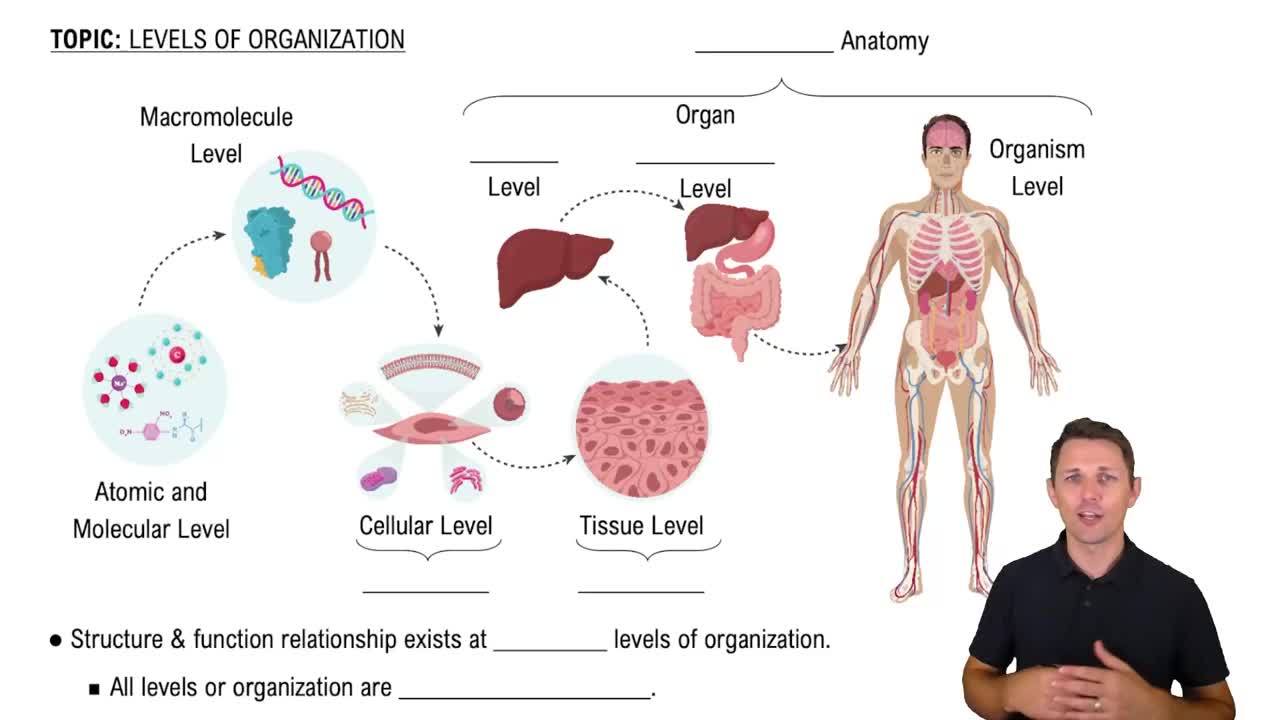
From simplest to most complex: Chemical (atoms & molecules), Cellular (cells), Tissue (similar cells), Organ (different tissues), Organ system (organs working together), Organismal (whole body).
1. Cell is basic unit of life. 2. Organism's activity depends on cells. 3. Cell structure dictates function. 4. Life continuity has cellular basis.
Nucleus, Cytoplasm, and Plasma membrane.
Fluid mosaic model: two layers of phospholipids arranged tail to tail, with cholesterol, proteins, and glycolipids scattered throughout.
Hydrophilic polar heads face outward (water), hydrophobic nonpolar tails face inward, creating a barrier to water-soluble molecules.
Fibroblasts (connect body parts), erythrocytes (carry oxygen), epithelial cells (line organs), muscle cells (movement), fat cells (store nutrients), macrophages (fight disease), nerve cells (control functions).
Epithelial, Connective, Muscle, and Nervous tissue.
Protection, absorption, filtration, and secretion.
Cells fit closely, apical surface free, rests on basement membrane, avascular, regenerates easily.
Layers: Simple (one layer), Stratified (multiple layers). Shapes: Squamous (flat), Cuboidal (cube), Columnar (column-shaped).
Lines air sacs of lungs, capillaries, serous membranes; functions in diffusion, filtration, secretion.
Found in glands, kidney tubules, ovaries; functions in secretion and absorption.
Lines digestive tract; functions in secretion and absorption; contains mucus-secreting goblet cells.
Single layer with varying cell heights, appears stratified; found in respiratory tract; functions in absorption and secretion.
Protective covering where friction is common; found in skin, mouth, esophagus.
Allows stretching and returns to normal shape; found in urinary bladder and ureters.
Protection, binding tissues, support, and varying blood supply.
Ground substance (water, adhesion proteins, polysaccharides) and fibers (collagen, elastic, reticular).
Osteocytes in lacunae, hard calcium matrix, collagen fibers; functions in protection and support.
Hyaline (larynx, fetal skeleton), elastic (external ear), fibrocartilage (intervertebral discs).
Tendons (muscle to bone), ligaments (bone to bone), dermis of skin.
Areolar (packing tissue, holds organs), adipose (insulation, protection, fuel storage).
Blood cells in fluid matrix (plasma); soluble fibers visible during clotting.
Irritability (respond to stimuli) and conductivity (transmit impulses).
Skeletal (voluntary, striated, multinucleate), cardiac (involuntary, striated, uninucleate, intercalated discs), smooth (involuntary, no striations, spindle-shaped).
Maintenance of a stable internal environment; dynamic equilibrium necessary for life.
Receptor detects change, Control center processes info, Effector responds to restore balance.
Shuts off or reduces original stimulus to maintain homeostasis; example: body temperature regulation.
Enhances original stimulus to accelerate process; examples: blood clotting, childbirth contractions.