 뒤로
뒤로Anatomy & Physiology: Central Nervous System - The Brain
 0:50
0:50
이 집합의 용어 (21)
Sensory functions detect sensations; Integrative functions involve decision-making; Motor functions stimulate muscle contractions or gland secretions.
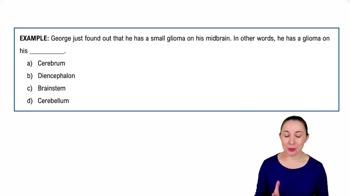
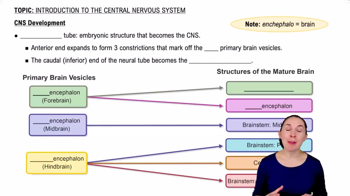
Cerebrum: higher mental functions; Diencephalon: processes and relays info; Cerebellum: coordinates movement; Brainstem: controls involuntary processes.
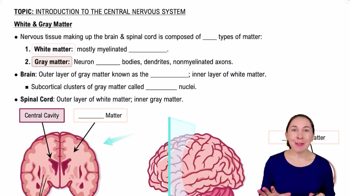
White matter contains myelinated axons; Gray matter contains neuron cell bodies, dendrites, and unmyelinated axons.
Gyri are ridges, Sulci are shallow grooves, and Fissures are deep grooves separating lobes and hemispheres.
Frontal, Parietal, Temporal, Occipital, and Insula lobes each have distinct sensory, motor, and association functions.
Located in the precentral gyrus of the frontal lobe; plans and executes voluntary movement.
Responsible for language production. Damage causes expressive aphasia, where speech is nonfluent but comprehension is intact.
Located in the postcentral gyrus of the parietal lobe; interprets somatic sensory stimuli like touch and temperature.
Involved in spatial awareness and attention. Damage can cause neglect syndrome, ignoring half of the visual field or body.
Responsible for language comprehension. Damage causes receptive aphasia, fluent but nonsensical speech and poor understanding.
Receives and processes visual input; located in the occipital lobe.
Involved in memory, learning, emotion, and behavior. Includes hippocampus, amygdala, cingulate gyrus.
Acts as the main relay station for sensory and motor signals to the cerebral cortex; involved in consciousness and arousal.
Maintains homeostasis, regulates autonomic nervous system, endocrine system, sleep/wake cycle, hunger, thirst, and body temperature.
Epithalamus includes pineal gland producing melatonin; Subthalamus works with basal nuclei to control movement.
Coordinates voluntary movement and reduces motor error by integrating sensory input and motor commands.
Controls basic life functions like heart rate and breathing; mediates reflexes; includes midbrain, pons, and medulla oblongata.
Contains pyramids where motor fibers decussate; controls autonomic functions and houses cranial nerve nuclei.
Reticular formation regulates sleep, pain, mood, and motor functions; RAS arouses cerebral cortex and maintains alertness.
Cushions brain, maintains temperature, removes waste, and increases buoyancy to prevent brain damage from its own weight.
Formed by endothelial cells with tight junctions and astrocyte foot processes; protects brain by restricting passage of harmful substances.