 뒤로
뒤로Anatomy & Physiology: Chemistry and Molecular Biology Basics
 02:13
02:13
이 집합의 용어 (22)
Matter is anything that takes up space.
Elements are the simplest form of matter; 92 elements occur naturally.
Oxygen, carbon, hydrogen, and nitrogen are the most abundant elements in living organisms.
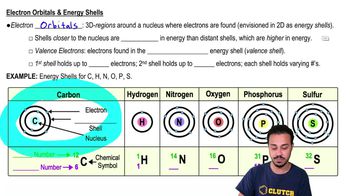
An atom has a nucleus containing protons and neutrons, with electrons orbiting in shells.
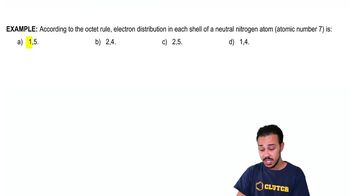
Protons have a positive charge, neutrons have no charge, and electrons have a negative charge.
Atomic number = number of protons; atomic mass = protons + neutrons.
Atoms form bonds by gaining, losing, or sharing electrons to fill their outer shells.
First shell holds 2 electrons; outer shells hold up to 8 electrons.
An ionic bond forms when oppositely charged ions attract after atoms gain or lose electrons.
A covalent bond forms when atoms share electrons: single (2 electrons), double (4 electrons), triple (6 electrons).
A molecule is two or more atoms combined; a compound is a molecule with different elements.
pH measures hydrogen ion concentration; 7 is neutral, below 7 acidic, above 7 basic.
Acids release hydrogen ions (H+); bases release ions that combine with hydrogen ions.
Water is the most abundant compound, a solvent, helps transport materials, and participates in metabolic reactions.
Carbohydrates provide energy and are made of carbon, hydrogen, and oxygen.
Lipids are fats, phospholipids, and steroids; they supply energy and form cell structures.
Saturated fats have no double bonds; unsaturated fats have one or more double bonds in fatty acid chains.
Proteins perform many functions; built from amino acids with amino, acid, and R groups.
Protein shape can be altered by pH, temperature, radiation, or chemicals, called denaturation.
Nucleic acids store genetic info and aid protein synthesis; DNA (double-stranded) and RNA (single-stranded).
Adenine pairs with Thymine; Cytosine pairs with Guanine.
Adenine pairs with Uracil; Cytosine pairs with Guanine.