 뒤로
뒤로Anatomy & Physiology: Chemistry of Life and Biochemistry Basics
 02:13
02:13
이 집합의 용어 (31)
Matter is anything that has mass and occupies space.
Solid, liquid, and gas.
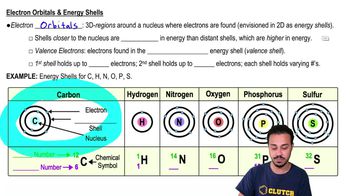
An atom is the smallest unit of matter that retains the properties of an element.
Protons carry a positive charge, neutrons are neutral, and electrons carry a negative charge.
First shell holds 2 electrons, second shell holds 8 electrons, third shell can hold more but is satisfied with 8 electrons.
The atomic number, or the number of protons in the nucleus, defines an element.
Oxygen, carbon, hydrogen, and nitrogen.
An isotope is an atom with the same atomic number and number of protons but different mass number due to varying neutrons.
A mixture is a physical combination of two or more substances where each retains its own properties.
A molecule is two or more atoms chemically bonded; a compound is a molecule with atoms of different elements.
Atoms tend to form bonds to have eight electrons in their valence shell, achieving stability.
An ionic bond forms when electrons are transferred from a metal to a nonmetal, creating cations and anions attracted by opposite charges.
A cation is a positively charged ion; an anion is a negatively charged ion.
A covalent bond forms when two or more nonmetals share electrons.
Nonpolar bonds share electrons equally; polar bonds share electrons unequally due to different electronegativities.
Hydrogen bonds are weak attractions between the partially positive end of one dipole and the partially negative end of another.
Energy is the capacity to do work or cause change, involved when bonds are formed or broken.
Potential energy is stored energy; kinetic energy is energy in motion.
Endergonic reactions absorb energy; exergonic reactions release energy.
Catabolic (decomposition), anabolic (synthesis), and exchange reactions.
Activation energy is the energy required to start a chemical reaction by overcoming electron repulsion.
Increased concentration, higher temperature, smaller particle size, and presence of catalysts.
Enzymes are protein catalysts that lower activation energy and increase reaction rates without being consumed.
An acid releases hydrogen ions (H+) in solution; a base accepts hydrogen ions or releases hydroxide ions (OH-).
The pH scale ranges from 0 to 14; 7 is neutral, below 7 is acidic, above 7 is basic (alkaline).
A buffer stabilizes pH by neutralizing excess acids or bases.
A salt is a compound of metal cations and nonmetal anions held by ionic bonds; when dissolved, it forms electrolytes that conduct electricity.
Dehydration synthesis joins monomers by removing water; hydrolysis breaks polymers by adding water.
Monosaccharides, fatty acids, amino acids, and nucleotides respectively.
A nucleotide consists of a sugar, a phosphate group, and a nitrogenous base.
Adenine pairs with thymine (A = T) and cytosine pairs with guanine (C ≡ G) via hydrogen bonds.