 뒤로
뒤로Anatomy & Physiology: Chemistry of Life
 02:13
02:13
이 집합의 용어 (30)
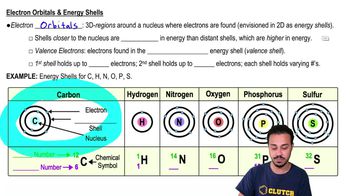
An atom is the smallest unit of matter that retains its original properties.
Protons (positive charge), neutrons (no charge), and electrons (negative charge).
Because the number of protons equals the number of electrons.
An element is defined by the number of protons in its atomic nucleus, called the atomic number.
Oxygen (65%), Carbon (18%), Hydrogen (10%), Nitrogen (3%).
An atom with the same number of protons but a different number of neutrons.
An unstable isotope that releases energy as radiation.
An energy relationship or attractive force between atoms.
Atoms are most stable with 8 electrons in their valence shell.
Electrons are transferred between a metal and a nonmetal, forming charged ions that attract each other.
Electrons are shared between two or more nonmetal atoms; it is the strongest type of chemical bond.
Nonpolar bonds share electrons equally; polar bonds share electrons unequally, creating partial charges.
Weak attractions between partially positive and partially negative atoms in polar molecules.
Hydrogen bonds between water molecules create a 'web' of molecular connections at air-water interfaces.
Any process where chemical bonds are formed, broken, or rearranged.
Increased concentration, higher temperature, smaller particle size, and presence of catalysts (enzymes).
Enzymes lower activation energy and speed up reactions without being consumed.
Enzymes change shape to fit the substrate when binding, facilitating the reaction.
Acids donate hydrogen ions; bases accept hydrogen ions.
The negative logarithm of hydrogen ion concentration; below 7 is acidic, 7 is neutral, above 7 is basic.
A chemical system that resists changes in pH by neutralizing added acids or bases.
Monomers are single subunits; polymers are large molecules made of many monomers linked together.
Organic compounds made of C, H, O with a 1:2:1 ratio; primarily function as fuel.
Nonpolar, hydrophobic organic compounds including fats, oils, phospholipids, and steroids; function as fuel and membrane components.
Three fatty acids linked to a glycerol molecule; storage form of fatty acids.
Composed of glycerol, two fatty acids, and a phosphate group; main structural component of cell membranes.
Made of C, H, O, N; monomers are amino acids; proteins perform structural, enzymatic, and many other functions.
Loss of protein shape due to heat, pH changes, or chemicals, causing loss of function.
Genetic material made of nucleotides, which consist of a nitrogenous base, five-carbon sugar, and phosphate group.
Adenosine triphosphate is the main energy currency of the cell, providing energy for cellular processes.