 뒤로
뒤로Anatomy & Physiology Comprehensive Final Exam Study Guide
 05:04
05:04
이 집합의 용어 (30)
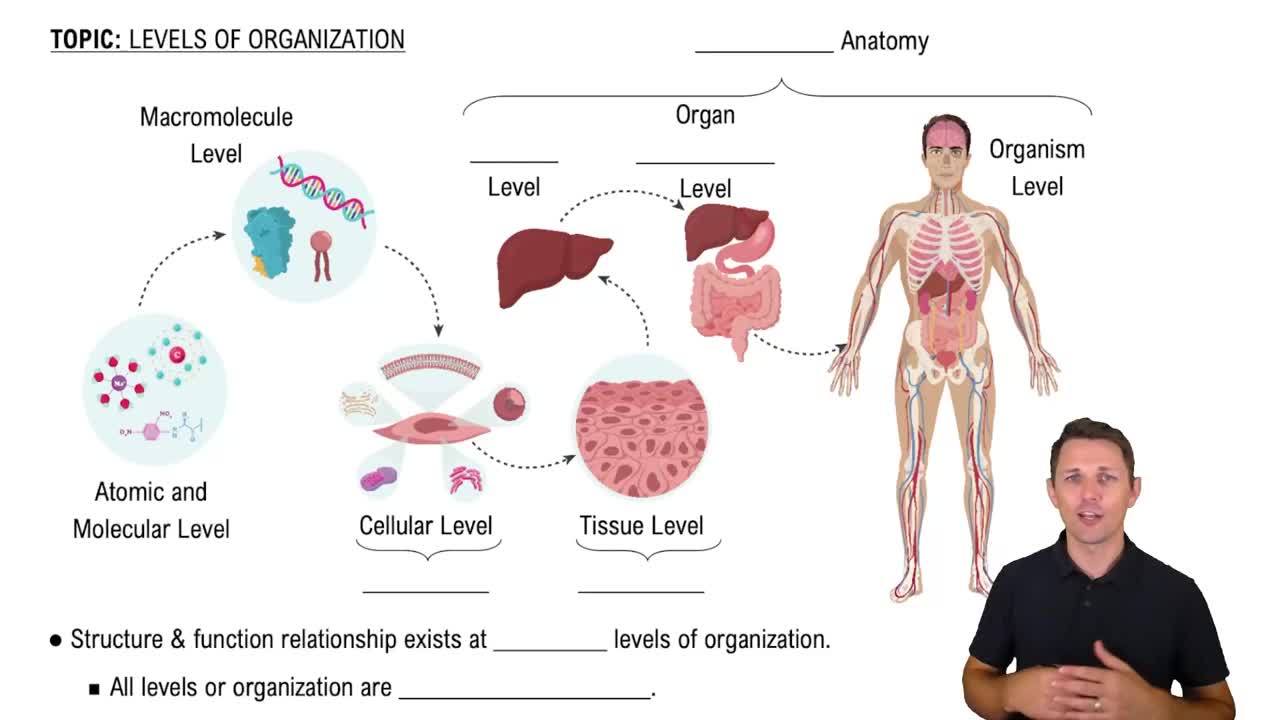
From simplest to most complex: Atoms, Molecules, Organelles, Cells, Tissues, Organs, Organ systems, Organism.
Superior vs Inferior, Anterior vs Posterior, Medial vs Lateral, Proximal vs Distal, Superficial vs Deep.
Sagittal divides left and right, Midsagittal divides equally, Frontal (Coronal) divides front and back, Transverse divides top and bottom.
Dorsal cavity: Cranial and vertebral cavities. Ventral cavity: Thoracic, abdominal, and pelvic cavities with respective organs.
Homeostasis maintains stable internal conditions. Negative feedback reverses changes (e.g., body temperature). Positive feedback amplifies changes (e.g., childbirth).
Carbohydrates, Lipids, Proteins, and Nucleic Acids with their key functions and examples.
Dehydration synthesis builds larger molecules by removing water. Hydrolysis breaks molecules apart by adding water.
ATP is the immediate energy source powering cellular work.
Composed of a phospholipid bilayer, membrane proteins, cholesterol, and glycoproteins.
Diffusion: movement down concentration gradient. Facilitated diffusion: uses transport proteins. Osmosis: water moves toward higher solute concentration. Active transport: requires ATP and protein pumps.
Hypotonic: lower solute concentration outside cell. Isotonic: equal solute concentration. Hypertonic: higher solute concentration outside cell.
Include nucleus, rough and smooth ER, Golgi apparatus, lysosomes, peroxisomes, and mitochondria.
Phase where DNA replication, protein synthesis, and cell growth occur. Cytokinesis does NOT occur during interphase.
Epithelial, Connective, Muscle, and Nervous tissues with distinct functions and characteristics.
Types include simple squamous, simple cuboidal, simple columnar, stratified squamous, pseudostratified, and transitional, classified by shape and layers.
Skeletal: voluntary, striated, multinucleated. Cardiac: involuntary, striated, intercalated discs. Smooth: involuntary, non-striated, dense bodies.
Include hypothalamus, pituitary, thyroid, parathyroid, adrenal, pancreas, and pineal.
Hormones travel through blood, target cells must have receptors, and hormones alter cellular activity.
Frontal lobe: voluntary movement. Parietal lobe: somatic sensation. Temporal lobe: auditory cortex and hearing. Occipital lobe: vision.
Three layers: dura mater, arachnoid mater, and pia mater. Spaces include subdural and subarachnoid.
Includes receptor, sensory neuron, integration center, motor neuron, and effector. Types: monosynaptic and polysynaptic.
Resting membrane potential, depolarization, repolarization, and hyperpolarization involving sodium and potassium channels.
Myelination increases speed. Larger axon diameter also increases conduction velocity.
Cornea, sclera, choroid, retina, macula, fovea centralis, optic disc, lens, iris, and pupil with their functions.
External, middle, and inner ear. Key parts: ossicles, cochlea, organ of Corti, semicircular canals, scala vestibuli, and scala tympani. Hearing vs equilibrium.
Hierarchy: muscle → fascicle → muscle fiber → myofibril → sarcomere.
Includes Z discs, actin, myosin, A band, I band, H zone, and M line.
Muscle contraction occurs as actin filaments slide over myosin filaments, shortening the sarcomere.
Endomysium surrounds muscle fibers, perimysium surrounds fascicles, and epimysium surrounds entire muscle.
Tendons connect muscle to bone, ligaments connect bone to bone, and aponeuroses are broad, flat tendinous sheets.