What are local hormones and how do autocrine and paracrine signaling differ?
Local hormones act near the site of release. Autocrine signals affect the same cell that released them, while paracrine signals affect nearby cells.
Compare endocrine and exocrine glands.
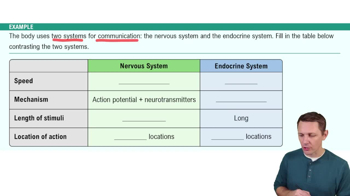
Endocrine glands secrete hormones directly into the bloodstream; exocrine glands release substances through ducts to an epithelial surface.
Where are hormone receptors located on target cells?
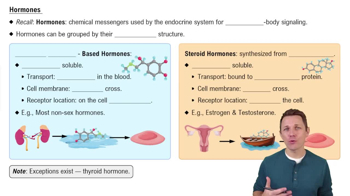
Receptors can be on the cell membrane for water-soluble hormones or inside the cytoplasm or nucleus for lipid-soluble hormones.
What are the two main categories of hormones and their differences?
Peptide hormones are water-soluble, bind membrane receptors, and act quickly. Steroid hormones are lipid-soluble, bind intracellular receptors, and have longer-lasting effects.
What are the main types of stimuli for endocrine glands?
Endocrine glands are stimulated by humoral (blood chemical changes), neural (nerve signals), and hormonal (other hormones) stimuli.
Describe the origin, target, and function of Follicle Stimulating Hormone (FSH).
FSH comes from gonadotropic cells of the anterior pituitary, targets the gonads, and stimulates follicle growth and oocyte maturation.
What are the two regions of the pituitary gland and their differences?
The anterior pituitary produces and secretes hormones; the posterior pituitary stores and releases hormones made by the hypothalamus.
How does the hypothalamus communicate with the anterior pituitary?
Via the hypophyseal portal system, a network of blood vessels that transports releasing and inhibiting hormones.
Which hormones are released by the posterior pituitary?
The posterior pituitary releases oxytocin and antidiuretic hormone (ADH).
What is the relationship between parathyroid hormone (PTH) and vitamin D?
PTH increases blood calcium and stimulates vitamin D activation, which enhances calcium absorption in the intestines.
Which hormone secretion is influenced by light exposure?
Melatonin secretion by the pineal gland is regulated by light, affecting circadian rhythms.
What are the primary functions of blood?
Blood transports gases, nutrients, wastes, hormones; regulates temperature and pH; and protects via clotting and immune responses.
Name the main dissolved plasma proteins and their functions.
Albumins maintain osmotic pressure, globulins transport and immune functions, and fibrinogen is essential for clotting.
How does the structure of red blood cells (RBCs) support their function?
RBCs are biconcave and lack nuclei, increasing surface area for oxygen transport and flexibility to pass through capillaries.
Where do blood cells form during embryonic development and in adults?
In embryos, blood cells form in the yolk sac, liver, and spleen; in adults, they form in red bone marrow.
What is the stem cell for red blood cells and the process leading to erythrocytes?
The hemocytoblast differentiates through stages to become an erythrocyte via erythropoiesis.
Define diapedesis.
Diapedesis is the process where white blood cells move through blood vessel walls to reach tissues.
What are the main types of white blood cells and their functions?
Neutrophils fight bacteria, eosinophils combat parasites, basophils release histamine, lymphocytes mediate immunity, and monocytes become macrophages.
What is the difference between chronic and acute leukemia?
Chronic leukemia progresses slowly with mature cells; acute leukemia progresses rapidly with immature cells.
What are the key events in blood coagulation and platelet plug formation?
Platelet adhesion, activation, and aggregation form a plug; coagulation involves a cascade producing fibrin to stabilize the clot.
Where are antigens and antibodies located in blood typing?
Antigens are on the surface of red blood cells; antibodies are in the plasma.
What are the antigen/antibody combinations for ABO blood types?
Type A has A antigens and anti-B antibodies; B has B antigens and anti-A antibodies; AB has both antigens and no antibodies; O has no antigens and both antibodies.
What is the universal donor and universal recipient blood type?
Universal donor is O negative; universal recipient is AB positive.
 뒤로
뒤로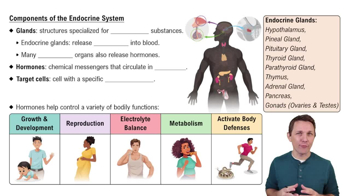
 7:06
7:06