뒤로

Anatomy & Physiology Exam 1 Brain and Nervous System Review

컨트롤 버튼이 '내비게이션' 모드로 변경되었습니다.
1/29
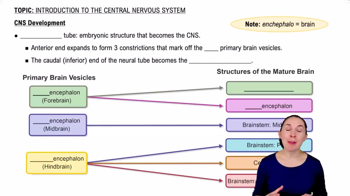
  • How does embryonic development explain adult brain structure?

    Folding during development determines the complex structure of the adult brain.
  • Name the major regions of the adult brain.

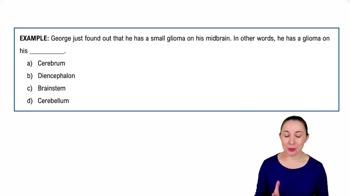
    The major regions are the cerebral hemispheres, diencephalon, brain stem, and cerebellum.
  • What are the ventricles of the brain?

    The ventricles are fluid-filled cavities within the brain that include the lateral ventricles, third ventricle, and fourth ventricle.
  • What are the components of the cerebral hemispheres?

    The cerebral hemispheres consist of the cortex, white matter, and basal nuclei.
  • List the major lobes of the cerebral cortex.

    The major lobes are frontal, parietal, temporal, and occipital lobes.
  • What is lateralization of cortical function?

    Lateralization refers to the specialization of each hemisphere for certain functions, such as language in the left hemisphere.
  • Differentiate between commissures, association fibers, and projection fibers.

    • Commissures connect corresponding areas of the two hemispheres.
    • Association fibers connect areas within the same hemisphere.
    • Projection fibers connect the cortex with lower brain or spinal cord centers.
  • What structures make up the diencephalon?

    The diencephalon includes the thalamus, hypothalamus, and epithalamus.
  • What is the function of the thalamus?

    The thalamus acts as a relay station for sensory information going to the cerebral cortex.
  • Name the three major regions of the brain stem.

    The midbrain, pons, and medulla oblongata.
  • What is the primary function of the cerebellum?

    The cerebellum adjusts motor output to ensure coordination and balance.
  • Where is the limbic system located and what is its role?

    The limbic system spans multiple brain structures and is involved in emotion, memory, and motivation.
  • What is EEG and what are the main brain wave types?

    EEG measures electrical activity of the brain. Main waves: alpha, beta, theta, and delta.
  • How is the brain protected?

    Protection is provided by bone (skull), meninges, cerebrospinal fluid, and the blood-brain barrier.
  • How is cerebrospinal fluid (CSF) formed and circulated?

    CSF is formed by the choroid plexus and circulates through the ventricles, central canal, and subarachnoid space.
  • What is the general structure of the spinal cord?

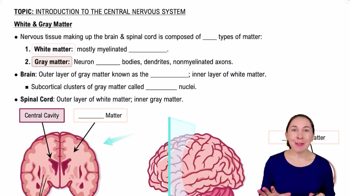
    The spinal cord has a central canal, gray matter (butterfly-shaped), and surrounding white matter.
  • How are sensory receptors classified?

    By stimulus type detected, body location, and structural complexity.
  • What are the components of a nerve?

    A nerve is a bundle of axons enclosed by connective tissue layers: endoneurium, perineurium, and epineurium.
  • What is a ganglion?

    A ganglion is a cluster of neuron cell bodies located outside the central nervous system.
  • What are the 12 pairs of cranial nerves?

    The 12 pairs are: I Olfactory, II Optic, III Oculomotor, IV Trochlear, V Trigeminal, VI Abducens, VII Facial, VIII Vestibulocochlear, IX Glossopharyngeal, X Vagus, XI Accessory, XII Hypoglossal.
  • What is a spinal nerve plexus?

    A plexus is a network of intersecting spinal nerves that redistribute fibers to peripheral nerves.
  • What are the components of a reflex arc?

    Receptor, sensory neuron, integration center, motor neuron, and effector.
  • How does the autonomic nervous system (ANS) differ from the somatic nervous system?

    The ANS can stimulate or inhibit effectors and controls involuntary functions, while the somatic system controls voluntary muscle movement.
  • What are the two divisions of the ANS?

    The parasympathetic and sympathetic divisions.
  • Where do parasympathetic fibers originate?

    Parasympathetic fibers originate in the craniosacral regions of the CNS.
  • Where do sympathetic fibers originate?

    Sympathetic fibers originate in the thoracolumbar regions of the CNS.
  • What neurotransmitters are used by the ANS?

    Acetylcholine and norepinephrine are the major neurotransmitters.
  • How do the sympathetic and parasympathetic divisions interact?

    They usually produce opposite effects on organs like the heart, lungs, and gastrointestinal tract.
  • Which brain region controls the autonomic nervous system?

    The hypothalamus oversees ANS activity.