 뒤로
뒤로Anatomy & Physiology Final Review Flashcards
 0:50
0:50
이 집합의 용어 (28)
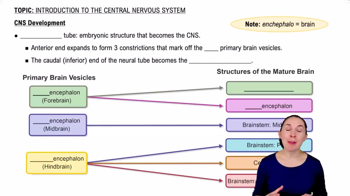
The nervous system is divided into the central nervous system (CNS) and the peripheral nervous system (PNS).
From outer to inner: dura mater (tough outer layer), arachnoid mater (web-like middle layer), and pia mater (delicate inner layer attached to spinal cord).
Spinal nerves are mixed nerves that carry motor, sensory, and autonomic signals between the spinal cord and the body.
Clusters of sensory neuron cell bodies located in the dorsal root of spinal nerves; they transmit sensory information to the CNS.
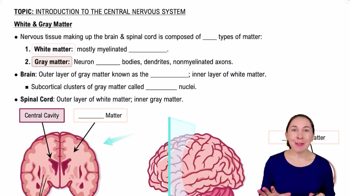
White matter is composed of myelinated axons; gray matter contains neuron cell bodies, dendrites, and unmyelinated axons.
A condition resulting from damage to peripheral nerves causing weakness, numbness, and pain, usually in the hands and feet.
Reflexes are classified by development (innate or acquired), response (somatic or visceral), complexity (monosynaptic or polysynaptic), and processing site (spinal or cranial).
Senses that detect touch, pressure, pain, temperature, vibration, and proprioception throughout the body.
Afferent pathways carry sensory information to the CNS; efferent pathways carry motor commands from the CNS to muscles or glands.
The somatic nervous system controls voluntary skeletal muscle movements; the autonomic nervous system regulates involuntary functions of smooth muscle, cardiac muscle, and glands.
Phasic receptors adapt quickly and detect changes in stimuli; tonic receptors adapt slowly and provide continuous information about stimulus intensity.
Both are located in the cerebral cortex: somatosensory cortex in the postcentral gyrus; motor cortex in the precentral gyrus.
Sympathetic prepares the body for 'fight or flight'; parasympathetic promotes 'rest and digest' functions.
Neurons located in autonomic ganglia that relay signals from preganglionic neurons to target organs.
Collateral ganglia are autonomic ganglia located anterior to the vertebral column; they serve abdominal and pelvic organs.
The five basic tastes are sweet, sour, salty, bitter, and umami (savory).
The retina contains photoreceptor cells (rods and cones) that detect light and convert it into neural signals.
The lens changes shape via ciliary muscles to focus light on the retina, a process called accommodation.
The endocrine system regulates body functions through hormones that control metabolism, growth, reproduction, and homeostasis.
A chemical messenger secreted by endocrine glands that travels through the bloodstream to target organs.
Peptide hormones are water-soluble and act on cell surface receptors; lipid hormones are lipid-soluble and act on intracellular receptors.
The hypothalamus controls the pituitary gland (endocrine) and regulates autonomic nervous system functions (neural).
The pituitary secretes hormones like growth hormone, ACTH, TSH, LH, FSH, prolactin, ADH, and oxytocin.
Blood consists of plasma (liquid), red blood cells, white blood cells, and platelets.
Red blood cells are formed in the red bone marrow of certain bones.
Blood types (A, B, AB, O) are determined by antigens on RBCs; antibodies in plasma react against foreign antigens.
Blood flows: vena cava → right atrium → right ventricle → pulmonary artery → lungs → pulmonary veins → left atrium → left ventricle → aorta.
Includes SA node (pacemaker), AV node, bundle of His, bundle branches, and Purkinje fibers to coordinate heartbeat.