 뒤로
뒤로Anatomy & Physiology: Histology and Tissue Types
 03:32
03:32
이 집합의 용어 (29)
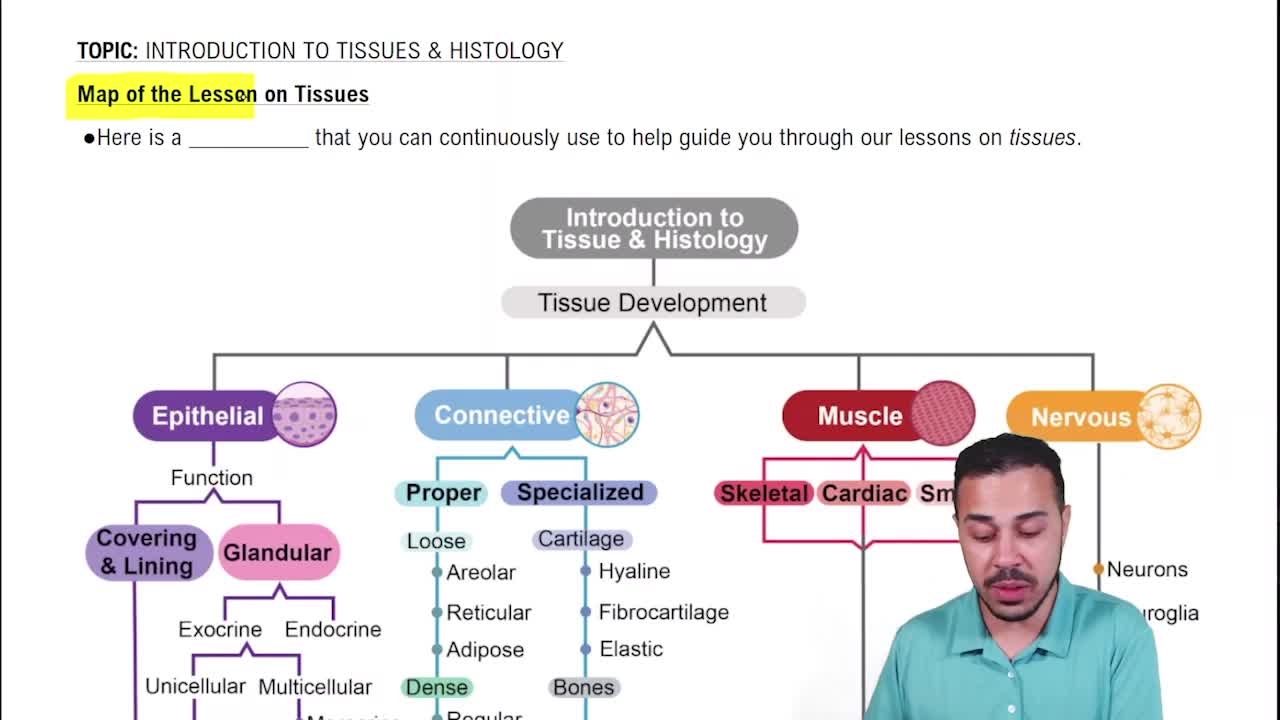
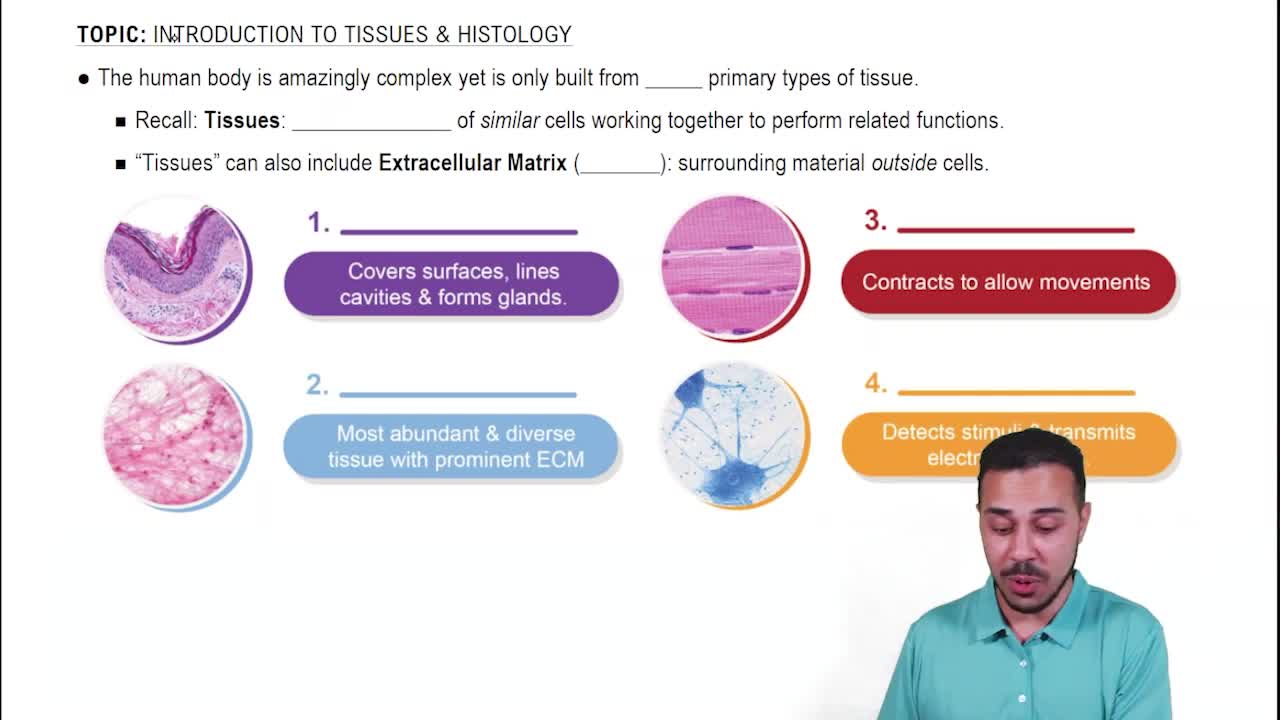
The four primary tissue classes are epithelial tissue, connective tissue, nervous tissue, and muscular tissue.
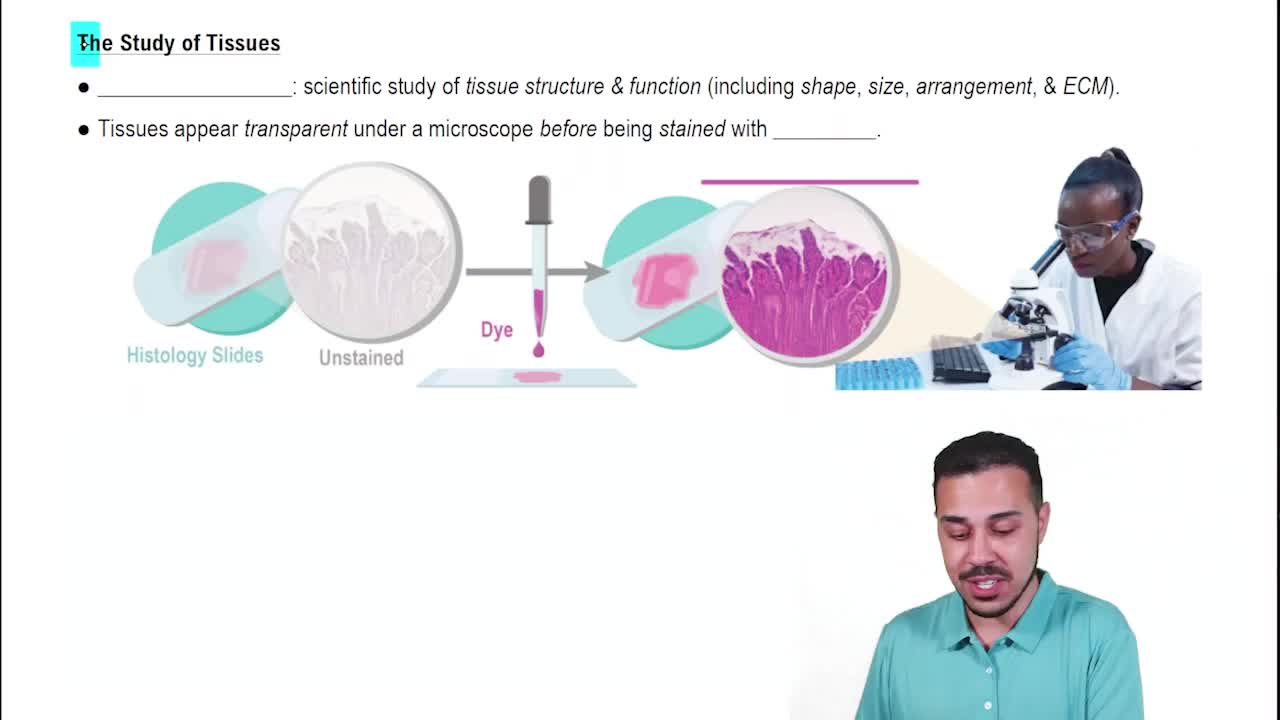
Histology is the study of tissues and how they are arranged into organs, also known as microscopic anatomy.
The basement membrane is a layer between epithelium and underlying connective tissue that anchors the epithelium and contains collagen, laminin, fibronectin, and heparin sulfate.
Simple epithelium has one cell layer with all cells touching the basement membrane; stratified epithelium has multiple layers with only the deepest layer touching the basement membrane.
Simple epithelia include simple squamous, simple cuboidal, simple columnar, and pseudostratified columnar epithelium.
It permits rapid diffusion or transport of substances and secretes serous fluid; found in alveoli, glomeruli, endothelium, and serosa.
Connective tissue has cells separated by extracellular matrix, is highly vascular, binds organs, supports and protects, and stores energy.
Fibrous connective tissue consists of cells (fibroblasts, macrophages, leukocytes, plasma cells, mast cells, adipocytes), fibers (collagenous, reticular, elastic), and ground substance.
Collagenous fibers are tough, flexible, and resist stretching; they are the most abundant protein in the body and found in tendons, ligaments, and skin.
Areolar tissue is loosely organized fibers with abundant blood vessels, found under all epithelia, surrounding blood vessels and nerves.
Adipose tissue is dominated by adipocytes storing triglycerides, providing energy storage, insulation, cushioning, and body contouring.
Cartilage has a flexible, rubbery matrix, no blood vessels, and chondrocytes in lacunae; types include hyaline, elastic, and fibrocartilage.
Hyaline cartilage provides a clear, glassy support, eases joint movement, holds airway open, and moves vocal cords.
Compact bone is arranged in osteons with concentric lamellae around central canals containing blood vessels and nerves; osteocytes occupy lacunae connected by canaliculi.
Formed elements include erythrocytes (red blood cells), leukocytes (white blood cells), and platelets (cell fragments involved in clotting).
Excitability is the ability to respond quickly to stimuli by changes in membrane potential, enabling nerve signal transmission and muscle contraction.
Skeletal muscle: voluntary, striated, multinucleated; Cardiac muscle: involuntary, striated, branched with intercalated discs; Smooth muscle: involuntary, nonstriated, fusiform cells.
Tight junctions are fused plasma membranes near the apical surface that seal cells together, preventing passage between cells.
Desmosomes are protein patches that hold cells together, resisting mechanical stress; hemidesmosomes anchor basal cells to the basement membrane.
Gap junctions are channels formed by connexons allowing ions and small molecules to pass directly between adjacent cells for communication.
Endocrine glands secrete hormones directly into the blood without ducts; exocrine glands secrete substances through ducts to body surfaces or cavities.
Exocrine glands can be simple (unbranched duct), compound (branched duct), and shaped as tubular, acinar, or tubuloacinar.
Merocrine: secretion by exocytosis; apocrine: secretion with some cytoplasm loss; holocrine: entire cell disintegrates to release secretion.
Membranes include cutaneous (skin), mucous (lines passages open to exterior), serous (lines body cavities), and synovial (lines joint cavities).
Hyperplasia: increase in cell number; hypertrophy: enlargement of existing cells; neoplasia: abnormal tissue growth forming tumors.
Metaplasia is the transformation of one mature tissue type into another, such as simple cuboidal epithelium changing to stratified squamous epithelium.
Stem cells are undifferentiated cells with potential to become specialized; types include totipotent, pluripotent, multipotent, and unipotent.
Regeneration replaces damaged cells with the same type restoring function; fibrosis replaces tissue with scar tissue, which does not restore function.
Apoptosis is programmed cell death, a normal process where cells die after completing their function to benefit the body.