 뒤로
뒤로Anatomy & Physiology Identification Study Guide 1
 05:04
05:04
이 집합의 용어 (28)
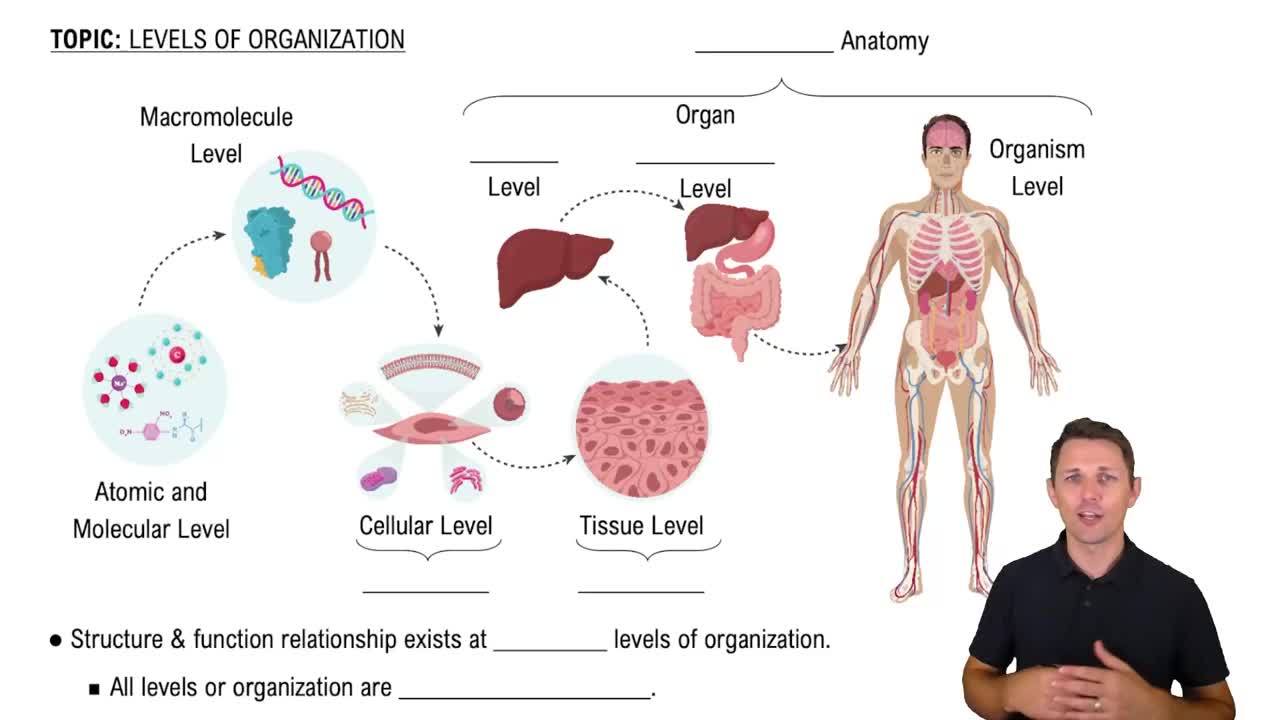
Order from smallest to largest: Chemical, Cellular, Tissue, Organ, Organ System, Organism.
Includes skin, hair, nails. Protects from friction and pathogens.
Includes bones and cartilage. Provides structure, support, and protects internal organs.
Includes skeletal muscles. Responsible for movement and posture.
Includes brain, spinal cord, nerves. Enables communication via electrical signals.
Includes thyroid, pituitary, adrenal glands. Provides slow communication using hormones.
Includes heart, blood vessels, blood. Transports oxygen, nutrients, waste, and hormones.
Process by which the body maintains stable internal conditions.
Breaks down complex molecules into simpler ones, releasing energy.
Builds complex molecules from simpler ones, requiring energy.
Lower solute concentration outside cell → water moves in → cell swells.
Higher solute concentration outside cell → water moves out → cell shrinks.
Same solute concentration inside and outside → no net water movement.
Movement of molecules from higher to lower concentration.
Diffusion of water across a selectively permeable membrane.
"Cell eating" — engulfs large particles or solids.
Has ribosomes on surface; synthesizes proteins.
Lacks ribosomes; involved in lipid synthesis, detoxification, and calcium storage.
Stack of flattened sacs; modifies and packages proteins and lipids.
Generates ATP through cellular respiration; known as the "powerhouse" of the cell.
Control center of the cell; contains genetic material.
Tiny finger-like projections that increase surface area for absorption.
Short hair-like projections that move in coordinated waves to move substances.
Toward the head or above.
Toward the feet or below.
Divides the body into left and right parts.
Divides the body into front and back parts.
Divides the body into upper and lower parts.