 뒤로
뒤로Anatomy & Physiology II Key Concepts
 7:06
7:06
이 집합의 용어 (29)
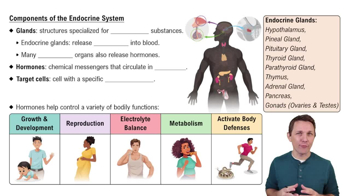
A chemical messenger secreted by endocrine glands, transported by the bloodstream to target organs to regulate physiology and behavior.
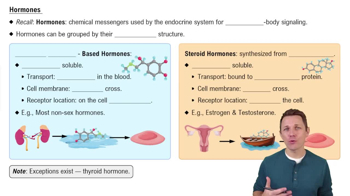
Steroid hormones are lipid-soluble and act via direct gene activation; non-steroid hormones are water-soluble and act via second messenger systems.
Hormone binds to a cell membrane receptor, activating intracellular signaling cascades such as cAMP to elicit a cellular response.
Steroid hormones cross the cell membrane, bind intracellular receptors, and directly influence gene transcription.
Two or more hormones produce the same effect on a target cell, amplifying the overall response.
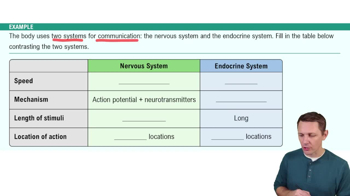
One hormone opposes the action of another, such as insulin opposing glucagon.
Most common feedback mechanism where hormone levels regulate their own secretion to maintain homeostasis, e.g., thyroid hormone regulation.
Feedback mechanism that amplifies a response, such as oxytocin release during childbirth.
Includes neural (nerve fibers), hormonal (hormones stimulating glands), and humoral (blood ion/nutrient levels) stimuli.
Includes growth hormone, TSH, ACTH, FSH, LH, and prolactin, regulated by hypothalamic releasing and inhibiting hormones.
Oxytocin and antidiuretic hormone (ADH), stored and released from the posterior pituitary.
Produces thyroid hormones T3 and T4, which regulate metabolism, and calcitonin, which lowers blood calcium levels.
Secreted by parathyroid glands to increase blood calcium levels by stimulating bone resorption and calcium absorption.
Produces mineralocorticoids (aldosterone), glucocorticoids (cortisol), and gonadocorticoids (estrogen, testosterone).
Secretes epinephrine and norepinephrine, which mediate the fight-or-flight response.
Insulin lowers blood glucose; glucagon raises blood glucose, both regulating energy metabolism.
\(CO=HR\times SV\) where CO is cardiac output, HR is heart rate, and SV is stroke volume.
\(BP=CO\times PR\) where BP is blood pressure, CO is cardiac output, and PR is peripheral resistance.
Transportation of gases, nutrients, wastes; regulation of pH and temperature; protection via immune response and clotting.
Includes erythrocytes (RBCs), leukocytes (WBCs), and thrombocytes (platelets).
Formation of blood cells in red bone marrow.
Production of red blood cells stimulated by erythropoietin (EPO) from the kidneys.
Oxyhemoglobin is hemoglobin bound to oxygen; deoxyhemoglobin is hemoglobin without oxygen.
Blood types determined by presence of A and/or B antigens; antibodies are anti-A and anti-B.
Rh incompatibility between mother and fetus can cause hemolytic disease of the newborn.
Maintains fluid balance, absorbs fats, and provides immune defense.
Pulmonary ventilation, external respiration, transport of gases, and internal respiration.
Functional unit of the kidney responsible for filtration, reabsorption, and secretion during urine formation.
Regulates blood pressure via the renin-angiotensin-aldosterone system.