 뒤로
뒤로Anatomy & Physiology: Joints and Movements
 04:06
04:06
이 집합의 용어 (31)
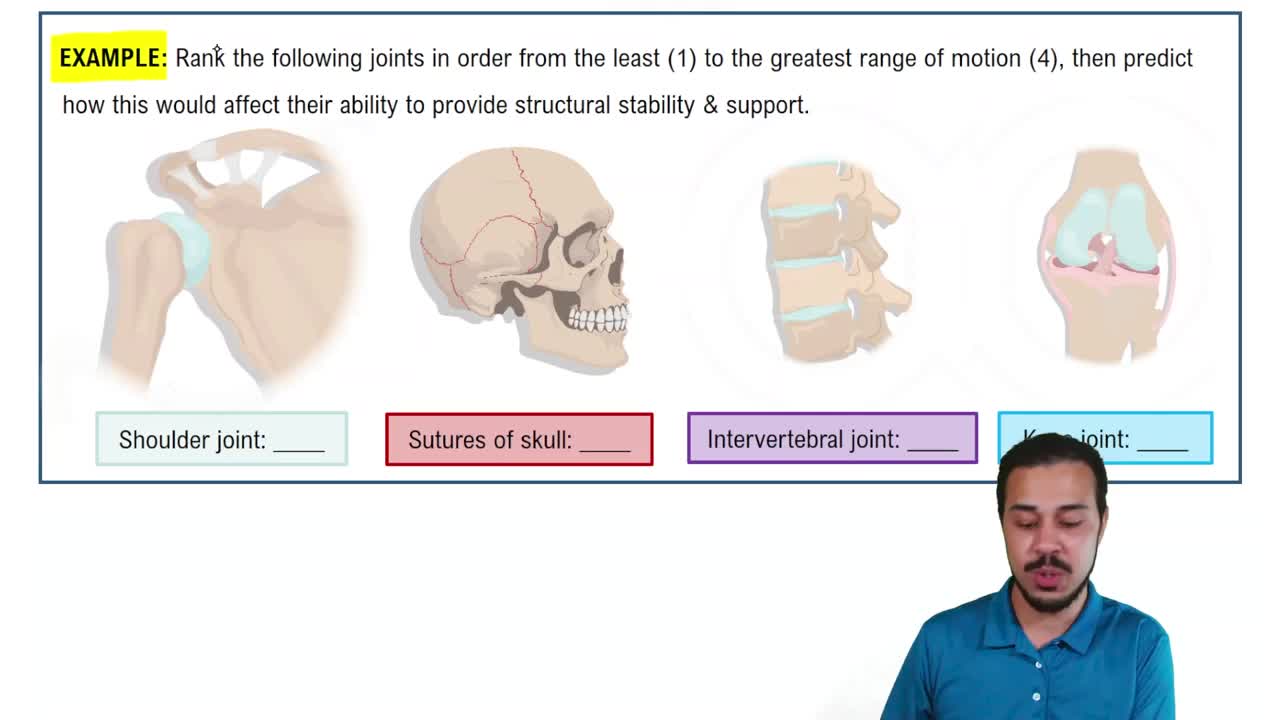
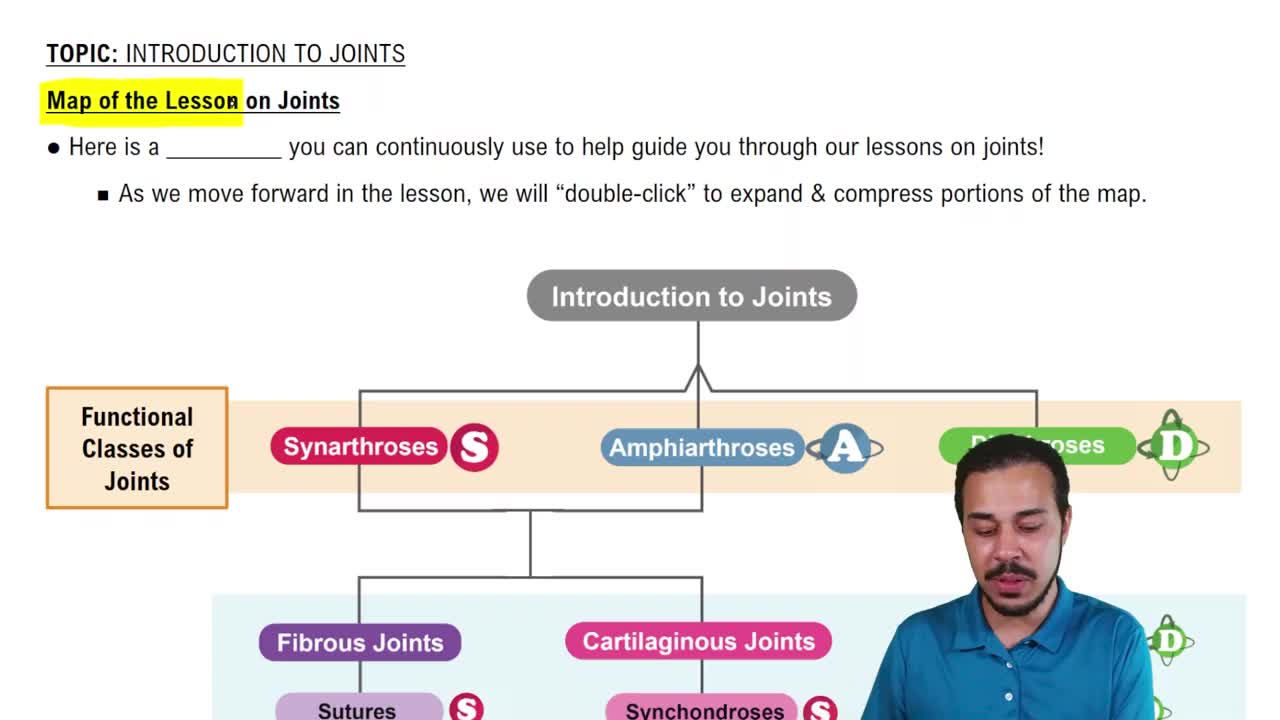
A suture is a fibrous joint found between skull bones, characterized by interlocking junctions filled with dense connective tissue fibers. It is immovable and fuses in middle age to form synostoses.
A syndesmosis is a fibrous joint where bones are connected by a ligament, allowing slight to no movement. Examples include the tibia-fibula and radius-ulna connections.
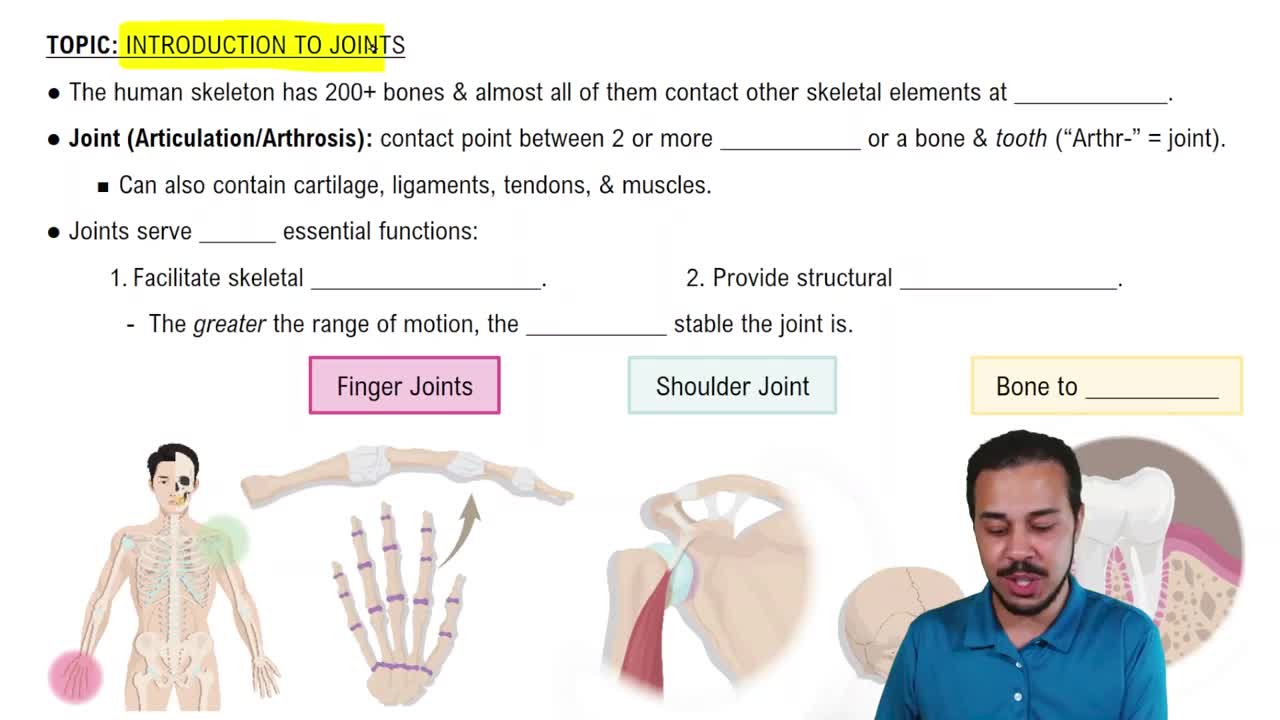
A gomphosis is a peg-in-socket fibrous joint between a tooth and its alveolar socket, connected by a short periodontal ligament.
Synchondroses are cartilaginous joints united by hyaline cartilage, are immovable (synarthrotic), such as epiphyseal plates and the first rib-sternum joint.
Symphyses are cartilaginous joints with hyaline cartilage covering bone surfaces fused to a fibrocartilage pad, allowing slight movement (amphiarthrotic), e.g., intervertebral discs and pubic symphysis.
Synovial joints have a fluid-filled joint cavity separating articulating bones, are freely movable (diarthroses), and include most limb joints.
Synovial joints contain articular cartilage, a joint cavity, an articular capsule, synovial fluid, and reinforcing ligaments.
Bursae are fibrous sacs with synovial fluid that reduce friction where tissues rub. Tendon sheaths are elongated bursae wrapping around tendons.
Stability depends on articular surface shape, ligaments preventing excess motion, and muscle tone keeping tendons taut.
Origin is the muscle attachment to the immovable bone; insertion is the attachment to the movable bone.
Movements include nonaxial (slipping), uniaxial (one plane), biaxial (two planes), and multiaxial (all three planes).
Gliding is when flat bone surfaces slip over each other, e.g., intercarpal and intertarsal joints.
Flexion decreases the joint angle by bending; extension increases the joint angle by straightening.
Hyperextension is extension beyond the normal anatomical position, increasing the joint angle past straight.
Dorsiflexion is lifting the foot upwards; plantar flexion is pointing the foot downwards.
Abduction moves a limb away from the midline; adduction moves it toward the midline; circumduction moves the limb in a cone-shaped path.
Rotation is turning a bone around its own long axis, such as between the atlas and axis or in shoulder and hip joints.
Special movements include supination/pronation, inversion/eversion, protraction/retraction, elevation/depression, and opposition.
Plane joints have flat articular surfaces allowing only gliding movements and are nonaxial.
Hinge joints have a cylindrical bone fitting into a trough-shaped bone, allowing uniaxial flexion and extension, e.g., elbow and interphalangeal joints.
Pivot joints have a rounded bone protruding into a ring of bone or ligament, allowing uniaxial rotation, e.g., atlas-axis joint and proximal radioulnar joint.
Condyloid joints have oval articular surfaces fitting into complementary depressions, allowing biaxial angular movements, e.g., wrist and knuckle joints.
Saddle joints resemble condyloid joints but allow greater movement; each surface is concave and convex, e.g., thumb carpometacarpal joint.
Ball-and-socket joints have a spherical head fitting into a cuplike socket, allowing multiaxial movement, e.g., shoulder and hip joints.
The knee is the largest, most complex joint, allowing flexion, extension, and some rotation. It is a modified hinge with three joints in one cavity: femoropatellar and lateral/medial tibiofemoral joints.
Important structures include the quadriceps tendon, patellar ligament, fibular and tibial collateral ligaments, and anterior/posterior cruciate ligaments.
Shoulder stability is weak but maintained by a thin capsule, coracohumeral and glenohumeral ligaments, the tendon of the long head of biceps, and the rotator cuff tendons.
The hip joint is a ball-and-socket joint with a deep socket (acetabulum) and strong ligaments (iliofemoral, pubofemoral, ischiofemoral) providing stability and good range of motion.
Injuries include sprains (ligament tears), cartilage injuries (e.g., meniscus tears), and dislocations (bones forced out of alignment).
Bursitis is inflammation of bursae; tendonitis is inflammation of tendon sheaths, both causing pain and swelling, often treated with anti-inflammatory drugs.
Arthritis is joint inflammation causing pain and stiffness. Common types include osteoarthritis (wear-and-tear), rheumatoid arthritis (autoimmune), and gouty arthritis (uric acid crystal deposition).