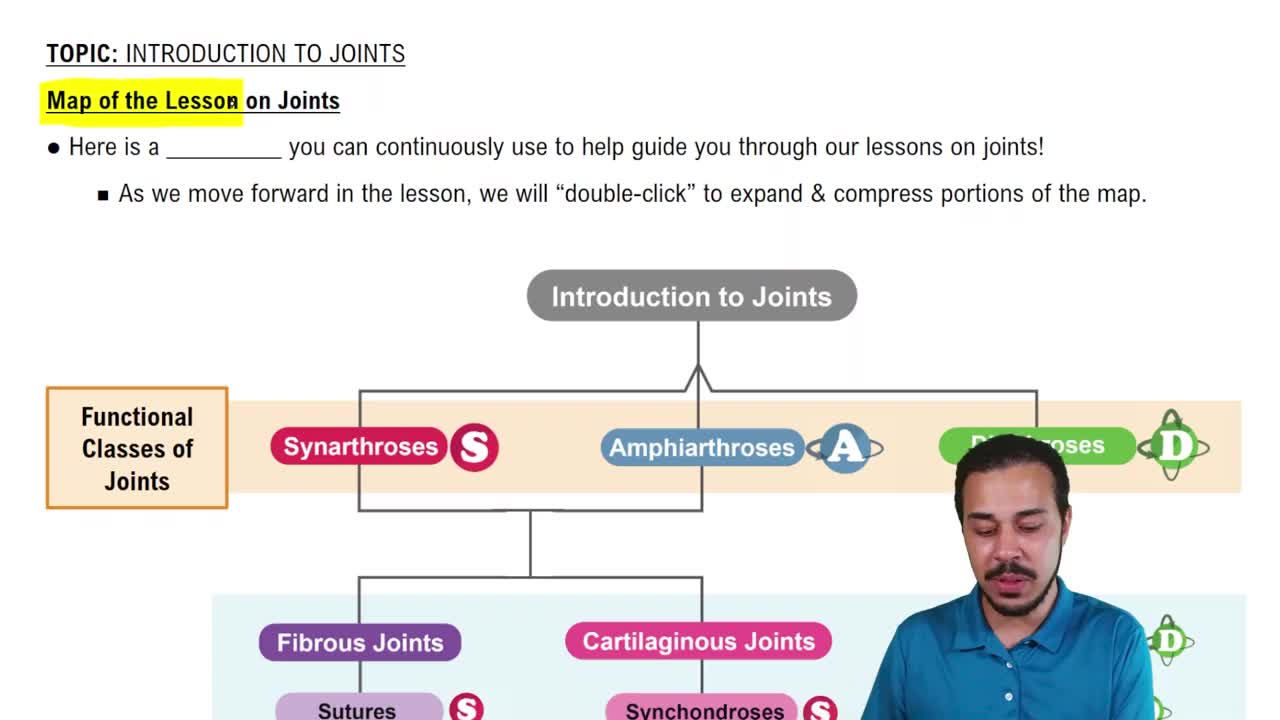
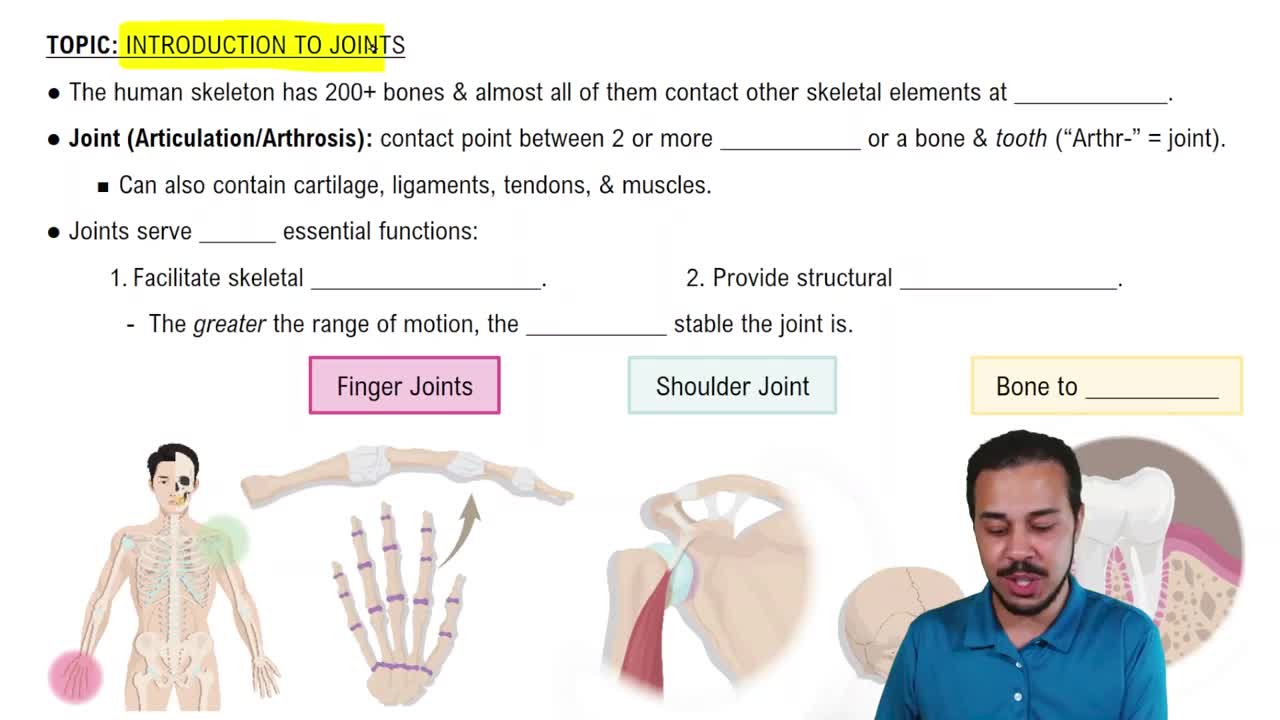
Articulations are joints where two bones connect, allowing body movement.
What determines the range of motion and strength of a joint?
The joint structure determines the direction and distance of movement (range of motion), and joint strength decreases as mobility increases.
What are the two main methods of classifying joints?
Joints are classified by function (range of motion) and structure (anatomical organization).
Name the three functional classifications of joints.
Synarthrosis (immovable), Amphiarthrosis (slightly movable), and Diarthrosis (freely movable).
What are the four structural classifications of joints?
Bony, Fibrous, Cartilaginous, and Synovial joints.
Describe a suture joint.
A suture is a fibrous synarthrotic joint where bones are interlocked and bound by dense connective tissue, found only in the skull.
What is a gomphosis joint?
A gomphosis is a fibrous joint where a tooth is bound to its socket by the periodontal ligament.
Define synchondrosis and give an example.
A synchondrosis is a rigid cartilaginous bridge between bones, such as the epiphyseal cartilage of long bones.
What is synostosis?
A synostosis is a bony fusion where two bones fuse and the joint disappears, like the metopic suture of the skull.
What characterizes amphiarthroses joints?
Amphiarthroses are slightly movable joints stronger than freely movable joints, connected by ligaments (syndesmosis) or fibrocartilage (symphysis).
What defines synovial joints (diarthroses)?
Synovial joints are freely movable joints at the ends of long bones, surrounded by a two-layered articular capsule lined with synovial membrane.
What is the function of articular cartilage in synovial joints?
Articular cartilage prevents bones from touching, provides smooth surfaces, and reduces friction for normal joint function.
List the three main functions of synovial fluid.
Lubrication, nutrient distribution, and shock absorption.
Name accessory structures found in synovial joints.
Accessory structures include cartilages (menisci), fat pads, ligaments, tendons, and bursae.
What is the role of ligaments in joints?
Ligaments support and strengthen joints by connecting bones and limiting excessive movement.
Describe the difference between a sprain and a dislocation.
A sprain is a ligament injury with torn collagen fibers; a dislocation is when articulating surfaces are forced out of position, damaging cartilage and ligaments.
What is gliding movement at synovial joints?
Gliding movement occurs when two flat surfaces slide past each other, such as between carpal bones.
Define flexion and extension movements.
Flexion reduces the angle between bones in the anterior-posterior plane; extension increases the angle.
What is circumduction?
Circumduction is a circular movement of a limb without rotation, combining flexion, extension, abduction, and adduction.
Explain the difference between medial and lateral rotation.
Medial rotation turns a bone toward the body's axis; lateral rotation turns it away.
What special movements occur at the foot and ankle?
Inversion twists the sole medially; eversion twists it laterally; dorsiflexion lifts toes; plantar flexion points toes downward.
What are the six structural types of synovial joints by shape?
Gliding, hinge, pivot, condylar, saddle, and ball-and-socket joints.
Describe the knee joint's main articulations.
The knee joint includes two femur-tibia articulations at the condyles and one between the patella and femur's patellar surface.
Name the seven major ligaments supporting the knee joint.
Patellar ligament, two popliteal ligaments, anterior and posterior cruciate ligaments, tibial collateral ligament, and fibular collateral ligament.
What is a slipped disc and a herniated disc?
A slipped disc is a bulge in the annulus fibrosus; a herniated disc is when the nucleus pulposus breaks through, pressing on nerves.
How does aging affect joints and bones?
Aging causes degenerative changes like osteoarthritis, reduces bone mass, weakens bones, and increases fracture risk.
What factors affect bone strength?
Age, physical stress, hormone levels, calcium and phosphorus balance, and genetic/environmental factors.
 뒤로
뒤로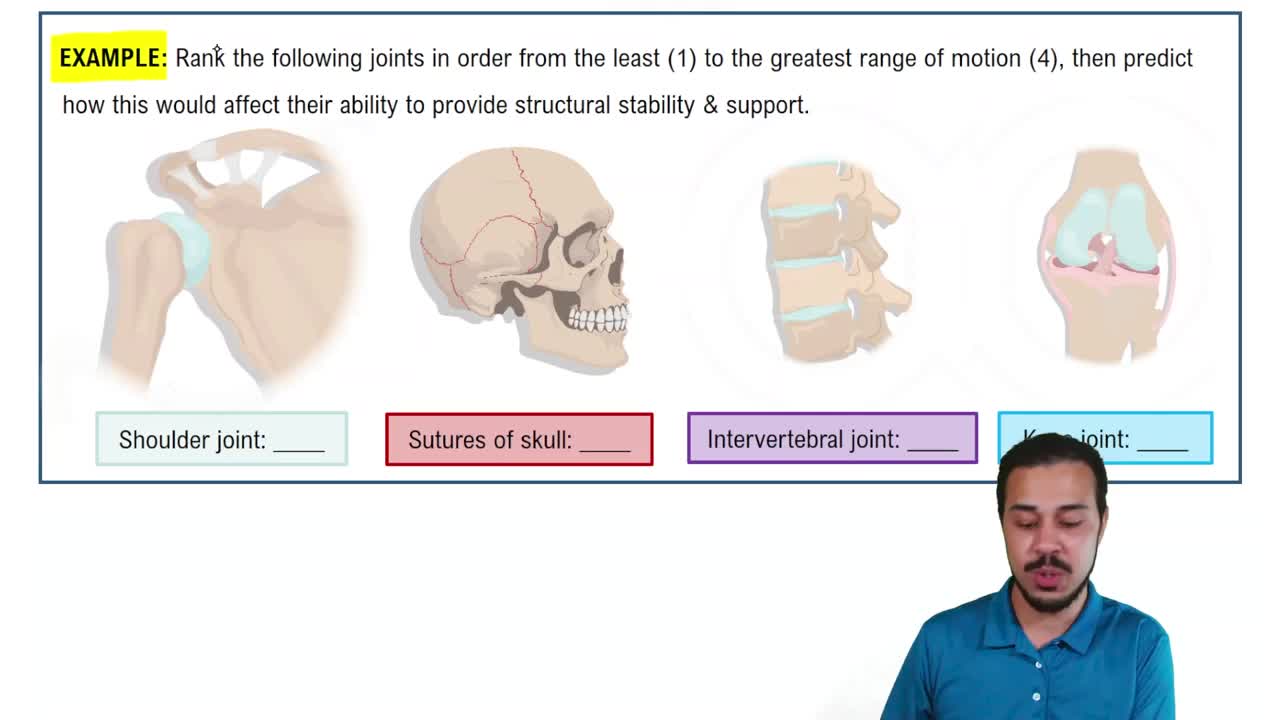
 04:06
04:06