 뒤로
뒤로Anatomy & Physiology Key Concepts
 03:00
03:00
이 집합의 용어 (30)
Toward the head; above. Example: The nose is superior to the mouth.
Away from the head; below. Example: The stomach is inferior to the heart.
Toward the front of the body. Example: The chest is anterior to the spine.
Toward the back of the body. Example: The spine is posterior to the heart.
Toward the midline of the body. Example: The nose is medial to the eyes.
Away from the midline of the body. Example: The ears are lateral to the nose.
Closer to the point of attachment. Example: The elbow is proximal to the wrist.
Farther from the point of attachment. Example: The fingers are distal to the elbow.
Toward the body surface. Example: The skin is superficial to the muscles.
Away from the body surface; internal. Example: The bones are deep to the skin.
Chemical → Cell → Tissue → Organ → Organ System → Organism. Similar cells form tissues; tissues combine to form organs; organs work together in systems.
Body standing upright, facing forward, head level, feet forward, arms at sides, palms facing forward, thumbs pointing away from body.
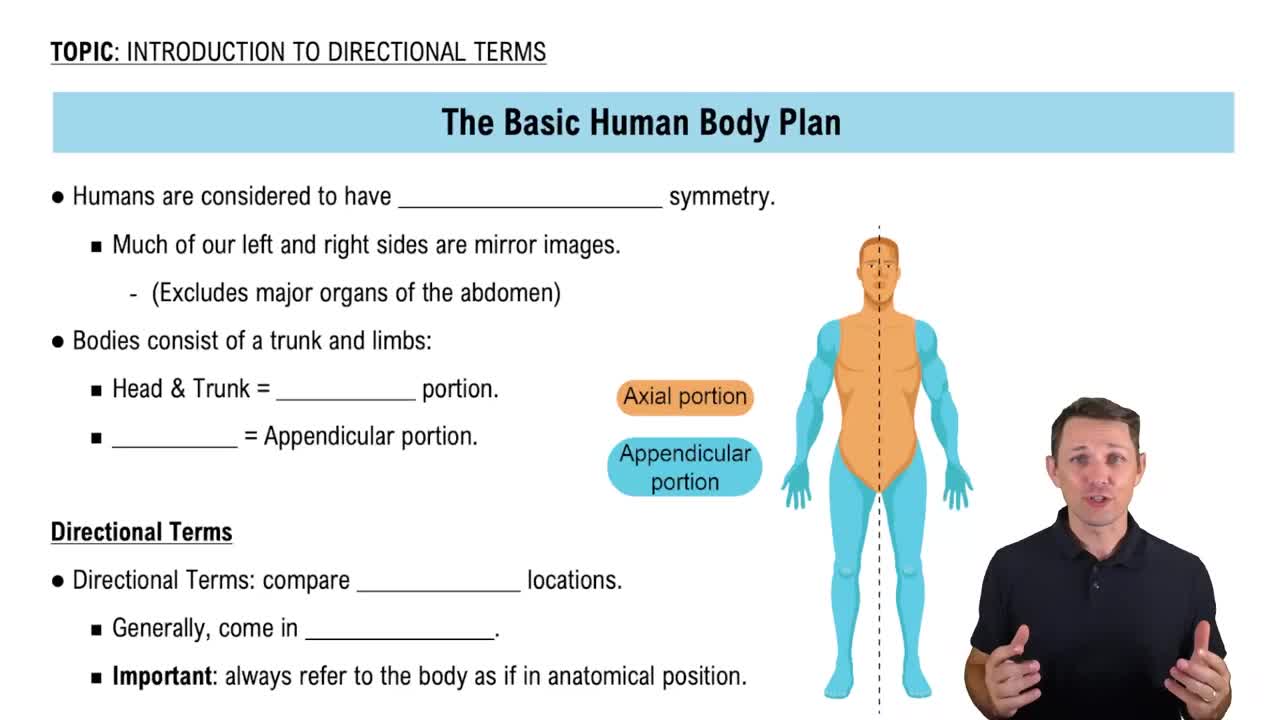
Axial: head, neck, trunk. Appendicular: upper and lower limbs (appendages).
Protection, vitamin D production, sensation. Includes skin, hair, nails, glands, and cutaneous receptors.
Divides body into right and left parts. Midsagittal divides equally.
Divides body into anterior (front) and posterior (back) parts.
Divides body into superior (top) and inferior (bottom) parts.
Dorsal cavity: cranial (brain) and vertebral (spinal cord). Ventral cavity: thoracic and abdominopelvic separated by diaphragm.
Parietal layer lines cavity wall; visceral layer covers organs. Examples: pleura (lungs), pericardium (heart), peritoneum (abdominopelvic organs).
Maintaining a relatively stable internal environment by detecting changes and responding to keep variables within normal ranges.
Epithelial (cover), Connective (connect), Muscle (move), Nervous (notify).
Classify by layers: simple (one), stratified (multiple), pseudostratified (appears layered). By shape: squamous (flat), cuboidal (cube), columnar (tall).
Consists of cells, fibers, and ground substance. More extracellular matrix than epithelial tissue.
Parallel collagen fibers for strong attachment in one direction, e.g., tendons and ligaments.
Smooth, glassy matrix providing support and cushioning at joints, ribs, nose, trachea, and larynx.
Skeletal: voluntary, striated, long fibers. Cardiac: involuntary, striated, branching. Smooth: involuntary, non-striated, spindle-shaped.
Communication, regulation, and control via neurons (signal transmission) and neuroglia (support).
Carpal = wrist, Brachial = arm, Coxal = hip, Femoral = thigh, Popliteal = back of knee, Occipital = back of head, Inguinal = groin, Sternal = breastbone.
Epidermis, dermis, hair shaft, hair follicle, sebaceous gland, sweat gland, arrector pili muscle (causes goosebumps).
1st degree: epidermis only. 2nd degree: epidermis + part of dermis. 3rd degree: full thickness of skin.