Skip to main content
Anatomy & Physiology
나의 코스
배우기
시험 준비
AI 튜터
학습 가이드
교과서적 해결책
플래시카드
탐험해 보세요
앱을 사용해 보세요
나의 코스
배우기
시험 준비
AI 튜터
학습 가이드
교과서적 해결책
플래시카드
탐험해 보세요
앱을 사용해 보세요
뒤로
Anatomy & Physiology: Muscle and Nervous System Study Guide
카드를 뒤집기 위해 탭할 수 있습니다.
Connective tissue layers of muscle from outside to inside
카드를 뒤집기 위해 탭할 수 있습니다.
👆
Connective tissue layers of muscle from outside to inside
Epimysium
surrounds entire muscle,
Perimysium
surrounds fascicles,
Endomysium
surrounds individual muscle fibers.
진행 상황 추적
컨트롤 버튼이 '내비게이션' 모드로 변경되었습니다.
1/30
추천 영상
8:11
Fascicle Arrangements
7312
views
148
rank
2:29
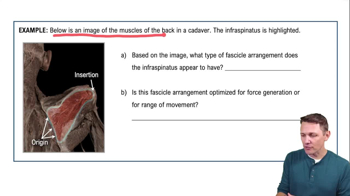
Fascicle Arrangements Example 1
5144
views
79
rank
이 집합의 용어 (30)
하이드의 정의
Connective tissue layers of muscle from outside to inside
Epimysium
surrounds entire muscle,
Perimysium
surrounds fascicles,
Endomysium
surrounds individual muscle fibers.
Types of fascicle arrangements
Parallel
: fibers run parallel (e.g., sartorius),
Pennate
: feather-like (uni-, bi-, multipennate),
Convergent
: broad origin to narrow insertion,
Circular
: surrounds openings (e.g., orbicularis oris).
Order of skeletal muscle organization from largest to smallest
Muscle → Fascicle → Muscle fiber (cell) → Myofibril → Sarcomere → Myofilaments.
Sarcomere regions and their filament composition
Z disc
: sarcomere boundary,
A band
: thick filaments,
I band
: thin filaments only,
H zone
: thick filaments only,
M line
: center of sarcomere.
What happens to sarcomere bands during muscle contraction?
I band
shortens,
H zone
shortens,
A band
stays the same length.
Main proteins in thick and thin filaments
Thick filament:
Myosin
. Thin filament:
Actin
,
Troponin
,
Tropomyosin
.
Role of tropomyosin and troponin in muscle contraction
Tropomyosin
blocks actin binding sites;
Troponin
binds calcium and moves tropomyosin to expose active sites.
Sequence of events in the sliding filament theory
Calcium released → binds troponin → tropomyosin moves → myosin binds actin → power stroke → ATP binds myosin → myosin detaches → ATP hydrolyzed → head resets.
Why is ATP needed in muscle contraction?
ATP is required for
myosin detachment
from actin,
re-cocking
the myosin head, and powering the
calcium pump
.
Role of calcium in muscle contraction
Calcium binds to troponin, causing tropomyosin to move and expose active sites on actin, enabling contraction.
Steps at the neuromuscular junction to initiate muscle contraction
Action potential arrives → calcium enters neuron → acetylcholine released → ACh binds receptors → sodium channels open → depolarization → muscle action potential → calcium released from SR → contraction.
Function of acetylcholine and acetylcholinesterase at NMJ
Acetylcholine stimulates muscle contraction; acetylcholinesterase breaks down ACh to stop stimulation.
Difference between isometric and isotonic muscle contractions
Isometric
: tension changes, length stays same (e.g., holding dumbbell still).
Isotonic
: muscle length changes; concentric shortens, eccentric lengthens.
Components of a lever system in the body
Fulcrum
: pivot point,
Effort
: force applied,
Load
: resistance.
Functions of the masseter and sternocleidomastoid muscles
Masseter: chewing. Sternocleidomastoid: rotates and flexes neck.
Muscles involved in breathing
Diaphragm and intercostals.
Four rotator cuff muscles (SITS)
Supraspinatus, Infraspinatus, Teres minor, Subscapularis.
Muscle adaptation: hypertrophy
Increase in muscle size due to increased workload, resistance training, and increased myofibrils/protein synthesis.
Neuron parts and their functions
Dendrites: receive signals, Cell body: control center, Axon: conducts impulse, Synaptic terminal: releases neurotransmitter.
Myelin-producing cells in CNS and PNS
CNS: oligodendrocytes. PNS: Schwann cells.
Resting membrane potential and ion distribution
About -70 mV; more sodium outside, more potassium inside the cell.
What occurs during depolarization and hyperpolarization?
Depolarization: membrane becomes less negative (sodium enters). Hyperpolarization: membrane becomes more negative (potassium leaves or chloride enters).
Threshold potential for triggering an action potential
Usually around -55 mV.
Saltatory conduction
Impulse jumps from node to node along myelinated axons, increasing conduction speed.
Difference between absolute and relative refractory periods
Absolute: neuron cannot fire again. Relative: neuron can fire if stimulus is strong enough.
Inhibitory neurotransmitter example
GABA
is an inhibitory neurotransmitter.
Functions of the frontal, temporal, parietal, and occipital lobes
Frontal: motor, personality, planning. Temporal: hearing, memory. Parietal: somatosensory. Occipital: vision.
Primary motor and somatosensory cortex functions
Primary motor cortex controls voluntary movement; primary somatosensory cortex processes touch sensation.
Functions of the hypothalamus
Regulates temperature, hunger/thirst, endocrine control, and autonomic nervous system.
Role of the cerebellum
Coordinates movement, balance, and motor learning.
 뒤로뒤로
뒤로뒤로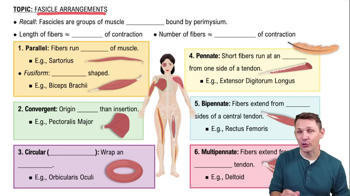
 8:11
8:11