 뒤로
뒤로Anatomy & Physiology: Nervous System and Muscle Physiology
 07:53
07:53
이 집합의 용어 (10)
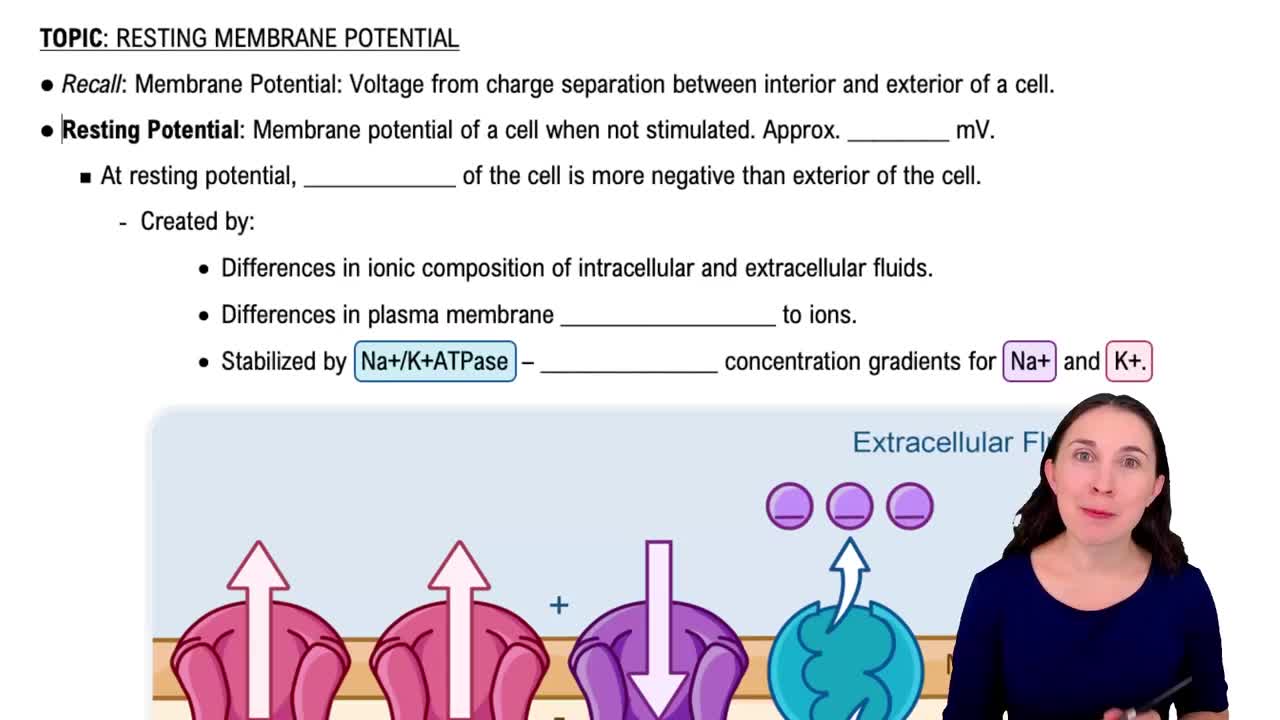
The electrical potential of a neuron at rest, approximately \(-70\,mV\), with the inside of the cell negative relative to outside.
Phase of the action potential where Na+ influx causes the membrane potential to become less negative, moving toward positive values.
Phase of the action potential where K+ efflux causes the membrane potential to return toward the resting negative value.
Time during which a neuron cannot fire another action potential regardless of stimulus strength, corresponding to depolarization and early repolarization phases.
Time during which a neuron can fire another action potential but requires a stronger-than-normal stimulus, occurring during late repolarization and return to resting potential.
The critical level of membrane depolarization (~-55 mV) that must be reached to trigger an action potential.
A rapid, temporary change in membrane potential that propagates along the neuron, enabling nerve signal transmission.
Entry of sodium ions into the neuron during depolarization, causing the membrane potential to rise sharply.
Exit of potassium ions from the neuron during repolarization, restoring the negative membrane potential.
Return of the membrane potential to its resting state after the action potential, maintained by ion pumps and leak channels.