 뒤로
뒤로Anatomy & Physiology: Nervous System Overview and Histology
 0:50
0:50
이 집합의 용어 (20)
Sensory input: gathers information from sensory receptors.
Integration: processes and interprets sensory input.
Motor output: activates muscles and glands to respond.
Central Nervous System (CNS): brain and spinal cord.
Peripheral Nervous System (PNS): cranial and spinal nerves connecting CNS to body.
Sensory (afferent) division: conducts impulses to CNS.
Motor (efferent) division: conducts impulses from CNS to effectors.
Somatic nervous system: controls voluntary skeletal muscles.
Autonomic nervous system: regulates involuntary functions of organs and glands.
Astrocytes: support neurons and exchange nutrients.
Microglial cells: defensive, phagocytic.
Ependymal cells: line CNS cavities, circulate CSF.
Oligodendrocytes: form myelin sheaths around CNS axons.
Satellite cells: surround neuron cell bodies, support.
Schwann cells: form myelin sheaths around PNS nerve fibers.
Excitable cells that transmit electrical impulses, extreme longevity, amitotic, and high metabolic rate requiring oxygen and glucose.
Cell body (soma): contains nucleus.
Dendrites: receive signals.
Axon: transmits impulses to terminals.
Receptive regions that receive signals from other neurons and convey them toward the cell body.
Conducts nerve impulses away from the cell body to axon terminals for communication with other cells.
A fatty, whitish substance that insulates axons and increases the speed of nerve impulse transmission.
They wrap around axons in a jelly roll fashion, each forming one segment of the myelin sheath.
Gaps between adjacent Schwann cells where the axon membrane is exposed, facilitating rapid impulse conduction.
Each oligodendrocyte extends processes that wrap around multiple axons, forming myelin sheaths without an outer collar of cytoplasm.
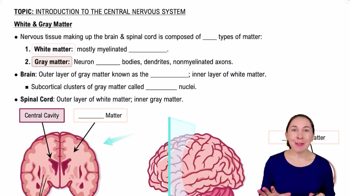
White matter: dense collections of myelinated fibers.
Gray matter: neuron cell bodies and nonmyelinated fibers.
Multipolar: 3+ processes, most common.
Bipolar: 2 processes, rare.
Unipolar: single T-shaped process, sensory neurons.
Sensory (afferent): transmit impulses to CNS.
Motor (efferent): carry impulses from CNS.
Interneurons: connect sensory and motor neurons within CNS.
In ganglia of the Peripheral Nervous System (PNS).
Multipolar neurons that shuttle signals within the CNS.
They act as defensive cells, monitoring neurons and becoming phagocytic when neurons are injured.