 뒤로
뒤로Anatomy & Physiology: Respiratory System Key Concepts
 4:28
4:28
이 집합의 용어 (31)
Nose, pharynx, larynx, trachea, bronchi, lungs (alveoli).
Only in the alveoli of the lungs.
Upper tract: nose to larynx; Lower tract: trachea to alveoli.
Moistens air, traps particles, destroys bacteria with lysozyme, moves mucus to throat.
Increase surface area and air turbulence to trap inhaled particles.
Lighten skull, act as resonance chambers for speech, produce mucus.
Nasopharynx (behind nasal cavity), oropharynx (behind mouth), laryngopharynx (attached to larynx).
Protects larynx opening during swallowing by routing food to esophagus and air to trachea.
True vocal cords that vibrate with expelled air to produce sound.
4-inch tube with C-shaped hyaline cartilage rings, lined with ciliated mucosa and goblet cells producing mucus.
Right bronchus is wider, shorter, and straighter than left.
Right lung has three lobes; left lung has two lobes; apex near clavicle, base rests on diaphragm.
Visceral pleura covers lungs, parietal pleura lines thoracic cavity, pleural fluid reduces friction during breathing.
Respiratory bronchioles, alveolar ducts, alveolar sacs, alveoli (site of gas exchange).
Formed by alveolar and capillary walls; allows gas diffusion between air and blood.
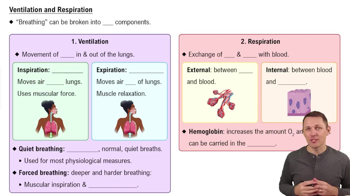
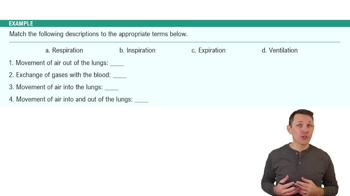
Pulmonary ventilation, external respiration, respiratory gas transport, internal respiration.
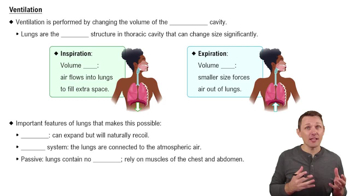
Diaphragm and external intercostals contract, increasing lung volume and decreasing pressure, drawing air in.
Passive lung recoil decreases volume, increases pressure, pushing air out; forced expiration uses internal intercostals.
Always negative to prevent lung collapse; equalizing with atmospheric pressure causes lung recoil.
Amount of air moved in or out during normal quiet breathing (~500 ml).
Additional air forcibly inhaled beyond tidal volume (~3100 ml).
Additional air forcibly exhaled beyond tidal volume (~1200 ml).
Air remaining in lungs after forced expiration (~1200 ml), keeps alveoli inflated.
Vital capacity = TV + IRV + ERV; total exchangeable air volume.
Air in conducting zone that does not reach alveoli (~150 ml).
Mostly bound to hemoglobin as oxyhemoglobin; small amount dissolved in plasma.
Mostly as bicarbonate ion in plasma; some bound to hemoglobin at different sites than oxygen.
Medulla sets basic rhythm via ventral respiratory group; pons smooths respiratory rate.
CO2 levels are primary stimulus; increased CO2 lowers pH and increases breathing rate and depth.
Excessive CO2 exhalation raises blood pH, may cause dizziness and apnea.
Includes chronic bronchitis and emphysema; causes labored breathing, hypoxia, CO2 retention, and respiratory failure.