뒤로

Anatomy & Physiology: Skeletal, Muscular, and Nervous Systems

컨트롤 버튼이 '내비게이션' 모드로 변경되었습니다.
1/21
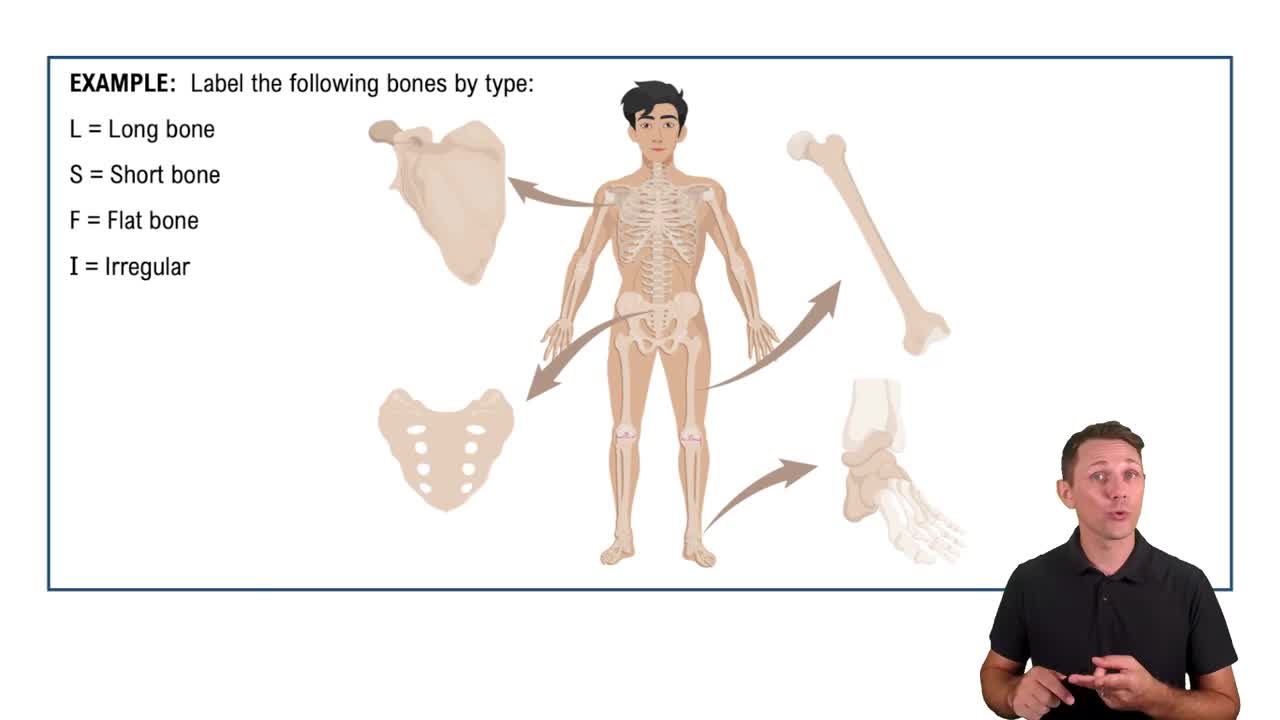
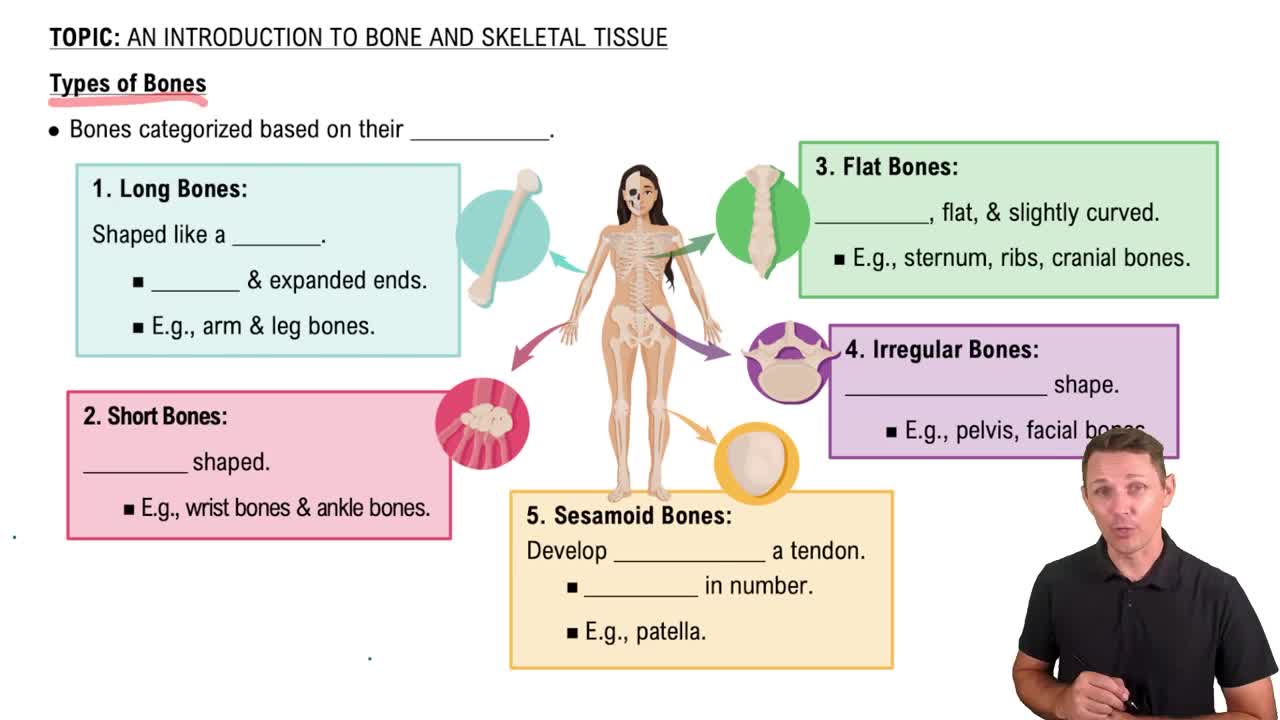
  • Name the four main types of bones and give an example of each.

    • Long bones: femur, humerus, tibia
    • Short bones: carpals, tarsals
    • Flat bones: sternum, ribs, skull bones
    • Irregular bones: vertebrae, pelvis
  • What is the function of sesamoid bones? Give an example.

    Sesamoid bones protect tendons and reduce friction. Example: patella.
  • List the four main bone cell types and their functions.

    • Osteoblasts: build bone, found on bone surface
    • Osteocytes: maintain bone matrix, found in lacunae
    • Osteoclasts: break down bone, found on bone surface
    • Osteoprogenitor cells: stem cells that become osteoblasts, found in endosteum and periosteum
  • Label the main parts of a long bone and their functions.

    • Epiphyses: bone ends, filled with spongy bone
    • Diaphysis: shaft, contains medullary cavity
    • Medullary cavity: contains yellow bone marrow
    • Periosteum: outer bone layer
    • Endosteum: inner bone layer
  • What is an osteon and what are its components?

    An osteon is the structural unit of compact bone, consisting of concentric lamellae, central canal, osteocytes in lacunae, and canaliculi.
  • Describe the process of bone remodeling.

    1. Osteoclasts break down bone
    2. Osteoblasts deposit osteoid
    3. Osteoid mineralizes
    4. Osteocytes maintain the bone
  • What is the composition of bone matrix?

    Bone matrix is made of 1/3 collagen fibers and 2/3 calcium phosphate.
  • Define hydroxyapatite.

    Hydroxyapatite is the calcium phosphate crystal that hardens and strengthens bone.
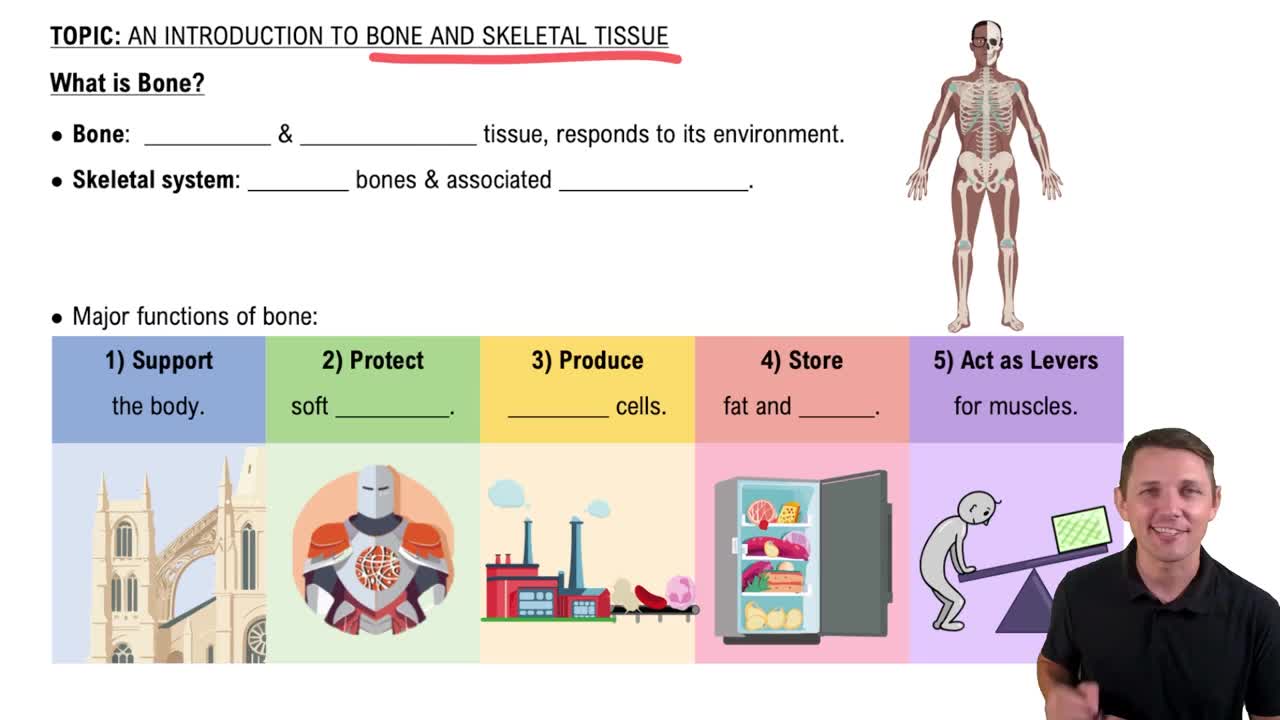
  • How many bones are in the axial and appendicular skeletons?

    Axial skeleton: 80 bones
    Appendicular skeleton: 126 bones
    Total: 206 bones
  • Define the following bone landmarks: fossa, sulcus, facet, fissure, line, process, condyle, epicondyle.

    • Fossa: shallow depression
    • Sulcus: narrow groove
    • Facet: small flat articular surface
    • Fissure: deep slit or cleft
    • Line: low ridge
    • Process: projection or bump
    • Condyle: smooth round articular process
    • Epicondyle: projection above condyle
  • Name the connective tissue layers of muscle and what they form at the muscle ends.

    • Epimysium: surrounds entire muscle
    • Perimysium: surrounds fascicles
    • Endomysium: surrounds muscle fibers
    • Together they form tendons or aponeuroses at muscle ends
  • What are the embryonic stem cells that form skeletal muscle?

    Myoblasts fuse to form myotubes, which mature into skeletal muscle fibers.
  • Compare the characteristics of skeletal, cardiac, and smooth muscle.

    • Skeletal: voluntary, many nuclei, striated
    • Cardiac: involuntary, one nucleus, striated, branched, intercalated discs
    • Smooth: involuntary, no striations, single nucleus
  • Define the five fascicle arrangements in muscles.

    • Pennate: fascicles attach obliquely to tendon
    • Circular: fascicles arranged in rings
    • Parallel: fascicles run parallel to muscle axis
    • Convergent: fascicles converge toward one point
    • Divergent: fascicles spread out from a common point
  • Identify the layers of muscle from superficial to deep.

    Epimysium > Perimysium > Endomysium
  • Name the four structural classifications of neurons.

    • Multipolar
    • Bipolar
    • Unipolar
    • Multipolar with anaxonic features
  • What are afferent and efferent signals?

    Afferent signals carry sensory information to the CNS; efferent signals carry motor commands from the CNS to effectors.
  • Name the three protective layers of the brain and spinal cord.

    Dura mater, arachnoid mater, and pia mater.
  • Define somatic and autonomic functions.

    Somatic functions control voluntary movements; autonomic functions regulate involuntary activities.
  • What are receptors and effectors in the nervous system?

    Receptors detect stimuli; effectors produce responses (muscles or glands).
  • Identify the gates involved in graded potentials.

    Graded potentials involve mechanical, chemical, and voltage-gated ion channels.