 뒤로
뒤로Anatomy & Physiology: Special Senses Study Guide
 5:05
5:05
이 집합의 용어 (28)
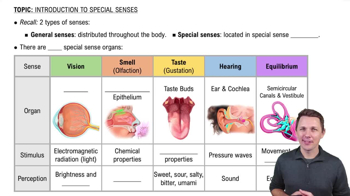
General senses detect touch, pressure, pain, temperature; special senses include smell, taste, vision, hearing, and equilibrium.
Olfaction (smell) and gustation (taste) are the chemical senses.
Odors are detected by olfactory receptors in the nasal cavity, which are specialized chemoreceptors.
The olfactory cortex is located in the temporal lobe of the brain.
Gustatory receptor cells located in taste buds are the receptors for taste.
Sweet, sour, salty, bitter, and umami (savory).
Taste receptor cells respond to chemicals in food, sending signals to the brain via cranial nerves.
The gustatory cortex is located in the insula and frontal operculum of the brain.
Fibrous layer: sclera and cornea; vascular layer: choroid, ciliary body, iris; inner layer: retina.
The cornea refracts light entering the eye and provides protection.
The iris controls pupil size to regulate light entering the eye.
The macula lutea is the central area of the retina responsible for sharp, detailed vision.
Degeneration causes loss of central vision, as seen in macular degeneration.
The fovea centralis is the center of the macula with the highest density of cones for detailed color vision.
Parasympathetic stimulation constricts the pupil; sympathetic stimulation dilates it in response to light levels.
Located in the retina; rods detect light intensity, cones detect color.
Light stimulates photoreceptors in the retina; signals travel via the optic nerve to the visual cortex.
Convex lenses converge light rays to focus images on the retina; refraction bends light rays.
The eye's ability to change lens shape to focus on near or distant objects.
Lens becomes more curved for close vision and flatter for distant vision.
Myopia: nearsightedness, difficulty seeing distant objects; hyperopia: farsightedness, difficulty seeing close objects.
Cataracts are clouding of the lens causing blurred vision.
Outer ear: collects sound; middle ear: transmits vibrations; inner ear: detects sound and balance.
Located in the cochlea of the inner ear.
Located in the vestibule and semicircular canals of the inner ear.
Sound waves travel through the outer ear, vibrate the tympanic membrane, ossicles, then stimulate cochlear hair cells.
Static equilibrium detects head position relative to gravity; dynamic equilibrium detects rotational movement.
The cerebellum and brainstem process balance and posture information.