Skip to main content
Anatomy & Physiology
나의 코스
배우기
시험 준비
AI 튜터
학습 가이드
교과서적 해결책
플래시카드
탐험해 보세요
앱을 사용해 보세요
나의 코스
배우기
시험 준비
AI 튜터
학습 가이드
교과서적 해결책
플래시카드
탐험해 보세요
앱을 사용해 보세요
뒤로
Anatomy & Physiology: Tissue Level of Organization
카드를 뒤집기 위해 탭할 수 있습니다.
What are tissues?
카드를 뒤집기 위해 탭할 수 있습니다.
👆
What are tissues?
Tissues
are collections of specialized cells and cell products that perform specific functions and form organs.
진행 상황 추적
컨트롤 버튼이 '내비게이션' 모드로 변경되었습니다.
1/30
추천 영상
03:32
Map of the Lesson on Tissues
12340
views
554
rank
2
comments
02:52
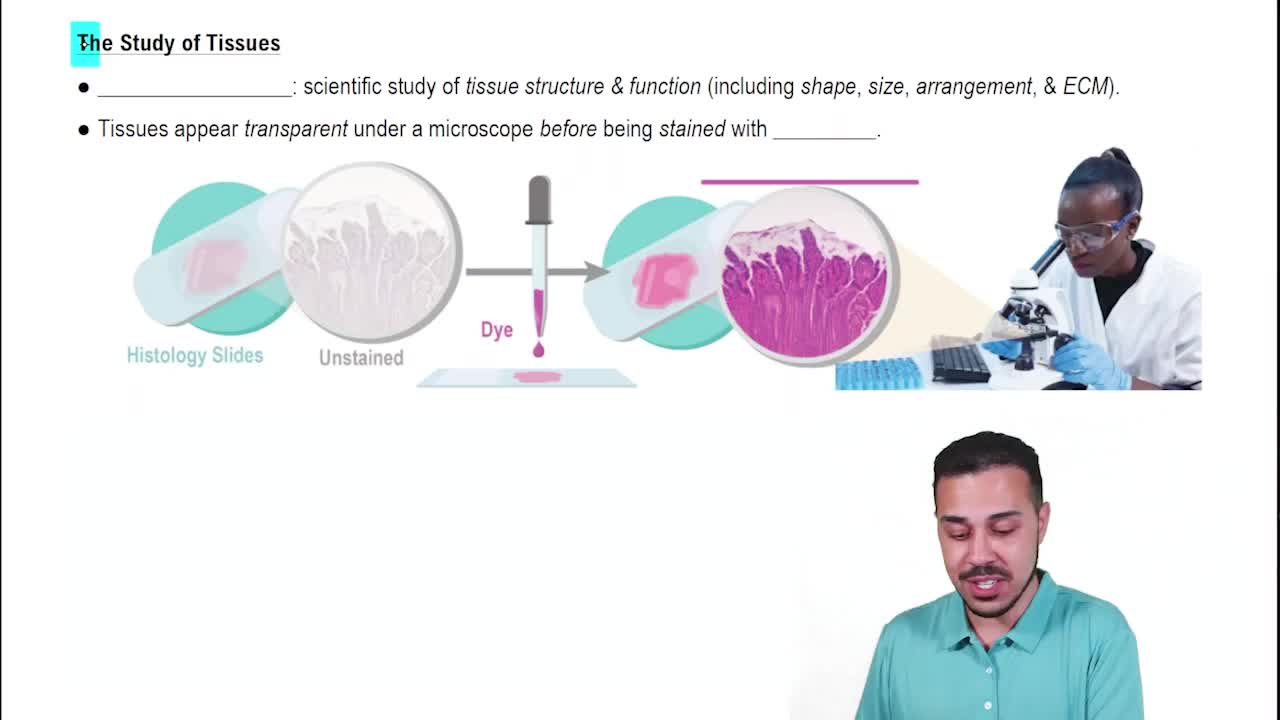
What is Histology?
12449
views
278
rank
04:14
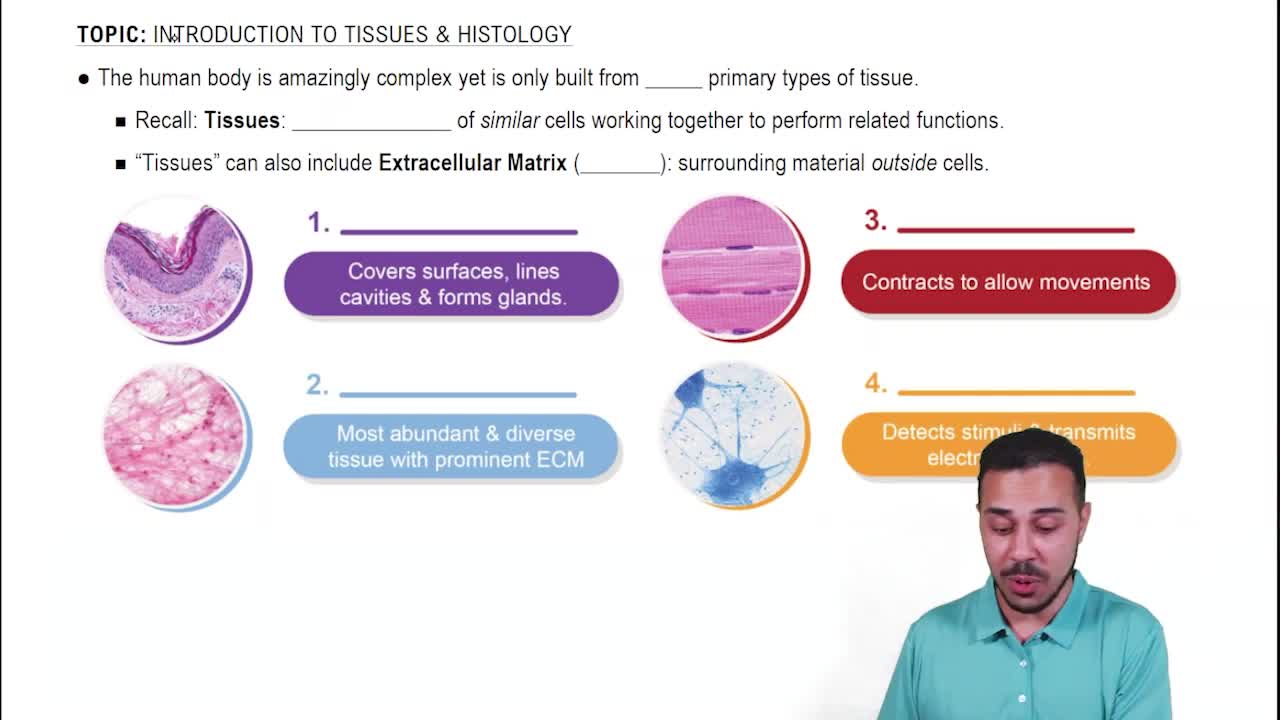
Intro to Human Tissues
20575
views
696
rank
이 집합의 용어 (30)
하이드의 정의
What are tissues?
Tissues
are collections of specialized cells and cell products that perform specific functions and form organs.
Name the four types of tissues.
Epithelial, connective, muscle, and nervous tissues.
What are the main functions of epithelial tissue?
Provide physical protection, control permeability, provide sensation, and produce specialized secretions.
List key characteristics of epithelial tissue.
Polarity, cellularity, attachment to basement membrane, avascularity, and regeneration.
What is the function of microvilli and cilia on epithelial cells?
Microvilli increase absorption or secretion; cilia move fluids over the epithelial surface.
Name three types of cell junctions in epithelial tissue.
Gap junctions, tight junctions, and desmosomes.
What is the difference between simple and stratified epithelia?
Simple epithelia have a single cell layer; stratified epithelia have multiple layers for protection.
Describe simple squamous epithelium and its function.
Thin, flat cells that allow absorption and diffusion; found in mesothelium and endothelium.
What is the role of stratified squamous epithelium?
Protects against mechanical stresses; keratinized forms add water resistance.
Where is transitional epithelium found and what is its function?
Found in urinary bladder; allows stretching and recoiling without damage.
What distinguishes pseudostratified columnar epithelium?
Cells of varying shapes all contact basement membrane; often ciliated; found in respiratory tract.
Differentiate endocrine and exocrine glands.
Endocrine glands release hormones into bloodstream; exocrine glands secrete onto epithelial surfaces via ducts.
Name the three methods of exocrine secretion.
Merocrine (exocytosis), apocrine (cytoplasm shedding), and holocrine (cell bursting).
What are the main components of connective tissue?
Specialized cells, extracellular protein fibers, and fluid extracellular ground substance.
List the three categories of connective tissue.
Connective tissue proper, fluid connective tissues, and supporting connective tissues.
Name the three types of fibers in connective tissue proper.
Collagen fibers (strong, resist force), reticular fibers (network support), and elastic fibers (stretch and recoil).
What are the functions of loose connective tissues?
Fill spaces, cushion cells, support epithelia, and hold capillary beds.
Describe the difference between white and brown adipose tissue.
White stores fat and insulates; brown is vascularized, generates heat, and is found in infants.
What is the function of dense regular connective tissue?
Provides strong attachment in tendons and ligaments with parallel collagen fibers.
What are the three types of cartilage?
Hyaline (flexible, reduces friction), elastic (supports and bends), and fibrocartilage (tough, limits movement).
How does cartilage grow?
By interstitial growth (from within) and appositional growth (at outer surface).
What are the main functions of bone tissue?
Supports weight, resists shattering, and allows material exchange via canaliculi.
Name the four types of tissue membranes.
Mucous, serous, cutaneous, and synovial membranes.
What is the role of mucous membranes?
Line passageways with external connections; keep surfaces moist to reduce friction and aid absorption.
Describe the structure and function of serous membranes.
Line closed cavities; have parietal and visceral layers; produce serous fluid to reduce friction.
What distinguishes skeletal muscle tissue?
Long, multinucleated, striated fibers under voluntary control.
How is cardiac muscle tissue specialized?
Branched, striated cells connected by intercalated discs; involuntary control by pacemaker cells.
Where is smooth muscle found and what are its characteristics?
Walls of hollow organs; spindle-shaped, non-striated, involuntary, capable of regeneration.
What are the two main cell types in nervous tissue?
Neurons (conduct electrical signals) and neuroglia (support and repair neurons).
What are the stages of tissue repair after injury?
Inflammation (swelling, redness, pain) followed by regeneration or fibrosis (scar tissue formation).
 뒤로뒤로
뒤로뒤로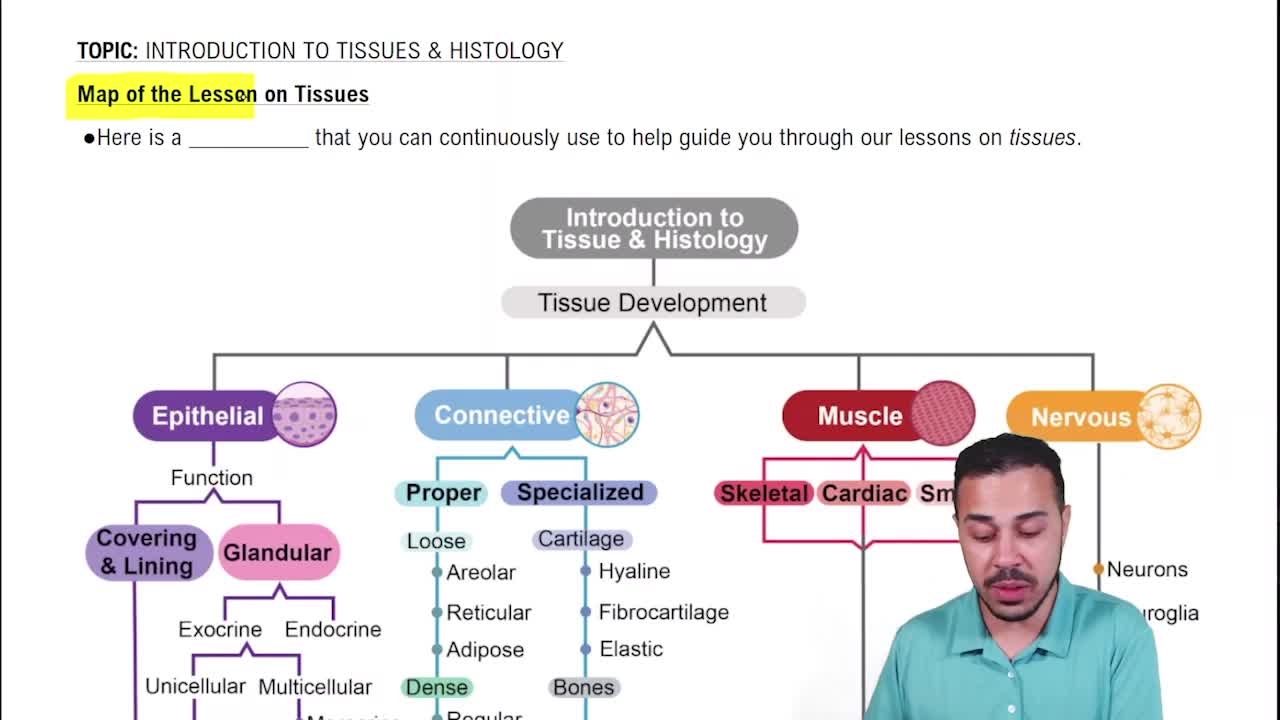
 03:32
03:32