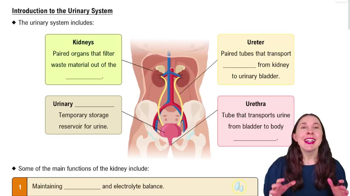
Filling of the bladder activates stretch receptors that initiate the micturition reflex.
Which muscle contracts during micturition to expel urine?
The detrusor muscle (smooth muscle of the bladder) contracts during micturition.
What nervous system controls the detrusor muscle during urination?
The parasympathetic nervous system controls contraction of the detrusor muscle during urination.
At what bladder volume does the urge to urinate typically appear?
The urge to urinate appears around 200 ml of bladder volume.
What happens when bladder volume exceeds 500 ml?
The internal sphincter is forced open, leading to reflexive opening of the external sphincter and loss of voluntary control.
What is urinary incontinence and some common causes?
Urinary incontinence is the inability to control urination voluntarily, caused by factors like immature corticospinal connections in infants, sphincter damage, spinal cord injury, aging, or CNS diseases.
What are the four main parameters maintained by homeostatic mechanisms for fluid and electrolyte balance?
Why is maintaining osmolarity important for cells?
Because water crosses cell membranes freely, maintaining osmolarity prevents cell swelling or shrinking, preserving normal cell volume and function.
What percentage of body water is intracellular fluid (ICF) and extracellular fluid (ECF)?
Approximately 2/3 of body water is intracellular fluid and 1/3 is extracellular fluid.
How do kidneys regulate urine concentration?
By varying water and Na+ reabsorption in the distal nephron, kidneys produce dilute urine (low osmolarity) or concentrated urine (high osmolarity).
What hormone controls water permeability in the distal tubule and collecting duct?
Vasopressin (antidiuretic hormone, ADH) controls water permeability by regulating insertion of aquaporin-2 water channels.
What is the main stimulus for vasopressin secretion?
Increased plasma osmolarity is the most potent stimulus for vasopressin secretion.
What role does the loop of Henle play in urine concentration?
The loop of Henle acts as a countercurrent multiplier, creating a hyperosmotic medullary interstitium essential for water reabsorption.
How does the vasa recta contribute to maintaining medullary osmolarity?
The vasa recta acts as a countercurrent exchanger, removing water and solutes to prevent washout of the hyperosmotic medulla.
What is the role of urea in the renal medulla?
Urea contributes significantly to the hyperosmotic medullary interstitium by recycling between the nephron and interstitium.
How does aldosterone affect sodium and potassium balance?
Aldosterone increases Na+ reabsorption and K+ excretion by acting on principal cells in the distal tubule and collecting duct.
What triggers aldosterone secretion?
Aldosterone secretion is triggered by increased plasma K+, decreased blood pressure via the renin-angiotensin system, and sometimes by low plasma Na+.
What is the renin-angiotensin system (RAS) and its function?
RAS is a hormone pathway that maintains blood pressure by producing angiotensin II, which stimulates aldosterone release and vasoconstriction.
What are the effects of angiotensin II?
Angiotensin II increases vasopressin secretion, stimulates thirst, causes vasoconstriction, increases sympathetic output, and enhances Na+ and water reabsorption.
What is atrial natriuretic peptide (ANP) and its function?
ANP is a hormone released by atrial myocardial cells in response to stretch that promotes Na+ and water excretion, reducing blood volume and pressure.
 뒤로
뒤로
 0:54
0:54