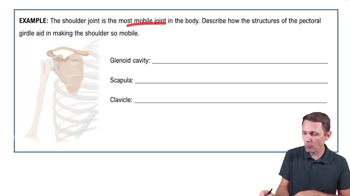
The pectoral girdle consists of the clavicle and scapula bones.
Name key features of the clavicle.
The clavicle has a sternal end, acromial end, and a conoid tubercle.
Identify important landmarks on the scapula.
Key scapula landmarks include the glenoid cavity, spine, acromion, coracoid process, and suprascapular notch.
What bones form the upper limb?
The upper limb includes the humerus (arm), radius and ulna (forearm), and the carpals, metacarpals, and phalanges (hand).
List major features of the humerus.
The humerus has a head, greater and lesser tubercles, anatomical and surgical necks, deltoid tuberosity, and epicondyles.
What distinguishes the radius from the ulna?
The radius has a head, neck, radial tuberosity, and styloid process; the ulna has an olecranon process, trochlear notch, and styloid process.
How many carpal bones are there and how are they arranged?
There are 8 carpal bones arranged in two irregular rows of four bones each.
What bones form the pelvic girdle?
The pelvic girdle is formed by two hip bones (ossa coxae), each consisting of the ilium, ischium, and pubis.
Name key features of the ilium.
The ilium includes the iliac crest, ala, anterior superior iliac spine, greater sciatic notch, and auricular surface.
What are important landmarks of the ischium?
The ischium has the ischial spine, lesser sciatic notch, ischial tuberosity, and ramus.
Describe the pubis bone features.
The pubis includes the superior and inferior pubic rami, pubic symphysis, pubic crest, and pubic tubercle.
What bones make up the lower limb?
The lower limb consists of the femur (thigh), patella, tibia and fibula (leg), and the tarsals, metatarsals, and phalanges (foot).
List key features of the femur.
The femur has a head, neck, greater and lesser trochanters, linea aspera, and medial and lateral condyles.
How can you differentiate the tibia from the fibula?
The tibia is larger with medial and lateral condyles, tibial tuberosity, and medial malleolus; the fibula is thinner with a head and lateral malleolus.
What is the mnemonic to remember the carpal bones?
Mnemonic: Stop Letting Those People Touch The Cadaver’s Hand for Scaphoid, Lunate, Triquetrum, Pisiform, Trapezium, Trapezoid, Capitate, Hamate.
What is the mnemonic to remember the tarsal bones?
Mnemonic: Tall Centers Never Take Shots From Corners for Talus, Calcaneus, Navicular, Third cuneiform, Second cuneiform, First cuneiform, Cuboid.
How does the female pelvis differ from the male pelvis in general structure?
The female pelvis is tilted forward, has a broad, shallow true pelvis, and a broader pubic arch (80-90°) compared to the male pelvis.
Describe the differences in bone thickness between male and female pelvises.
Female pelvic bones are lighter, thinner, and smoother; male pelvic bones are heavier, thicker with more prominent markings.
How do the pelvic inlet and outlet differ between sexes?
The female pelvic inlet is wider and oval, and the outlet is wider with shorter ischial tuberosities; the male inlet is narrow and heart-shaped with a narrower outlet.
What are key sacrum differences between male and female pelvises?
The female sacrum is wider, shorter with accentuated curvature; the male sacrum is narrower, longer and more ventrally curved.
How does the pubic arch angle differ between males and females?
The female pubic arch angle is greater than 90°, while the male pubic arch angle is less than 90°.
 뒤로
뒤로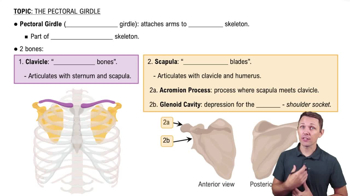
 6:23
6:23