 뒤로
뒤로Autonomic Nervous System - Anatomy & Physiology
 1:10
1:10
이 집합의 용어 (20)
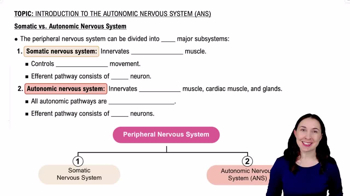
The ANS helps stabilize our internal environment and controls involuntary functions by innervating smooth muscle, cardiac muscle, and glands.
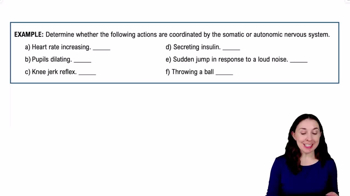
Somatic nervous system controls skeletal muscle, while the autonomic nervous system controls smooth muscle, cardiac muscle, and glands.
Somatic: single motor neuron from CNS to muscle, heavily myelinated. Autonomic: two-neuron chain with lightly myelinated preganglionic and nonmyelinated postganglionic neurons.
Somatic motor neurons release acetylcholine (ACh) and are always excitatory. Autonomic postganglionic fibers release either ACh or norepinephrine (NE), which can be excitatory or inhibitory depending on receptors.
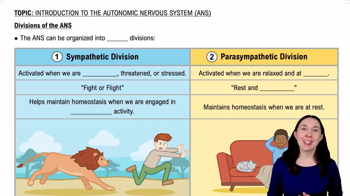
Parasympathetic division calms the body (rest and digest). Sympathetic division arouses the body for action (fight or flight).
Parasympathetic fibers originate from the craniosacral regions, while sympathetic fibers originate from the thoracolumbar regions of the spinal cord.
Parasympathetic: long preganglionic and short postganglionic fibers. Sympathetic: short preganglionic and long postganglionic fibers.
Parasympathetic ganglia are located in or near the target organs. Sympathetic ganglia are located close to the spinal cord in the sympathetic trunk.
Cranial nerves III (oculomotor), VII (facial), IX (glossopharyngeal), and X (vagus) carry parasympathetic preganglionic fibers.
The vagus nerve (cranial nerve X) serves most thoracic and abdominal organs, providing parasympathetic innervation to the heart, lungs, digestive organs, and more.
Sympathetic trunk ganglia form a chain alongside the vertebral column, allowing sympathetic fibers to synapse and distribute to various body regions.
They can synapse at the same level, at a higher or lower level, or pass through to synapse in distant collateral ganglia.
Cholinergic fibers release acetylcholine (ACh). Adrenergic fibers release norepinephrine (NE).
Nicotinic receptors are always stimulatory and found on postganglionic neurons. Muscarinic receptors can be excitatory or inhibitory depending on the target organ.
Alpha and Beta receptors bind norepinephrine. For example, B1 receptors increase heart rate, while B2 receptors relax bronchiole smooth muscle.
Most visceral organs receive input from both sympathetic and parasympathetic divisions, which usually have opposing effects to maintain balance.
Sympathetic fibers maintain partial constriction of blood vessels. Increased firing causes vasoconstriction; decreased firing causes vasodilation.
It regulates thermoregulatory responses, releases renin from kidneys, and influences metabolic effects.
Parasympathetic effects are short-lived and localized due to one-to-one neuron connections and rapid ACh breakdown. Sympathetic effects are diffuse and longer-lasting due to branching fibers and circulating catecholamines.
The hypothalamus is the main integrative center, coordinating autonomic functions and influencing lower CNS centers.