An involuntary response to a stimulus involving visceral effectors such as the heart, glands, or smooth muscle.
Name the five components of a visceral reflex arc.
1. Receptor, 2. Sensory (afferent) neuron, 3. Integration center, 4. Motor (efferent) neuron, 5. Effector.
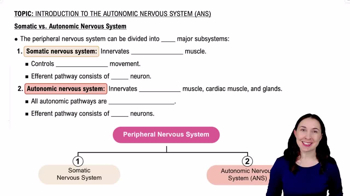
How do the somatic and autonomic nervous systems differ in motor pathways?
SNS uses a single neuron from CNS to effector; ANS uses a two-neuron chain (preganglionic and postganglionic neurons).
What neurotransmitters are used by the somatic and autonomic nervous systems?
SNS uses acetylcholine (ACh); ANS uses ACh and norepinephrine (NE).
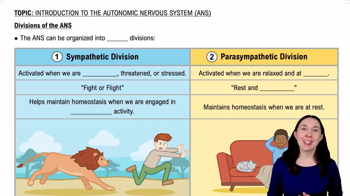
What are the two divisions of the autonomic nervous system and their general functions?
Sympathetic division prepares for 'fight or flight'; parasympathetic division promotes 'rest and digest' activities.
Where are the preganglionic neurons located in the sympathetic division?
In the lateral horns of spinal cord segments T1 to L2.
What is the difference between sympathetic chain ganglia and collateral ganglia?
Sympathetic chain ganglia lie alongside the vertebral column and innervate organs above the diaphragm; collateral ganglia are anterior to the vertebral column and innervate organs below the diaphragm.
How does the adrenal medulla contribute to sympathetic responses?
Preganglionic fibers stimulate the adrenal medulla to release epinephrine and norepinephrine into the blood, prolonging sympathetic effects.
Where are parasympathetic preganglionic neurons located?
In the brainstem (cranial nerves III, VII, IX, X) and sacral spinal cord segments S2 to S4.
What are terminal and intramural ganglia in the parasympathetic division?
Terminal ganglia are near target organs; intramural ganglia are located within the walls of target organs.
Which cranial nerves are involved in parasympathetic innervation and their target organs?
What types of receptors bind acetylcholine in the autonomic nervous system?
Cholinergic receptors, including nicotinic and muscarinic receptors.
What receptors bind norepinephrine and epinephrine in the sympathetic nervous system?
Adrenergic receptors, including alpha (α) and beta (β) receptors.
Which neurotransmitters are released by postganglionic neurons in the sympathetic and parasympathetic divisions?
Sympathetic postganglionic neurons usually release norepinephrine (NE), except sweat glands which release ACh; parasympathetic postganglionic neurons release ACh.
What is dual innervation in the autonomic nervous system?
Most organs receive input from both sympathetic and parasympathetic divisions, allowing precise control.
Name some structures that do not receive dual innervation.
Adrenal medulla, arrector pili muscles, sweat glands, and most blood vessels.
What is the role of beta blockers in autonomic pharmacology?
Beta blockers inhibit beta receptors to reduce sympathetic stimulation of the heart, lowering heart rate and blood pressure.
What is the difference between general and special senses?
General senses are widely distributed and detect touch, pain, temperature, and proprioception; special senses are localized in the head and include smell, taste, vision, hearing, and equilibrium.
Where are olfactory receptors located and what do they detect?
In the olfactory epithelium of the nasal cavity; they detect odorants.
What are the five basic tastes detected by gustatory receptors?
Sweet, sour, salty, bitter, and umami.
Name the three layers (tunics) of the eyeball.
Fibrous tunic (sclera and cornea), vascular tunic (choroid, ciliary body, iris), and neural tunic (retina).
What is the function of the cornea compared to the sclera?
The cornea is transparent and refracts light; the sclera is opaque and protective.
What is the pathway of aqueous humor in the eye?
Produced by ciliary body → posterior chamber → pupil → anterior chamber → drains via canal of Schlemm.
What causes glaucoma?
Increased intraocular pressure due to impaired drainage of aqueous humor, which can damage the optic nerve.
What are rods and cones in the retina responsible for?
Rods detect dim light and black-and-white vision; cones detect color and sharpness.
What is the fovea centralis?
The area of highest visual acuity in the retina, densely packed with cones.
How does the lens change shape during accommodation for near and distant objects?
For near objects, ciliary muscle contracts, suspensory ligaments relax, lens thickens; for distant objects, ciliary muscle relaxes, ligaments tighten, lens flattens.
 뒤로
뒤로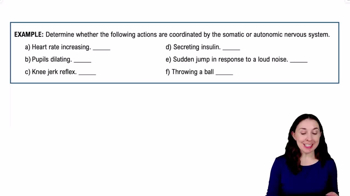
 1:10
1:10