 뒤로
뒤로Basic Chemistry and Biomolecules in Anatomy & Physiology
 02:45
02:45
이 집합의 용어 (18)
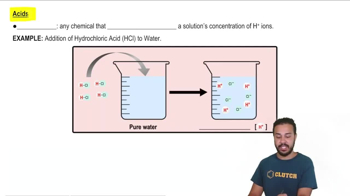
An acid is a substance that releases hydrogen ions (H+) in solution, increasing the acidity.
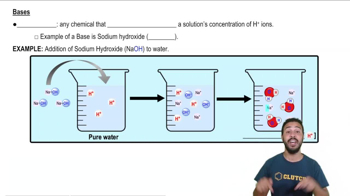
A base is a substance that accepts hydrogen ions (H+) or releases hydroxide ions (OH-), decreasing acidity.
A covalent bond is a chemical bond where atoms share one or more pairs of electrons.
Inorganic salts are compounds that dissociate into ions in water and are essential for various physiological functions.
Lipids are organic molecules that are hydrophobic, including fats, oils, and steroids, important for energy storage and cell membranes.
Organic compounds contain carbon atoms bonded to hydrogen and often other elements, forming the basis of living organisms.
Water is a polar inorganic molecule essential for life, acting as a solvent and participating in chemical reactions.
Atomic mass is the total number of protons and neutrons in an atom's nucleus.
Carbohydrates are organic molecules composed of carbon, hydrogen, and oxygen, serving as energy sources and structural components.
An electron is a negatively charged subatomic particle orbiting the nucleus of an atom.
An ion is an atom or molecule with a net electric charge due to loss or gain of electrons.
A neutron is a neutral subatomic particle found in the nucleus of an atom.
A proton is a positively charged subatomic particle located in the nucleus of an atom.
Atomic number is the number of protons in an atom's nucleus, defining the element.
A catalyst is a substance that speeds up a chemical reaction without being consumed.
Inorganic compounds generally do not contain carbon-hydrogen bonds and include salts, water, and acids.
An ionic bond is a chemical bond formed by the transfer of electrons from one atom to another, creating charged ions.
Nucleic acids are organic molecules (DNA and RNA) that store and transmit genetic information.