 뒤로
뒤로Basic Chemistry Concepts in Anatomy & Physiology
 02:13
02:13
이 집합의 용어 (23)
Matter is anything that has mass and occupies space. It can be seen, smelled, or felt.
Solid: definite shape and volume.
Liquid: changeable shape, definite volume.
Gas: changeable shape and volume.
Energy is the capacity to do work or put matter into motion.
Kinetic energy: energy in action.
Potential energy: stored (inactive) energy.
Chemical (stored in bonds), Electrical (movement of charged particles), Mechanical (directly moves matter), Radiant/Electromagnetic (travels in waves like light).
Elements are substances that cannot be broken down by ordinary chemical means.
The four main elements are carbon, oxygen, hydrogen, and nitrogen.
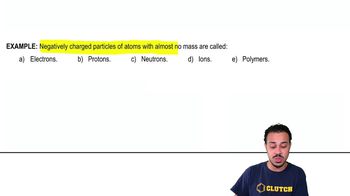
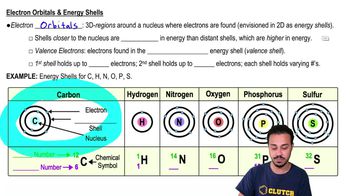
Atoms consist of protons (+, 1 amu) and neutrons (0, 1 amu) in the nucleus, with electrons (−, ~0 amu) orbiting the nucleus.
Atomic number: number of protons.
Mass number: total protons and neutrons.
Isotopes: atoms of the same element with different neutrons.
Radioisotopes: unstable isotopes that emit energy as they decay.
Molecule: two or more atoms bonded.
Compound: molecule with different atoms.
Mixture: physical combination of substances.
Solutions: homogeneous, solute particles do not settle.
Colloids: heterogeneous, larger particles, do not settle.
Suspensions: heterogeneous, large particles settle out.
Concentration is expressed as percent, mg/dL, or molarity (M). 1 mole equals molecular weight in grams.
Mixtures do not involve chemical bonding and can be separated physically; compounds involve chemical bonds and require chemical means to separate.
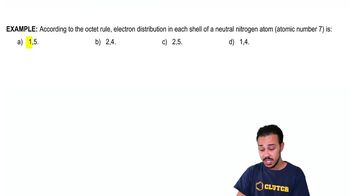
The valence shell is the outermost electron shell involved in bonding.
The octet rule states atoms seek 8 electrons in their valence shell (except H and He, which seek 2).
Ionic bonds form by transfer of electrons, creating oppositely charged ions that attract (e.g., NaCl).
Covalent bonds involve sharing electrons.
Nonpolar: equal sharing (e.g., CO2).
Polar: unequal sharing causing partial charges (e.g., H2O).
Hydrogen bonds are weak attractions between electropositive hydrogen and electronegative atoms, important for water properties and molecular structure.
Atoms or molecules combine to form larger molecules. General form: A + B → AB.
A molecule breaks down into smaller parts. General form: AB → A + B.
Bonds are both made and broken. General forms: AB + C → AC + B or AB + CD → AD + CB.
Electrons are transferred between atoms. Oxidation is loss of electrons; reduction is gain of electrons.
Exergonic: release energy (products have less energy).
Endergonic: absorb energy (products have more energy).
Temperature, concentration, particle size, and catalysts affect reaction rate.
Catalysts increase reaction rate without being changed; enzymes are biological catalysts.