 뒤로
뒤로Basic Chemistry for Anatomy & Physiology
 02:13
02:13
이 집합의 용어 (28)
Matter is anything that has mass and occupies space.
Solid (definite shape and volume), Liquid (changeable shape, definite volume), Gas (changeable shape and volume).
Energy is the capacity to do work or put matter into motion; it has no mass or volume.
Kinetic energy is energy in action; Potential energy is stored, inactive energy.
Elements are substances that cannot be broken down chemically; atoms are the smallest units of elements with their properties.
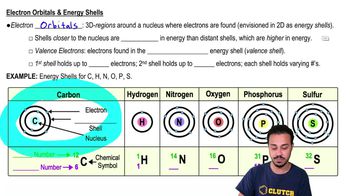
Protons (positive charge), Neutrons (no charge), Electrons (negative charge).
The number of protons in the nucleus of an atom; written as a subscript to the left of the atomic symbol.
A molecule is two or more atoms bonded together; a compound is a molecule with two or more different kinds of atoms.
Solutions (homogeneous), Colloids (heterogeneous, cloudy), Suspensions (heterogeneous, particles settle out).
An ionic bond forms when valence electrons are transferred between atoms, creating charged ions attracted to each other.
A covalent bond is formed by sharing valence electrons between atoms; can be single, double, or triple bonds.
Nonpolar: equal sharing of electrons; Polar: unequal sharing, creating partial charges (dipoles).
Weak attractions between electropositive hydrogen of one molecule and electronegative atom of another; important in water properties.
Atoms or molecules combine to form a larger, more complex molecule (A + B → AB); anabolic process.
A molecule breaks down into smaller molecules or atoms (AB → A + B); catabolic process.
Both synthesis and decomposition occur; bonds are made and broken (AB + C → AC + B).
Exergonic: release energy, products have less potential energy; Endergonic: absorb energy, products have more potential energy.
Temperature, concentration of reactants, particle size, and presence of catalysts.
Enzymes are biological catalysts that lower activation energy and speed up reactions without being consumed.
Water absorbs/releases heat, dissolves substances, cushions organs, and participates in chemical reactions.
Acids release H+ ions; Bases release OH– ions in solution.
Concentration of hydrogen ions [H+]; acidic (0–6.99), neutral (7), alkaline/basic (7.01–14).
Organic molecules made of C, H, O with a 2:1 H to O ratio; include monosaccharides, disaccharides, and polysaccharides.
Hydrophobic organic molecules including triglycerides (fats/oils), phospholipids, and steroids.
Polymers of amino acid monomers linked by peptide bonds; have four structural levels determining shape and function.
Loss of a protein's 3-D shape and function due to heat or pH changes.
Large molecules made of nucleotide monomers; include DNA and RNA, which store and transfer genetic information.
Adenosine triphosphate (ATP) stores and provides immediate usable energy for cellular processes.