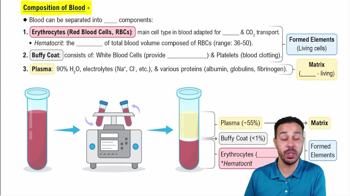
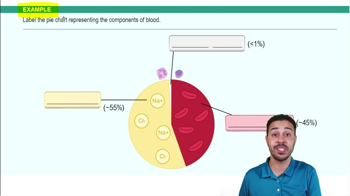
Plasma, formed elements (erythrocytes, leukocytes, platelets), and the buffy coat which contains leukocytes and platelets.
What proportion of centrifuged blood is plasma, buffy coat, and erythrocytes?
Plasma ~55%, buffy coat <1%, erythrocytes ~45%.
What percent of body weight is blood and how many liters are typically in the body?
Blood is about 7-8% of body weight, with approximately 4-6 liters in an adult.
What are the 7 basic functions of blood?
Transport of gases, nutrients, wastes; regulation of pH and temperature; protection against blood loss and infection.
What is the composition of plasma?
About 92% water, 7% plasma proteins (albumins, globulins, clotting proteins), and 1% solutes like electrolytes and nutrients.
What are the main plasma proteins and their functions?
Albumins maintain osmotic pressure, gamma-globulins are antibodies, alpha- and beta-globulins transport lipids and metals, and clotting proteins help blood coagulation.
Describe the structure and function of erythrocytes.
Biconcave, anucleate cells specialized for oxygen transport via hemoglobin.
What is hemoglobin and what is a heme group?
Hemoglobin is a protein with 4 globin chains, each with a heme group containing iron that binds oxygen.
What is erythropoiesis?
The process of red blood cell formation from hematopoietic stem cells in bone marrow.
Which hormone regulates erythropoiesis and where is it produced?
Erythropoietin, produced mainly by the kidneys in response to low oxygen.
How long do erythrocytes last and why do they die?
About 120 days; they lack nuclei and organelles, so they cannot repair themselves.
Which organ breaks down erythrocytes and what are the components of hemoglobin breakdown?
The spleen breaks them down; hemoglobin splits into heme, globin, and iron.
What is transferrin and its role?
A plasma protein that transports iron recycled from heme to the bone marrow.
What happens to the heme group after erythrocyte breakdown?
Heme is converted to biliverdin then bilirubin, which is processed by the liver for excretion.
Define anemia and list three common causes.
Anemia is a reduced oxygen-carrying capacity of blood; causes include iron deficiency, pernicious anemia, and hemolytic anemia.
What are the five major types of leukocytes?
Neutrophils, eosinophils, basophils, monocytes, and lymphocytes.
 뒤로
뒤로
 2:36
2:36