Skip to main content
Anatomy & Physiology
나의 코스
배우기
시험 준비
AI 튜터
학습 가이드
교과서적 해결책
플래시카드
탐험해 보세요
앱을 사용해 보세요
나의 코스
배우기
시험 준비
AI 튜터
학습 가이드
교과서적 해결책
플래시카드
탐험해 보세요
앱을 사용해 보세요
뒤로
Blood and Hemostasis - Anatomy & Physiology
카드를 뒤집기 위해 탭할 수 있습니다.
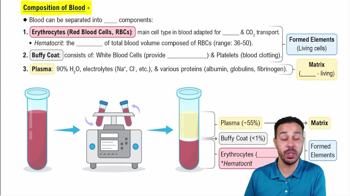
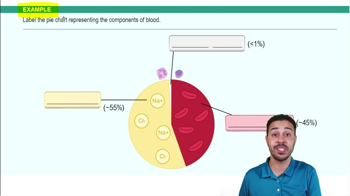
What are the main components of blood?
카드를 뒤집기 위해 탭할 수 있습니다.
👆
What are the main components of blood?
Plasma
(fluid component) and
formed elements
(cells and cell fragments).
진행 상황 추적
컨트롤 버튼이 '내비게이션' 모드로 변경되었습니다.
1/27
추천 영상
VideoThumbView.guidedCourse
2:36
Introduction to Blood Example 1
9867
views
294
rank
VideoThumbView.guidedCourse
7:49
Composition of Blood
10510
views
297
rank
VideoThumbView.guidedCourse
1:55
Introduction to Blood Example 2
8211
views
193
rank
이 집합의 용어 (27)
하이드의 정의
What are the main components of blood?
Plasma
(fluid component) and
formed elements
(cells and cell fragments).
List the major functions of blood.
Transports gases, nutrients, hormones, wastes; regulates pH and ions; restricts fluid loss; defends against toxins/pathogens; stabilizes body temperature.
What is plasma composed of?
92% water, plasma proteins (albumins, globulins, fibrinogen), organic nutrients, wastes, and electrolytes.
Name the three major plasma proteins and their functions.
Albumins
: maintain osmolarity and transport;
Globulins
: antibodies and transport;
Fibrinogen
: clotting protein converted to fibrin.
What are the formed elements in blood?
Red blood cells (RBCs), white blood cells (WBCs), and platelets (cell fragments).
Describe the structure of red blood cells.
Small, biconcave discs, anucleate, lack mitochondria, flexible to pass through capillaries, contain hemoglobin.
What is hemoglobin and its function?
A protein in RBCs with four polypeptide chains and heme groups that bind oxygen and carbon dioxide for transport.
How does fetal hemoglobin differ from adult hemoglobin?
Fetal hemoglobin binds oxygen more readily to extract it from maternal blood at the placenta.
What is erythropoiesis?
The process of red blood cell formation occurring in red bone marrow from hematopoietic stem cells.
What hormone regulates erythropoiesis and when is it released?
Erythropoietin (EPO)
, released by kidneys and liver in response to low oxygen (hypoxia).
How are red blood cells recycled?
Macrophages break down RBCs; heme is converted to biliverdin then bilirubin; iron is recycled via transferrin.
What determines blood type?
Presence or absence of surface antigens A, B, and Rh on RBC membranes.
What antibodies are present in type A blood plasma?
Anti-B antibodies that attack B antigens.
Explain Rh blood group incompatibility in pregnancy.
An Rh-negative mother exposed to Rh-positive fetal blood can produce antibodies that attack fetal RBCs in future pregnancies.
What are the main types of white blood cells?
Granulocytes: neutrophils, eosinophils, basophils; Agranulocytes: monocytes, lymphocytes.
What is the primary function of neutrophils?
Phagocytize bacteria and are first responders to infection sites.
What role do eosinophils play in the immune response?
Attack large parasites and modulate allergic inflammatory responses.
What substances do basophils release and their effects?
Histamine (vasodilation) and heparin (prevents clotting) to enhance inflammation.
Describe the function of monocytes.
Differentiate into macrophages that engulf pathogens and attract other immune cells.
What are the three phases of hemostasis?
Vascular phase (vasoconstriction), platelet phase (platelet plug formation), coagulation phase (blood clotting).
What triggers the vascular phase of hemostasis?
Contraction of smooth muscle in vessel walls and release of chemical factors by endothelial cells.
How do platelets contribute to hemostasis?
Adhere to damaged vessels, aggregate to form plugs, and release chemicals that promote clotting and vessel repair.
What are the intrinsic and extrinsic pathways in coagulation?
Intrinsic: activated by collagen exposure; Extrinsic: activated by tissue factor from damaged cells; both activate Factor X.
What is the role of thrombin in coagulation?
Converts fibrinogen to fibrin, stabilizing the clot and promoting platelet activation.
Name anticoagulants that prevent excessive clotting.
Antithrombin-III, heparin, thrombomodulin, and prostacyclin.
Why are calcium ions and vitamin K important in clotting?
Calcium ions are required for multiple clotting steps; vitamin K is essential for synthesizing several clotting factors.
What is clot retraction and fibrinolysis?
Clot retraction pulls vessel edges together; fibrinolysis dissolves the clot via plasmin enzyme.
 뒤로뒤로
뒤로뒤로
 2:36
2:36