Skip to main content
Anatomy & Physiology
나의 코스
배우기
시험 준비
AI 튜터
학습 가이드
교과서적 해결책
플래시카드
탐험해 보세요
앱을 사용해 보세요
나의 코스
배우기
시험 준비
AI 튜터
학습 가이드
교과서적 해결책
플래시카드
탐험해 보세요
앱을 사용해 보세요
뒤로
Blood Vessels Anatomy & Physiology
카드를 뒤집기 위해 탭할 수 있습니다.
What are the three layers (tunics) of a blood vessel wall?
카드를 뒤집기 위해 탭할 수 있습니다.
👆
What are the three layers (tunics) of a blood vessel wall?
Tunica intima
(innermost, endothelium),
tunica media
(middle, smooth muscle and elastic tissue), and
tunica externa
(outermost, connective tissue).
진행 상황 추적
컨트롤 버튼이 '내비게이션' 모드로 변경되었습니다.
1/21
추천 영상
VideoThumbView.guidedCourse
3:38
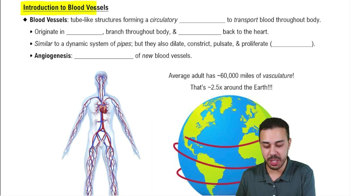
Introduction to Blood Vessels Example 1
5844
views
118
rank
VideoThumbView.guidedCourse
4:59
Blood Vessels
8497
views
191
rank
2
comments
VideoThumbView.guidedCourse
2:04
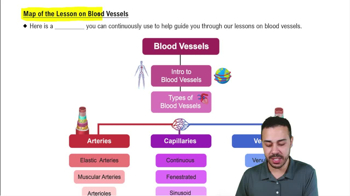
Map of the Lesson on Blood Vessels
5973
views
196
rank
1
comments
이 집합의 용어 (21)
하이드의 정의
What are the three layers (tunics) of a blood vessel wall?
Tunica intima
(innermost, endothelium),
tunica media
(middle, smooth muscle and elastic tissue), and
tunica externa
(outermost, connective tissue).
What is the function of the tunica intima?
It is the innermost layer composed of simple squamous epithelium (endothelium) that lines the lumen and provides a smooth surface for blood flow.
Which blood vessels have only the tunica intima layer?
Capillaries
consist solely of the tunica intima to allow efficient exchange of gases and nutrients.
What is the primary role of the tunica media?
It contains circular smooth muscle responsible for
vasoconstriction
and
vasodilation
, regulating blood pressure and flow.
How does the tunica media differ between arteries and veins?
The tunica media is thicker in arteries with more smooth muscle and elastic fibers, while veins have a thinner tunica media.
What is the function of the tunica externa?
It provides structural support and elasticity with connective tissue and elastic fibers, protecting vessels from high pressure.
What are the three main types of arteries?
Elastic arteries
(large, pressure buffers),
muscular arteries
(medium, regulate blood flow), and
arterioles
(small, regulate flow into capillaries).
What is the role of elastic arteries?
They act as pressure buffers, expanding during systole and recoiling during diastole to maintain blood pressure.
How do muscular arteries regulate blood flow?
Through thick layers of smooth muscle in the tunica media, they perform vasoconstriction and vasodilation to control blood distribution.
What is the function of arterioles?
Arterioles regulate blood flow into capillary beds and are primary regulators of systemic blood pressure.
What is an anastomosis in blood vessels?
It is a connection between two or more arteries supplying the same area, providing alternate routes for blood flow.
What is the Circle of Willis?
A hexagonal arterial anastomosis at the base of the brain ensuring constant blood flow through collateral circulation.
What is the structure and function of capillaries?
Capillaries have walls of only endothelium allowing exchange of gases, nutrients, and wastes between blood and tissues.
Name the three types of capillaries based on permeability.
Continuous
(unbroken lining),
fenestrated
(pores for increased permeability), and
sinusoids
(large gaps for cells and molecules).
What regulates blood flow through capillary beds?
Precapillary sphincters, rings of smooth muscle that open or close to control blood flow.
What are the main types of veins?
Venules, small/medium veins, and large veins, all returning blood to the heart with valves to prevent backflow.
What is the function of valves in veins?
Valves prevent backflow of blood, especially in veins of the lower extremities, aiding venous return.
What mechanisms assist venous return to the heart?
The skeletal muscle pump, respiratory pump, and venous valves help overcome low pressure and gravity.
What is the hepatic portal system?
A venous system that carries nutrient-rich blood from the intestines to the liver for processing before returning to the heart.
Describe pulmonary circulation.
Blood flows from the right heart to the lungs for oxygenation and returns to the left heart.
Describe systemic circulation.
Oxygenated blood is pumped from the left heart to the body tissues and deoxygenated blood returns to the right heart.
 뒤로
뒤로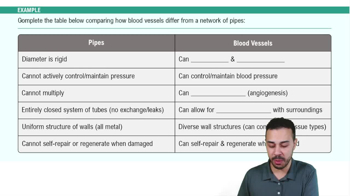
 3:38
3:38