 뒤로
뒤로Endocrine System - Anatomy & Physiology
 7:06
7:06
이 집합의 용어 (21)
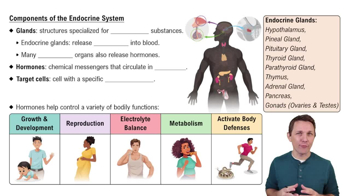
The endocrine system regulates growth, metabolism, reproduction, and homeostasis by releasing hormones into the bloodstream to target cells.
A hormone is a chemical messenger secreted by endocrine glands that travels through the blood to affect target cells.
An endocrine gland is a ductless gland that secretes hormones directly into the bloodstream.
Endocrine tissue or organ contains cells that produce hormones but may have other functions as well, e.g., pancreas or kidney.
A target cell has specific receptors for a hormone and responds to that hormone's signal.
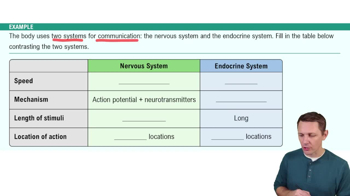
The nervous system uses electrical impulses for rapid, short-term control; the endocrine system uses hormones for slower, long-lasting regulation.
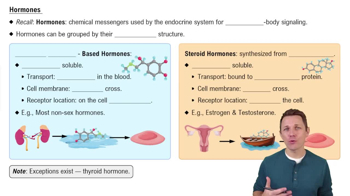
Hormones are classified as amino acid derivatives, peptides/proteins, and steroids.
Amino acid and peptide hormones are water-soluble and travel freely; steroid hormones are lipid-soluble and travel bound to carrier proteins.
Water-soluble hormones bind to cell membrane receptors; lipid-soluble hormones bind to intracellular receptors in the cytoplasm or nucleus.
Water-soluble hormones activate second messenger systems; lipid-soluble hormones directly affect gene transcription.
Hormone release is controlled by humoral, neural, and hormonal stimuli.
Negative feedback decreases hormone secretion when levels reach a set point to maintain homeostasis.
Positive feedback increases hormone secretion to amplify a response, e.g., oxytocin during childbirth.
The hypothalamus connects to the anterior pituitary via the hypophyseal portal system and to the posterior pituitary via neural connections.
Releasing hormones from the hypothalamus stimulate the anterior pituitary to secrete specific hormones.
Inhibiting hormones from the hypothalamus suppress anterior pituitary hormone secretion.
Tropic hormones are anterior pituitary hormones that regulate hormone secretion by other endocrine glands.
The hypothalamus secretes releasing and inhibiting hormones into the portal system to control anterior pituitary hormone secretion.
The hypothalamus produces oxytocin and ADH, which are transported and released by the posterior pituitary.
Key glands include the pituitary, thyroid, parathyroid, adrenal, testes, ovaries, pancreas, kidney, thymus, heart, and placenta.
Each hormone has a specific source gland, a stimulus for release, and a target effect on the body.