 뒤로
뒤로Endocrine System - Anatomy & Physiology
 7:06
7:06
이 집합의 용어 (24)
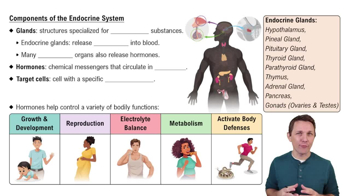
The endocrine system uses hormones to regulate body functions and maintain homeostasis such as fluid balance, growth, and metabolism.
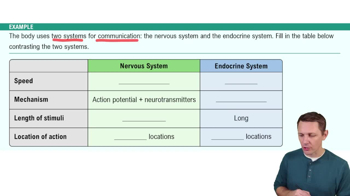
The nervous system acts fast with short-lasting effects using neurotransmitters, while the endocrine system acts slower with longer-lasting effects using hormones.
Primary glands secrete only hormones; secondary organs have endocrine and other functions; neuroendocrine organs release neurohormones.
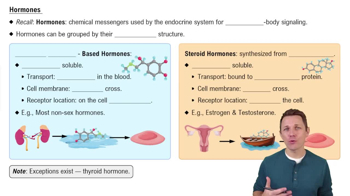
Amino-acid based hormones are hydrophilic; steroid hormones are hydrophobic and cholesterol-based.
Hydrophilic hormones travel freely in the bloodstream without carrier proteins.
Hydrophobic hormones require carrier proteins to travel through the bloodstream.
Hydrophilic hormones bind to receptors on the cell surface; hydrophobic hormones bind to receptors inside the cell.
Hydrophilic hormones use second messengers like \(cAMP\) to relay signals inside the cell.
Hydrophobic hormones enter the cell and bind to receptors that change gene expression.
Hormones can have synergistic (enhancing) or antagonistic (opposing) effects.
Negative feedback loops maintain homeostasis by reducing hormone secretion when levels are sufficient.
The hypothalamus links the nervous and endocrine systems and controls the pituitary gland.
The pituitary gland is the master gland; the anterior pituitary secretes tropic hormones, and the posterior pituitary releases ADH and oxytocin.
Thyroid hormones regulate metabolism and body temperature.
Parathyroid hormone regulates blood calcium levels.
Calcitonin lowers blood calcium levels.
The adrenal cortex produces steroid hormones including aldosterone and cortisol.
Aldosterone regulates salt and water balance in the body.
Cortisol helps the body manage stress.
The adrenal medulla releases epinephrine during stress.
Insulin lowers blood glucose; glucagon raises blood glucose; they act as antagonists.
The pineal gland releases melatonin, which regulates sleep cycles.
The thymus supports immune cell development.
The gonads produce sex hormones such as estrogen and testosterone.