Skip to main content
Anatomy & Physiology
나의 코스
배우기
시험 준비
AI 튜터
학습 가이드
교과서적 해결책
플래시카드
탐험해 보세요
앱을 사용해 보세요
나의 코스
배우기
시험 준비
AI 튜터
학습 가이드
교과서적 해결책
플래시카드
탐험해 보세요
앱을 사용해 보세요
뒤로
Endocrine System - Anatomy & Physiology
카드를 뒤집기 위해 탭할 수 있습니다.
Major functions of the endocrine system
카드를 뒤집기 위해 탭할 수 있습니다.
👆
Major functions of the endocrine system
Regulates body functions by releasing hormones that control metabolism, growth, reproduction, and homeostasis.
진행 상황 추적
컨트롤 버튼이 '내비게이션' 모드로 변경되었습니다.
1/29
추천 영상
7:06
Components of the Endocrine System
13707
views
416
rank
6:20
Hormones
10450
views
258
rank
3:33
Introduction to the Endocrine System Example 1
14954
views
443
rank
1
comments
이 집합의 용어 (29)
하이드의 정의
Major functions of the endocrine system
Regulates body functions by releasing hormones that control metabolism, growth, reproduction, and homeostasis.
Define hormone
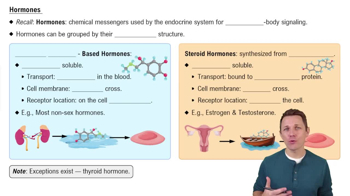
A chemical messenger secreted by endocrine glands that travels through the blood to target cells to regulate physiology.
Endocrine gland vs endocrine tissue (organ)
Endocrine glands are specialized organs that secrete hormones; endocrine tissues are hormone-producing cells within organs.
Define target cell
A cell that has specific receptors for a hormone and responds to that hormone's signal.
Compare nervous and endocrine system control
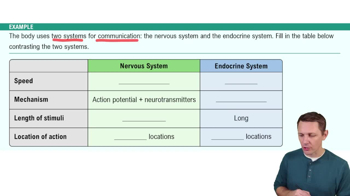
Nervous system uses electrical impulses for rapid, short-term control; endocrine system uses hormones for slower, long-lasting regulation.
Major chemical classes of hormones
Peptides/proteins, steroids, and amines.
Transport of peptide hormones in blood
Peptide hormones are water-soluble and travel freely dissolved in the plasma.
Transport of steroid hormones in blood
Steroid hormones are lipid-soluble and travel bound to carrier proteins.
Receptor types for peptide hormones
Peptide hormones bind to cell membrane receptors because they cannot cross the lipid membrane.
Receptor types for steroid hormones
Steroid hormones bind to intracellular receptors inside the cytoplasm or nucleus.
Mechanism of peptide hormone action
Activate second messenger systems via membrane receptors to alter cell function quickly.
Mechanism of steroid hormone action
Enter the cell, bind intracellular receptors, and regulate gene transcription to change protein synthesis.
Types of stimuli controlling hormone secretion
Humoral (blood chemistry), neural (nerve signals), and hormonal (other hormones).
Role of negative feedback in hormone release
Decreases hormone secretion when target effects are sufficient to maintain homeostasis.
Role of positive feedback in hormone release
Increases hormone secretion to amplify a response until a specific event occurs.
Anatomical relationship: hypothalamus and pituitary glands
Hypothalamus controls anterior and posterior pituitary glands via releasing/inhibiting hormones and neural connections.
Define releasing hormone
Hormones from the hypothalamus that stimulate the anterior pituitary to release specific hormones.
Define inhibiting hormone
Hormones from the hypothalamus that suppress anterior pituitary hormone secretion.
Define tropic hormone
Hormones from the anterior pituitary that regulate hormone secretion by other endocrine glands.
Hypothalamus role in anterior pituitary hormone release
Secretes releasing and inhibiting hormones into the hypophyseal portal system to regulate anterior pituitary.
Hypothalamus role in posterior pituitary hormone release
Produces oxytocin and ADH, which are transported and released by the posterior pituitary.
Hormone source: pituitary gland
Anterior pituitary produces hormones like GH, ACTH, TSH; posterior pituitary releases oxytocin and ADH.
Hormone source: thyroid gland
Produces thyroid hormones T3 and T4 and calcitonin.
Hormone source: parathyroid gland
Produces parathyroid hormone (PTH) to regulate calcium levels.
Hormone source: adrenal gland layers
Cortex produces mineralocorticoids, glucocorticoids, and androgens; medulla produces catecholamines (epinephrine, norepinephrine).
Hormone source: pancreas
Produces insulin and glucagon to regulate blood glucose.
Hormone source: testes and ovaries
Testes produce testosterone; ovaries produce estrogen and progesterone.
Stimulus for hormone release
Hormone release is triggered by changes in blood chemistry, neural input, or other hormones.
Effect of tropic hormones
Stimulate target endocrine glands to produce and release their hormones.
 뒤로뒤로
뒤로뒤로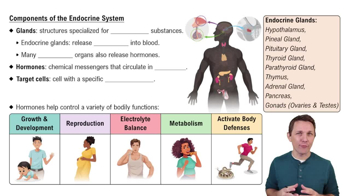
 7:06
7:06